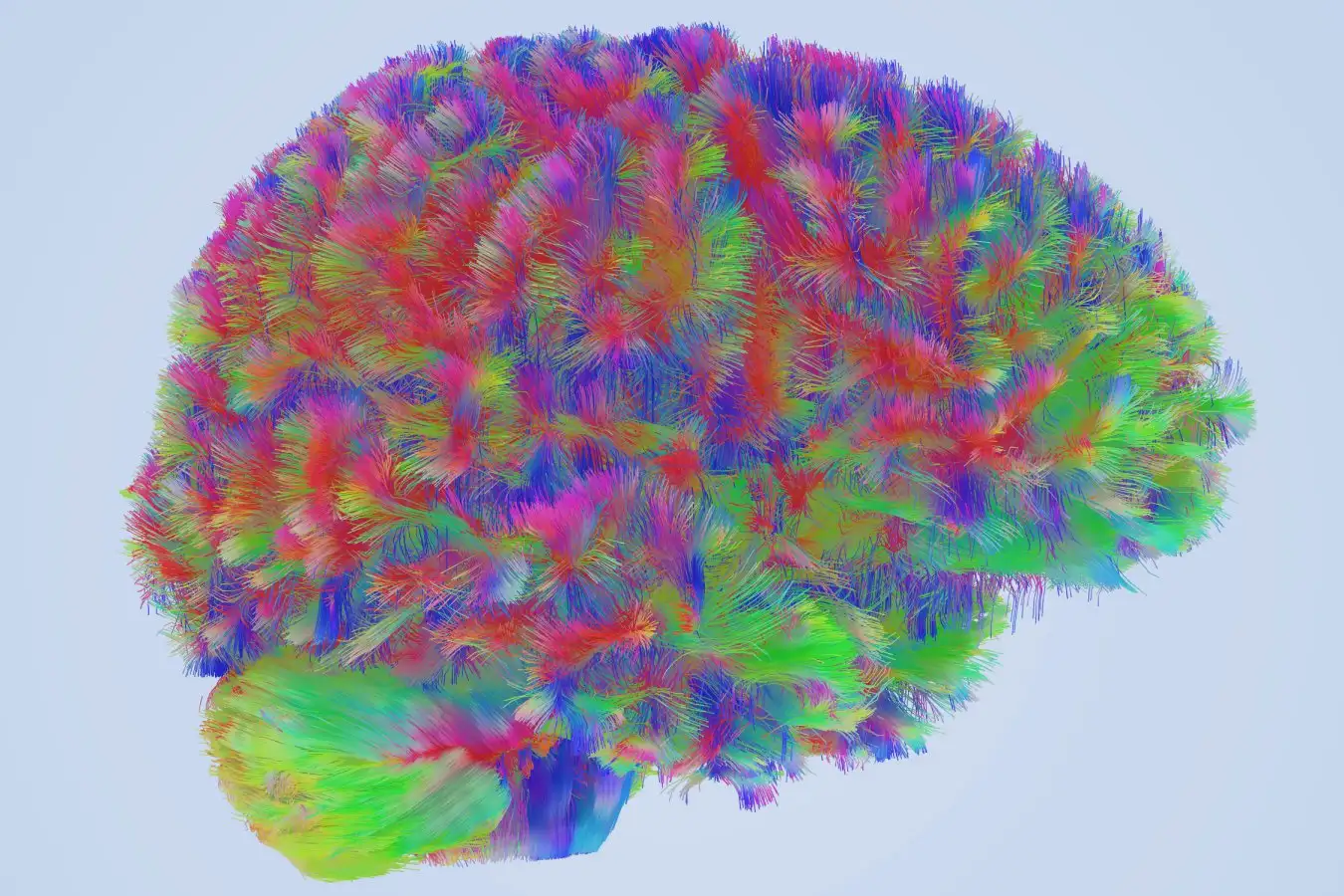
The wiring of our neurons changes with the passing decades
Alexa Mousley, University of Cambridge
Our brain function is far from static throughout our lives. We already know that our capacity to learn, and our risk of cognitive decline, varies from when we are a newborn through to our 90s. Now, scientists may have uncovered a potential reason why this occurs: our brain wiring seems to undergo four major turning points at ages 9, 32, 66 and 83.
Previous research suggests that our bodies go through three rapid bursts of ageing at around 40, 60 and 80. But the complexity of the brain makes it harder to understand.
The brain has distinct regions that exchange information via white matter tracts – wiry structures made of spindly projections, called axons, that project from neurons, or brain cells. These connections influence our cognition, such as our memory. But it was unknown whether major shifts in this wiring occur throughout life. “No one has combined multiple metrics together to characterise phases of brain wiring,” says Alexa Mousley at the University of Cambridge.
To fill this knowledge gap, Mousley and her colleagues analysed MRI brain scans from around 3800 people in the UK and US, who were mostly white, and ranged in age from newborns to 90. These scans were previously taken as part of various brain imaging projects, most of which excluded people with neurodegenerative or mental health conditions.
The researchers found that among people who reach 90, the brain’s wiring has generally undergone five main phases, separated by four key turning points.
In the first phase, which occurs between birth and 9 years old, white matter tracts between brain regions seem to become longer, or more convoluted, making them less efficient. “It takes longer for information to pass between regions,” says Mousley.
This could be because our brain is packed with lots of connections as infants, but as we grow and experience things, the ones we don’t use are gradually pruned away. The brain seems to prioritise making a broad range of connections that are useful for things like learning to play the piano, at the cost of them being less efficient, says Mousley.
But during the second phase, between 9 and 32 years old, this pattern seems to flip, which is potentially driven by the onset of puberty and its hormonal changes influencing brain development, says Mousley. “Suddenly, the brain is increasing the efficiency of the connections – they become shorter, so information gets from one place to another more quickly.” This may support the development of skills like planning and decision-making, and improvements in cognitive performance, such as working memory, says Mousley.
The next phase is the longest, spanning from 32 until 66. “This phase is a point in your lifespan where your brain, of course, is still changing, but much less,” says Mousley. Specifically, connections between brain regions switch back to gradually losing efficiency, she says. “It’s unclear exactly what drives this shift, but the 30s map onto a lot of different major lifestyle changes – for instance, having kids, settling down – so that could play a role,” says Mousley. It could also just be down to general wear and tear of the body, says Katya Rubia at King’s College London.
From age 66 to 83, the researchers found that connections between neurons in the same brain region seem to be more stable than between those in distinct areas. “This is interesting because, around this time, there’s increasing risk for developing things like dementia and general health concerns,” says Mousley.
In the final phase, from age 83 to 90, connections between brain regions weaken, and increasingly pass through “hubs” that connect lots of areas. “It suggests that there are fewer resources to maintain connections during this phase, so the brain relies more on using certain regions to act as hubs for connections,” says Mousley.
Understanding such brain changes could help to explain why mental health conditions usually occur before age 25 and why people over 65 are especially at risk of dementia, she says.
“It’s important to understand the normal turning points in brain structure over the human lifespan, so we can, in future studies, explore what deviates during mental health or neurodegenerative conditions,” says Rubia. “Once you understand what’s deviating, that can help you pinpoint ways to treat it. For instance, you could explore which environmental factors or chemicals are causing the differences and find ways to reverse them using therapy, policies or drugs.”
But first, further studies are needed to explore whether the findings apply to more ethnically and geographically diverse populations, says Rubia.
Topics:
Source link : https://www.newscientist.com/article/2505656-your-brain-undergoes-four-dramatic-periods-of-change-from-age-0-to-90/?utm_campaign=RSS%7CNSNS&utm_source=NSNS&utm_medium=RSS&utm_content=home
Author :
Publish date : 2025-11-25 10:00:00
Copyright for syndicated content belongs to the linked Source.