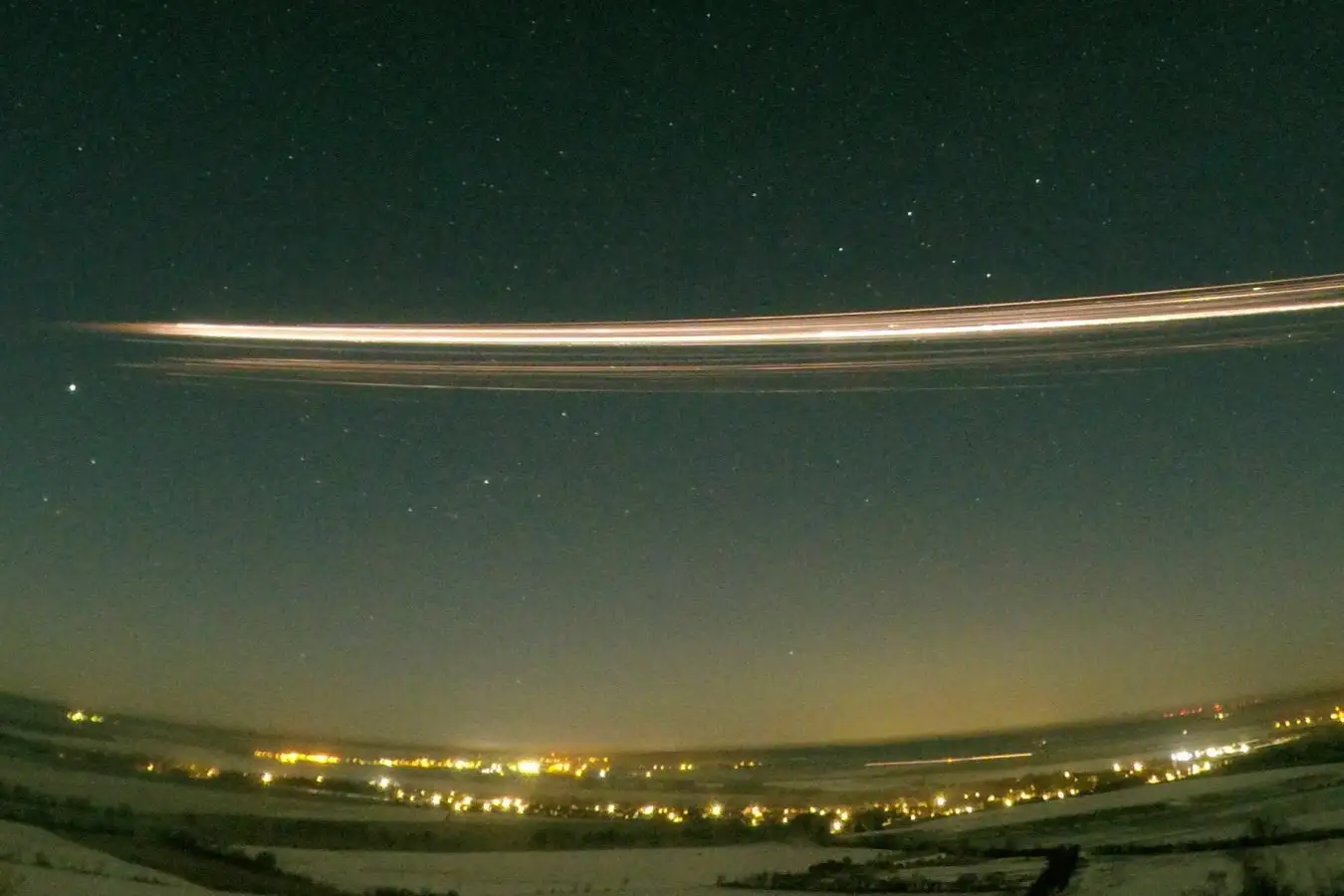
A 30-second exposure showing a Falcon 9 upper stage re-entering the atmosphere above Berlin, Germany, on 19 February 2025
Gerd Baumgarten
A SpaceX rocket that burned up after re-entering the atmosphere unleashed a plume of vaporised metals over Europe, a type of pollution that is expected to increase as spacecraft and satellites multiply.
The upper stage of a Falcon 9, which is designed to splash down in the Pacific Ocean for possible re-use, lost control due to engine failure and fell from orbit over the north Atlantic in February 2025.
People across Europe saw fiery debris streaking through the sky, some of which crashed behind a warehouse in Poland. Seeing the news, Robin Wing at the Leibniz Institute of Atmospheric Physics in Germany and his colleagues turned on their lidar, an instrument for atmospheric sensing. Twenty hours later, it detected a 10-fold spike in lithium, a key component of rocket hulls, in the upper atmosphere as the plume of vaporised metal drifted over it.
Atmospheric modelling suggested this plume had drifted 1600 kilometres from the area where the Falcon 9 re-entered the atmosphere. The study is the first to trace high-altitude pollution to a specific spacecraft re-entry.
The tiny metal particles “could be catalysing ozone destruction, creating clouds in the stratosphere and mesosphere, affecting the way that sunlight travels through the atmosphere”, says Wing. “But all of this is understudied.”
Worries about this type of pollution are growing as commercial space launches skyrocket and companies expand their mega-constellations of satellites, like SpaceX’s Starlink and Amazon’s Leo. About 14,500 satellites are already in orbit, and last month SpaceX applied to launch 1 million more for Elon Musk’s goal of creating orbital data centres to power artificial intelligence.
To avoid a runaway cycle of collisions producing ever more space debris, satellites are typically allowed to fall and burn up at the end of their lifespan. Experts say the amount of space trash particles could grow by 50 times in the next decade and exceed 40 per cent of the mass that meteoroids currently bring into the atmosphere.
There is a misconception that space debris burns up in the atmosphere and disappears, says Daniel Cziczo at Purdue University, Indiana, who wasn’t involved in the study. “Let’s tap the brakes here, and let’s really do some thorough analysis of what effect this material could have.”
The Falcon 9 plume contained an estimated 30 kilograms of lithium. But given the composition of the alloys in rocket hulls, it would have contained a far greater amount of aluminium.
Vaporised aluminium reacts with atmospheric oxygen to form particles of aluminium oxide, which provide a surface where chlorine compounds can more easily break down. The chlorine radicals freed by this process react with and destroy ozone molecules in the stratosphere.
Researchers estimate that spacecraft burn-up is releasing 1000 tonnes of aluminium oxide into the atmosphere each year and growing. This threatens to expand the southern hemisphere’s ozone hole, which has been shrinking as countries phase out ozone-depleting refrigerant gases. The loss of ozone could allow in more of the sun’s ultraviolet rays, which cause skin cancer.
“In terms of metals, we’re sort of moving into this new paradigm where the upper atmosphere is increasingly more influenced by anthropogenic pollution than natural sources,” says Eloise Marais at University College London. “Space debris is starting to undo the progress with the ozone hole.”
The metal oxide particles can also serve as nuclei upon which water vapour can condense into droplets, forming cirrus clouds in the upper troposphere, which tend to trap heat.
Scientists have measured particles from burned-up spacecraft in cirrus clouds. If they are encouraging cirrus cloud formation, it could worsen global warming, although this impact would still be small compared with that of greenhouse gases like carbon dioxide.
“There is a lot of scientific evidence that this material could be having deleterious effects on our atmosphere, and now it’s on us as scientists to figure out if those effects are taking place and how bad are they,” says Cziczo.
There may be solutions, such as building satellites out of materials like wood — although that could still release black carbon soot upon re-entry — or retiring more of them to high-altitude “graveyard orbits”.
“We need to take a little bit of time and think about what we’re doing before we do it,” says Wing. “This explosion of satellites… it’s very fast, and we don’t know the consequences.”
Topics:
Source link : https://www.newscientist.com/article/2516338-atmospheric-pollution-caused-by-space-junk-could-be-a-huge-problem/?utm_campaign=RSS%7CNSNS&utm_source=NSNS&utm_medium=RSS&utm_content=home
Author :
Publish date : 2026-02-19 16:00:00
Copyright for syndicated content belongs to the linked Source.