There may be a layer of reality even deeper than the quantum realm
Cappan/iStockphoto/Getty Images
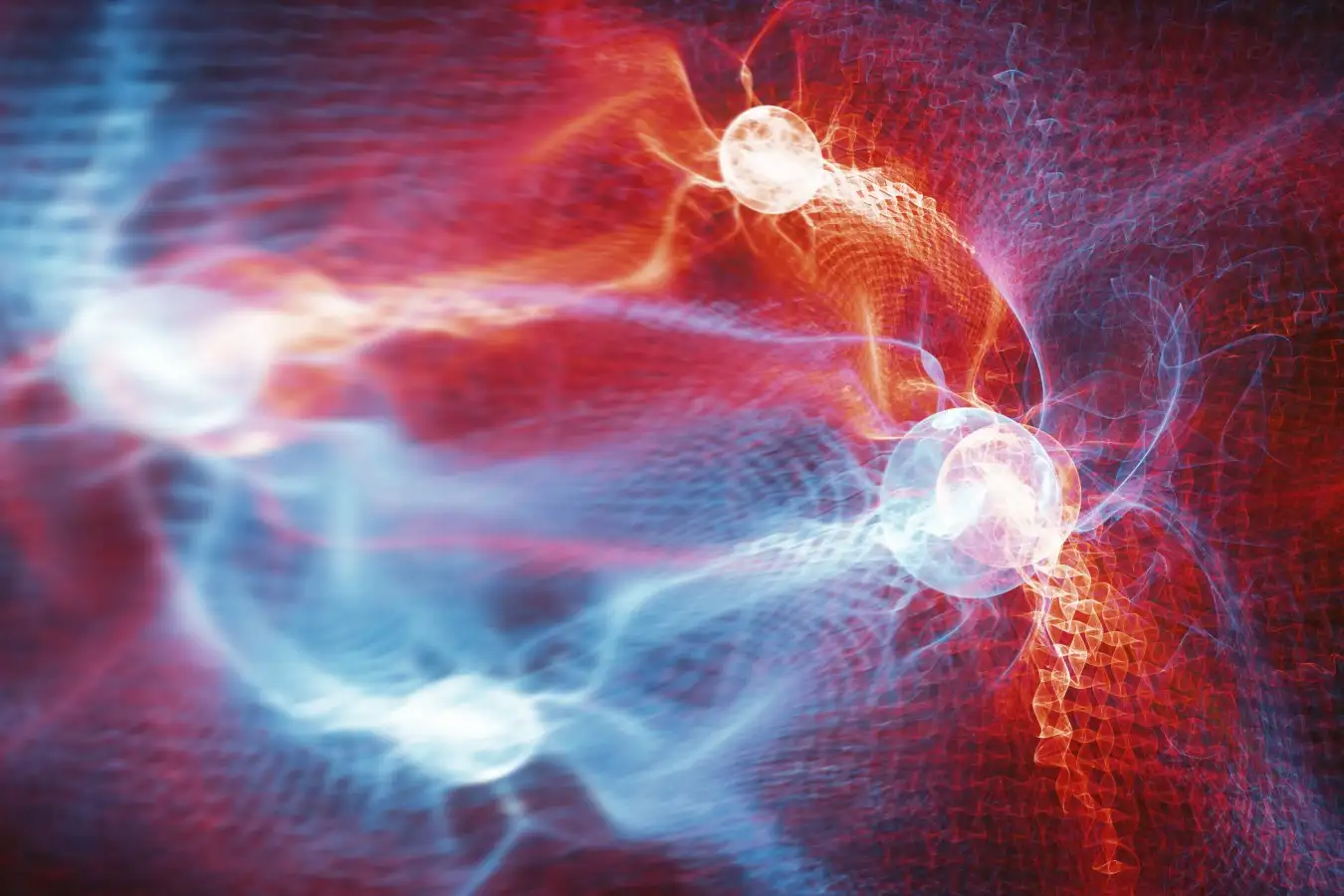
Physicists are making new inroads into the world of post-quantum theories, uncovering what reality may look like on a level deeper and stranger than the already infamously odd quantum theory.
In the 1920s, physicists had several extremely useful theories for how the world works, yet they kept uncovering situations where those theories didn’t work. Through these holes in so-called classical physics, they glimpsed a deeper layer of the world that underlies everything – the quantum realm. Now, physicists are having déjà vu. Quantum theory works incredibly well, but it also has gaping holes when confronted with cosmically large objects controlled by gravity. What sort of post-quantum world could reveal itself through that hole?
James Hefford at the National Institute for Research in Digital Science and Technology and Matt Wilson at Paris-Saclay University, both in France, have now developed a mathematical sketch of one plausible post-quantum world, possibly the deepest layer of reality yet.
“Quantum theory doesn’t describe the entire universe,” says Hefford. “One of the greatest problems in physics is to come up with a theory of quantum gravity, a theory that describes both quantum theory and gravity. That thing ought to somehow go beyond just quantum theory.”
There are many proposals for how to develop a theory of quantum gravity, but Wilson and Hefford took inspiration from the relationship between quantum and classical physics. Specifically, we do not encounter strange quantum effects in everyday life because of a process called decoherence, which destroys most objects’ quantumness. It is thanks to decoherence that our very reasonable and tangible world emerges from the quantum world in which cats can seemingly be simultaneously dead and alive, and particles can tunnel through walls like ghosts. The researchers posited that an analogous process of “hyperdecoherence” ought to make quantum theory emerge from a post-quantum one.
The idea had been studied before, but a specific theorem from 2018 had proved it to be mathematically impossible to come up with a sensible and internally consistent process of hyperdecoherence that would correctly reproduce quantum theory. Hefford and Wilson carefully studied the assumptions that underlie this theorem and devised a workaround. The price they paid was that they ended up in a very strange post-quantum realm: a theory called QBox.
One of its key features is that it bends the conventional idea of causality. Conventionally, either event A causes event B or vice versa, but in QBox, it is allowable to have mixtures of “A causes B” and “B causes A” where it is impossible to tell which one is unambiguously correct.
“This is causal indefiniteness. We should care about it if we want to pursue a theory of quantum gravity,” says Carlo Maria Scandolo at the University of Calgary in Canada, who did not work on the project. This is because our best theory of gravity – Albert Einstein’s general relativity – imposes different orders of cause-and-effect at different points of space-time, he says.
This manifests itself, for instance, in thought experiments where people travelling in different spaceships observing the same set of events can’t agree on the order in which they occurred.
The two physicists also had to make sure that hyperdecoherence reduces QBox to quantum theory correctly. For example, they had to make sure that a given object that we can only know approximately in QBox does not become more clearly known after hyperdecohering. Wilson says that the hyperdecoherence process is akin to there being dimensions that an agent operating in the QBox realm – someone who can interact with objects within it – can access, but that become hidden to those of us who can only access the quantum or classical realms.
The two researchers are still working out the details of how to think of these dimensions, and what exactly the agent would experience, but the dimensions that become inaccessible seem to be temporal rather than spatial, with hyperdecoherence cutting off access to processes that happen backwards, going into the past rather than the future.
“There have [previously] been a few toy theories that would support notions of indefinite causal order and so forth, but getting them to then reproduce all of quantum mechanics was a challenging thing that no one seemed to have really kind of gotten right,” says Ciarán Gilligan-Lee at the Causal Inference Research Lab at Spotify who had co-authored the 2018 theorem arguing against hyperdecoherence. He says that it is a real strength of the new work that it is a concrete theory and also fairly mathematically minimal. Despite some of its oddities, QBox does not require making up a whole new world of objects, such as cosmic strings, to get to a theory of quantum gravity, he says.
An important next step is to flesh out the physical details of hyperdecoherence, in addition to proving that it can exist as a mathematical function, says John Selby at the University of Gdańsk in Poland, who was the other co-author of the 2018 theorem. “There should be some narrative, some story that says why in our current experiments this is [what is] happening,” he says. In his view, even if QBox turns out to not be exactly what the post-quantum layer of reality is like, Hefford and Wilson’s mathematical work is a promising starting point.
Gilligan-Lee and Selby have also drafted a new and different theorem that has not yet been reviewed by other physicists but that may put more stringent constraints on what it would mean for a theory like QBox to meaningfully decohere to quantum theory.
Such challenges are welcome, even if they mean that QBox ends up being a stepping stone towards a better wish list for what a post-quantum theory ought to be, says Wilson. Remarkably, experimental tests of QBox may also eventually be possible because the theory could have concrete implications for certain experiments where quantum waves overlap.
And if QBox does make it through future mathematical and experimental gauntlets, an even more tantalising question will become relevant. “Can you have whole towers of theories decohering into each other by similar [decoherence] mechanisms?” says Hefford. The quest for the deepest layer of reality may involve some more mathematical digging after all.
Topics:
Source link : https://www.newscientist.com/article/2524032-qbox-theory-may-offer-glimpse-of-reality-deeper-than-quantum-realm/?utm_campaign=RSS%7CNSNS&utm_source=NSNS&utm_medium=RSS&utm_content=home
Author :
Publish date : 2026-04-24 10:00:00
Copyright for syndicated content belongs to the linked Source.