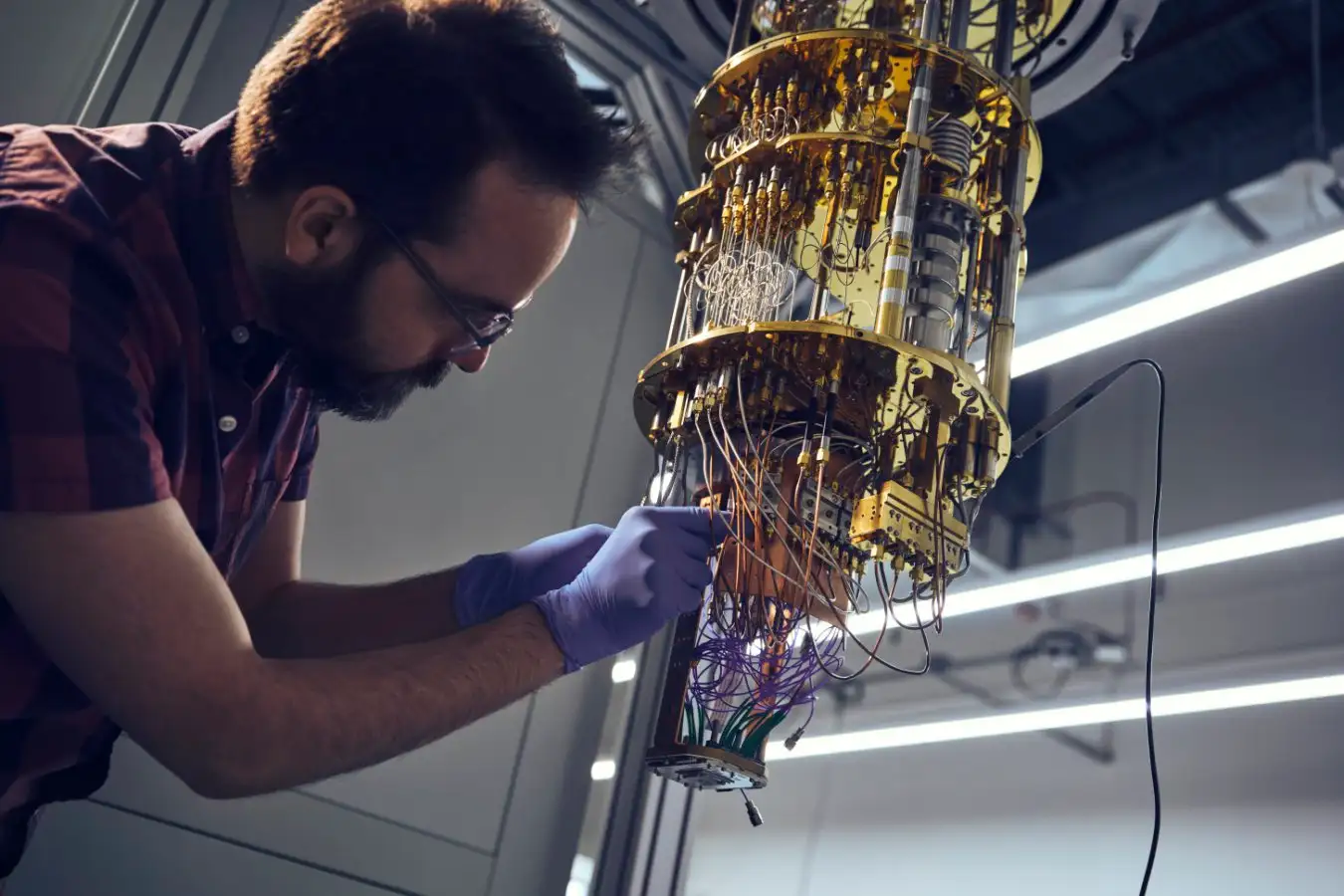
Adam Weiss at SEEQC, a quantum chip foundry, configuring a dilution refrigerator
SEEQC
There’s a lot I love about the 1980s, from the new wave of British heavy metal to abundant purple blush favoured by the era’s make-up artists. But among all that hair, noise and glam, there were some ignored superstars: superconducting circuits. In 1980, the computing giant IBM was betting on this technology to build computers that would be so efficient as to be revolutionary. In May that year, the popular science magazine Scientific American even put a superconducting circuit on its cover.
But the revolution never came. Superconducting computer chips seemed to have gone the way of perms and pegged pants. Yet one company kept the research alive. I recently visited the headquarters of SEEQC, and the firm’s quantum chip foundry in upstate New York, which partly rose up from IBM’s shuttered superconducting computing programme. There, I learned about the company’s hopes that superconducting chips will play a hand in a new technological revolution – this time with quantum computers.
Inside SEEQC’s fabrication facility, I’m surrounded by large machines and technicians in full-body protective suits. In some of these clean rooms, ultrathin layers of the superconducting metal niobium are repeatedly and carefully deposited on layers of dielectric materials, creating a delicate sandwich-like structure. In others, lithography devices use light to write intricate circuits onto these structures, and every tiny trench and groove becomes important for quantum processes that make them work. The whole floor buzzes with noise and everything basks in yellow light that, I am told, interferes with the chip-making process less than other colours. While we talk in an adjacent conference room, SEEQC’s chief executive officer John Levy hands me a version of the company’s superconducting chip, and I am struck by how unassumingly small and square it is for a device that aims to change an already futuristic industry.
The problem we must solve
Superconductors transmit electricity with perfect efficiency, which makes them markedly different from all materials we commonly use for electronics. When you plug in your phone to charge, the cord or the charger often grow hot, diminishing the energy that was meant for your phone. This happens to such an extent that, in 2017, computer scientist Michael Frank wrote, “A conventional computer is, essentially, an expensive electric heater that happens to perform a small amount of computation as a side effect.”
A computer with superconducting components wouldn’t have this problem. But there’s a catch: all known superconductors must either be kept extremely cold or be put under extreme pressure to work. This means a superconducting computer would always have to be kept at only a few degrees above absolute zero. Historically, this proved to be too costly and inconvenient. IBM terminated its research efforts on superconducting computing in 1983. Heat-spewing conventional computers won out, and, somewhat ironically, the energy cost of computing has only increased, skyrocketing today largely due to the AI boom.
However, superconductors found themselves back in the spotlight a few decades later. In 1999, a team of researchers in Japan made the first superconducting quantum bit, or qubit, which is the most basic building block for a quantum computer. This was a fundamentally different proposition from what researchers had attempted a decade earlier. Instead of replicating commonly used computing with superconducting materials, they cracked the door open to a completely new kind of computing, with devices that process information through mechanisms that simply don’t exist within any conventional computer.
Quantum computing has come a long way since then and superconducting qubits played a role in that progress. Google and IBM use them to drive some of today’s most powerful quantum computers, and those devices have begun to tackle scientifically interesting problems with encouraging success. Some demonstrations showing “quantum supremacy” over classical computers stand uncontested, buttressing the promise that these machines are fundamentally different from any previously built computers.
At the same time, quantum computers have not yet lived up to their disruptive promises: they haven’t broken widely used encryption, discovered new wonder drugs or revolutionised industrial chemistry, just to name a few. The road to doing any of those things remains riddled with technical challenges and engineering obstacles.
Might part of the answer lie all the way back in the 1980s? Levy certainly thinks so. He says his team is building digital superconducting chips that could allow quantum computers to become bigger, more powerful and more easily proofed against errors all at once. Down the hall from us, researchers are testing chips in all manner of tubular fridges, as he tells me that they aim to not just make one more tool, or one more component, but to take the place of many components that currently make quantum computers bulky and inefficient.
At its core, a superconducting quantum computer consists of a chip filled with superconducting qubits and a fridge where that chip must be kept to function. Looking from the outside, you may see one slick rectangular box, typically as tall as a person. But there’s more. Qubits must be controlled and monitored, information must be input into them from a conventional computer and the results of their computations must be read out by one as well. Qubits are also fragile and prone to making errors, so they must run error-correction algorithms, which require sophisticated controls that monitor and adjust many qubits at once in real time. So, non-quantum components of a quantum computer are remarkably important for its functioning – and these take up a lot of space and consume a lot of energy. Behind every tall fridge that houses qubits, there are usually several other equally tall cabinets filled with racks of energy-wasting conventional devices. And there are myriad cables connecting the quantum and non-quantum parts of the computer.
Adding more qubits, which you must do to make a computer more powerful, requires even more cables. “Physically, you can’t just keep adding cables forever,” says Shu-Jen Han, the chief technical officer at SEEQC. Not only does space within the fridge become an issue, but each cable brings with it some heat, which then disturbs the qubits and ruins their performance. How qubits are connected, controlled, wired and packaged may seem like a nitty-gritty facet of the technology that only engineers and experts ought to worry about, but it has become one of the problems keeping quantum computers from maturing further.
The SEEQC chip I was holding could address much of this.
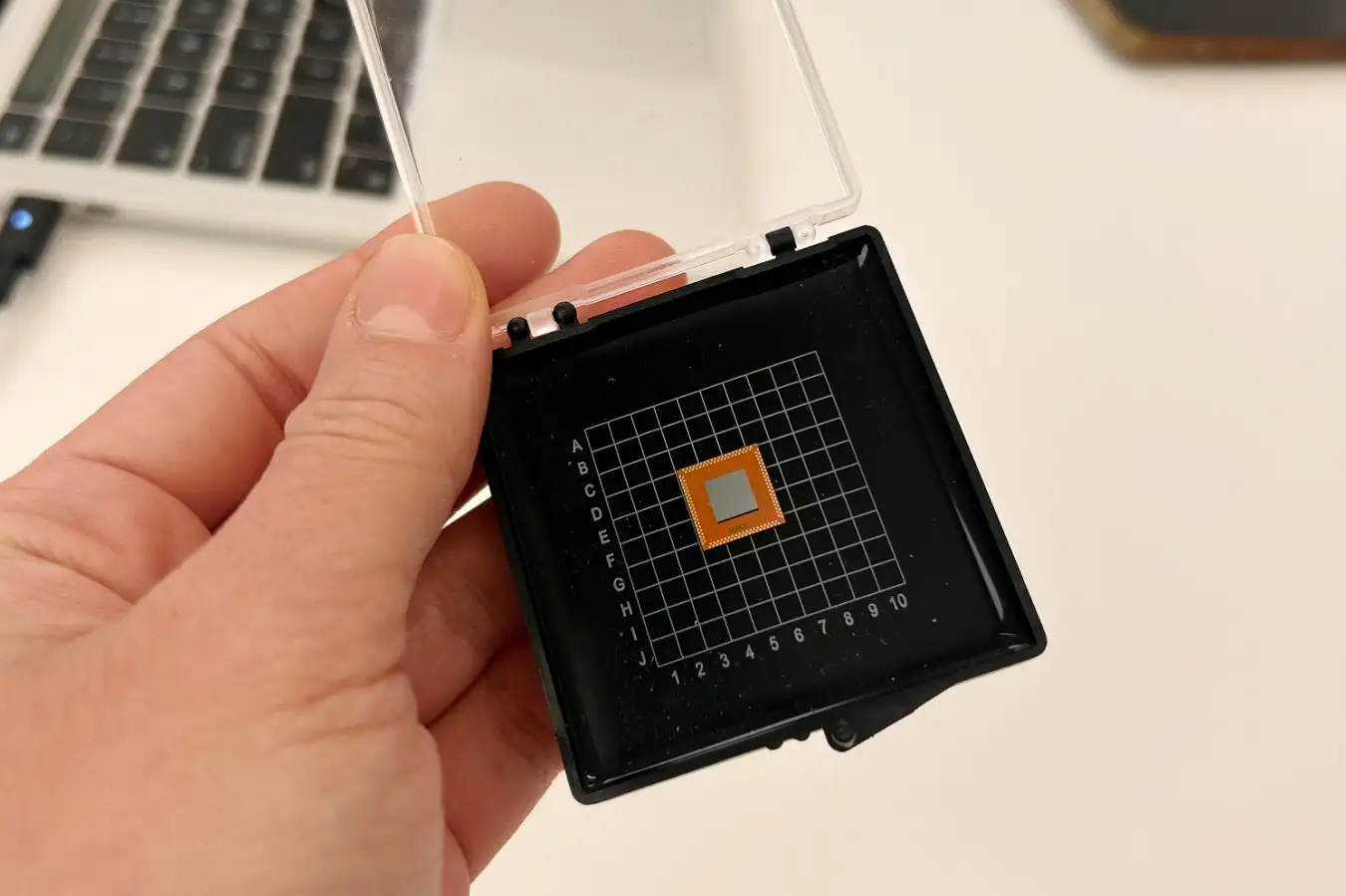
SEEQC’s quantum chip
Karmela Padavic-Callaghan
It looks just like you may imagine a computer chip – small and flat, featuring a metallic rectangle on top of a slightly bigger one. Levy explains that the small rectangle contains the superconducting qubits, while the bigger one is a conventional computing chip made from superconducting materials that can digitally control those qubits. Because they are both superconducting, they can be placed in the same fridge, eliminating the need for many of the room-temperature devices that quantum computers currently rely on.
Not introducing any extra heat into the fridge is one clear benefit, but the superconducting control chip is also a lot less power-hungry. SEEQC projects that it could achieve a billion-fold improvement in a quantum computer’s energy efficiency. Estimates from the Quantum Energy Initiative indicate that some designs for large, error-proof quantum computers would require more energy than existing conventional supercomputers – those behemoths that fill entire rooms – and a lot of that energy consumption can be blamed on classical computing components.
Because the two chips – the quantum one that computes and the classical one that controls it – can be close together, there are fewer delays in transmitting instructions to the qubits and how their computations are both read out and corrected for errors. Levy also told me that because the chip’s signals are digital, the qubits it controls also ought to have less “crosstalk” or unintended interactions that make them more error-prone.
In 2025, I spoke with David DiVincenzo, who, almost 20 years ago, proposed seven conditions for constructing a working quantum computer that researchers are still following. He told me that when he imagines a useful and powerful quantum computer, it is a million-qubit device that might comprise whole rooms filled with machinery, more akin to particle-collider facilities than a laptop or a rack in a data centre. The team at SEEQC is working to avoid this oversized future. For the computing fans out there, think Mac not ENIAC.
The team at SEEQC is currently testing its chips in various configurations and with qubits made both by its own researchers and those from other quantum computer manufacturers. Levy says early tests show good performance across the board, which speaks to the chip’s versatility. At the same time, all tests have been limited to a small number of qubits, typically fewer than 10, which is several orders of magnitude smaller than the practical quantum computers of the future the firm hopes to enable.
Physics problems pop up as well – superconductors have a propensity to become filled with tiny quantum vortices when there is a magnetic field nearby, such as those used to tune some qubits. Oleg Mukhanov, SEEQC’s chief science officer, told me about the method the firm innovated to deal with this issue, where vortices are swept away by another electromagnetic field. Briefly, I was transported to my time in graduate school and sitting in classes on superconductor physics – even the most futuristic technologies cannot escape the whims of fundamental quantum effects.
Could the superconducting circuits rise up and send me even further back? The time just might be right for the 80s to make a comeback in the quantum world, though I hope we’ll be leaving the shoulder pads behind.
Topics:
Source link : https://www.newscientist.com/article/2516804-could-a-niche-80s-technology-be-the-key-to-better-quantum-computers/?utm_campaign=RSS%7CNSNS&utm_source=NSNS&utm_medium=RSS&utm_content=home
Author :
Publish date : 2026-02-27 09:00:00
Copyright for syndicated content belongs to the linked Source.