- In a large randomized trial, treating patients with acute hypoxemic respiratory failure with high-flow oxygen didn’t improve survival compared with standard oxygen.
- However, high-flow oxygen did reduce intubation as a secondary endpoint.
- Experts suggested that the findings recalibrate expected benefits but also shore up the rationale for early use of high-flow oxygen in appropriate patients.
High-flow oxygen didn’t help patients survive acute hypoxemic respiratory failure better than standard oxygen, the SOHO trial showed.
Mortality at day 28 came out an identical 14.6% in patients randomized to either treatment (P=0.98), Jean-Pierre Frat, MD, PhD, of the Centre Hospitalier Universitaire de Poitiers in France, and colleagues reported in the New England Journal of Medicine. The findings were also presented at the International Symposium on Intensive Care and Emergency Medicine in Brussels.
That primary endpoint of the large open-label trial contravenes the group’s 2015 FLORALI trial that had moved high-flow nasal oxygen “from physiological curiosity to frontline therapy,” wrote Ary Serpa Neto, MD, PhD, of Monash University in Melbourne, Australia, in an accompanying editorial. The earlier 310-patient trial had failed its primary endpoint of intubation at 28 days but showed a two-fold difference in 90-day survival (a secondary endpoint) in the same setting compared with standard oxygen delivered via face mask.
“Even so, the absence of a mortality effect should not be interpreted as an absence of clinical value,” he argued.
In SOHO, intubation within 28 days occurred significantly less with high-flow oxygen (42.4% vs 48.4%) but at a similar median time until intubation compared with standard oxygen, suggesting a sustained reduction rather than delay in invasive ventilation, he noted. That interpretation was supported by early improvements in respiratory rate and dyspnea with high-flow oxygen, “a finding that was consistent with its physiological effects on work of breathing and dead-space washout.”
And that’s not a trivial advantage, Neto wrote: “Even when mortality is unaffected, reducing exposure to invasive ventilation may improve the patient’s experience, preserve functional outcomes, and reduce healthcare costs.”
“Essentially, the trial recalibrates expectations,” he added. “For clinicians, this factor reinforces the rationale for early use of high-flow oxygen in appropriate patients while maintaining vigilance for clinical deterioration.”
SOHO included 1,116 consecutive patients age 18 and older admitted to 42 ICUs in France for acute hypoxemic respiratory failure who had a ratio of the partial pressure of arterial oxygen to the fraction of inspired oxygen of 200 or less, a respiratory rate of more than 25 breaths per minute, and pulmonary infiltrate on chest imaging. The trial included the 324 patients with COVID-19-related respiratory failure who had been enrolled between January and April 2021 but not those enrolled after April 2021 in a substudy called SOHO-COVID.
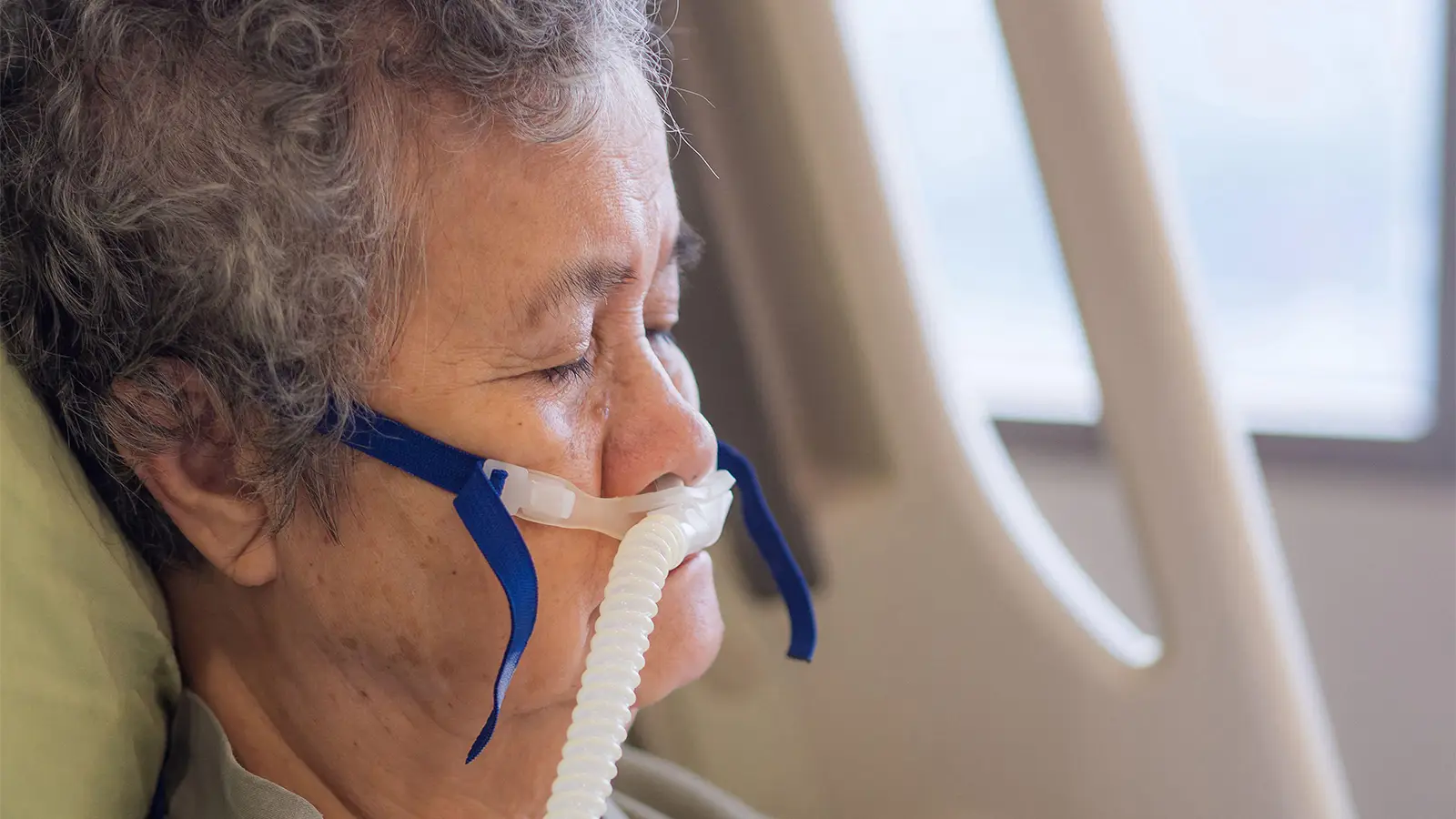
They were randomized within the first 3 hours after validation of inclusion criteria to open-label treatment with either high-flow oxygen delivered continuously through large-bore nasal prongs at a gas flow rate of at least 50 L/min for at least 48 hours or standard oxygen delivered continuously through a nonrebreather mask at a flow rate of 10 L/min or more. Both were adjusted to maintain pulse oximetry of 92-96%.
In terms of safety, the rate of serious adverse events (cardiac arrest or pneumothorax) during spontaneous breathing was 2.3% (13 patients) with high-flow oxygen and 1.1% (6 patients) with standard oxygen. Discontinuation due to discomfort with high-flow oxygen was also more common — although still low in absolute terms, according to the authors — at 30 patients versus 14 in the standard flow oxygen group.
The researchers cautioned that the trial was powered to detect “a quite large” reduction in mortality that the study ended up not powered to find, given lower than expected event rates. Smaller benefits could still be potentially meaningful, but the group noted that looking for them could take several thousand patients and pose ethical challenges.
“Future studies may evaluate alternative respiratory-support strategies, including personalized noninvasive approaches, with high-flow-oxygen therapy as the control,” Frat and colleagues suggested.
Source link : https://www.medpagetoday.com/criticalcare/generalcriticalcare/120357
Author :
Publish date : 2026-03-18 14:30:00
Copyright for syndicated content belongs to the linked Source.