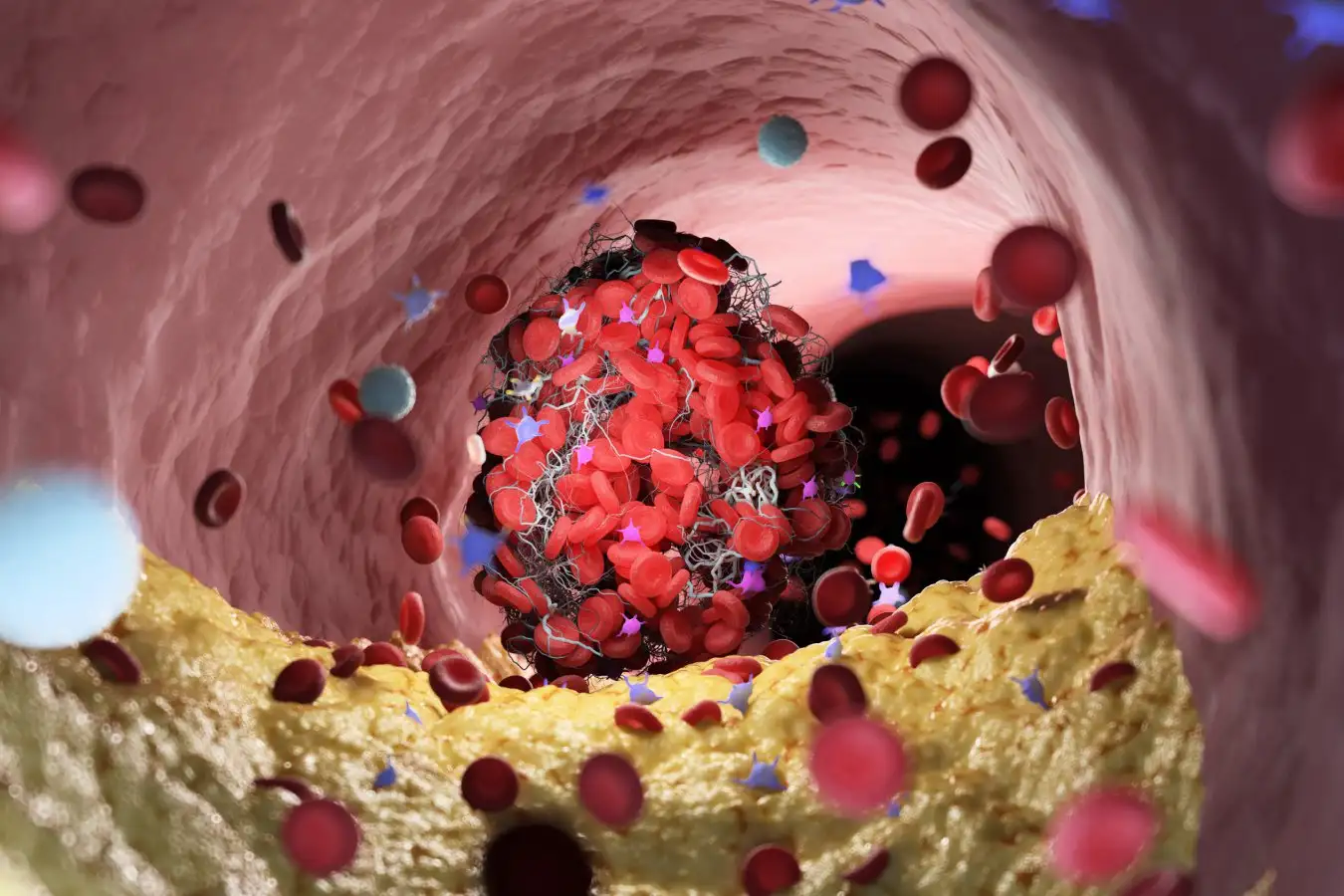
Red blood cells can be manipulated to play a bigger role in wound healing
3DMEDISPHERE/SCIENCE PHOTO LIBRARY
A simple modification to the cells that carry oxygen around our body seems to stop severe bleeds almost immediately. When applied to serious wounds in the livers of rats, the animals formed clots in just 5 seconds and lost very little blood, raising hopes that the approach could one day help people undergoing planned or emergency surgery.
Blood loss kills around 2 million people worldwide each year, with the risk rising with every minute that bleeding continues. In mild cases, blood clots normally form quickly, but more severe incidences can require costly transfusions that are hard to deliver quickly, or the use of bandages that sometimes trigger immune reactions or interfere with healing.
Although red blood cells primarily carry oxygen around the body, they also combine with platelets — cell fragments that stop bleeding — to form a sticky mesh in response to injury, plugging the wound. Red blood cells make up the bulk of this plug, but are inherently fragile, which made Jianyu Li at McGill University in Montreal, Canada, and his colleagues wonder whether they could be made stronger. “We saw and used the elephant in the room,” he says.
First, the researchers took blood from rats and separated out its various cellular components. They then added different chemicals that act like handles: one side randomly attaches to proteins on the surface of the red blood cells, while the other is free to join with a long-chain molecule that links cells together, which the researchers also added to the mix.
Next, the modified cells were returned to the liquid part of the blood, called the plasma, which the team injected into severe liver wounds in rats. These started clotting in less than 5 seconds, compared with 265 seconds in untreated rats. The treated rats also lost just 24 milligrams of blood, compared with nearly 2000 milligrams in the untreated group.
Unlike natural clots, which break down within days, these lasted one to two months, which Li says could give wound-healing molecules more time to act. The team also observed no safety concerns over this time.
“It is exciting work that shows a new design method for cell-based biomaterials for surgical and regenerative applications,” says Hyunwoo Yuk, founder of SanaHeal, a company developing bioadhesive technologies in Boston, Massachusetts.
In the future, the researchers hope that a small sample of a patient’s blood could be collected and modified in less than 30 minutes ahead of a planned surgical procedure. For emergencies, the treatment could be prepared in advance from blood-bank samples and refrigerated for at least a month. However, Jayachandran Kizhakkedathu at the University of British Columbia, Canada, says that existing treatments can be stored for longer. “One challenge could be the shorter shelf life of such cellular materials, unlike synthetic materials,” he says.
Li says his team has applied for a patent and is planning further research.
Topics:
Source link : https://www.newscientist.com/article/2524800-simple-treatment-tweak-drastically-reduces-blood-loss-from-severe-cuts/?utm_campaign=RSS%7CNSNS&utm_source=NSNS&utm_medium=RSS&utm_content=home
Author :
Publish date : 2026-04-29 16:25:00
Copyright for syndicated content belongs to the linked Source.