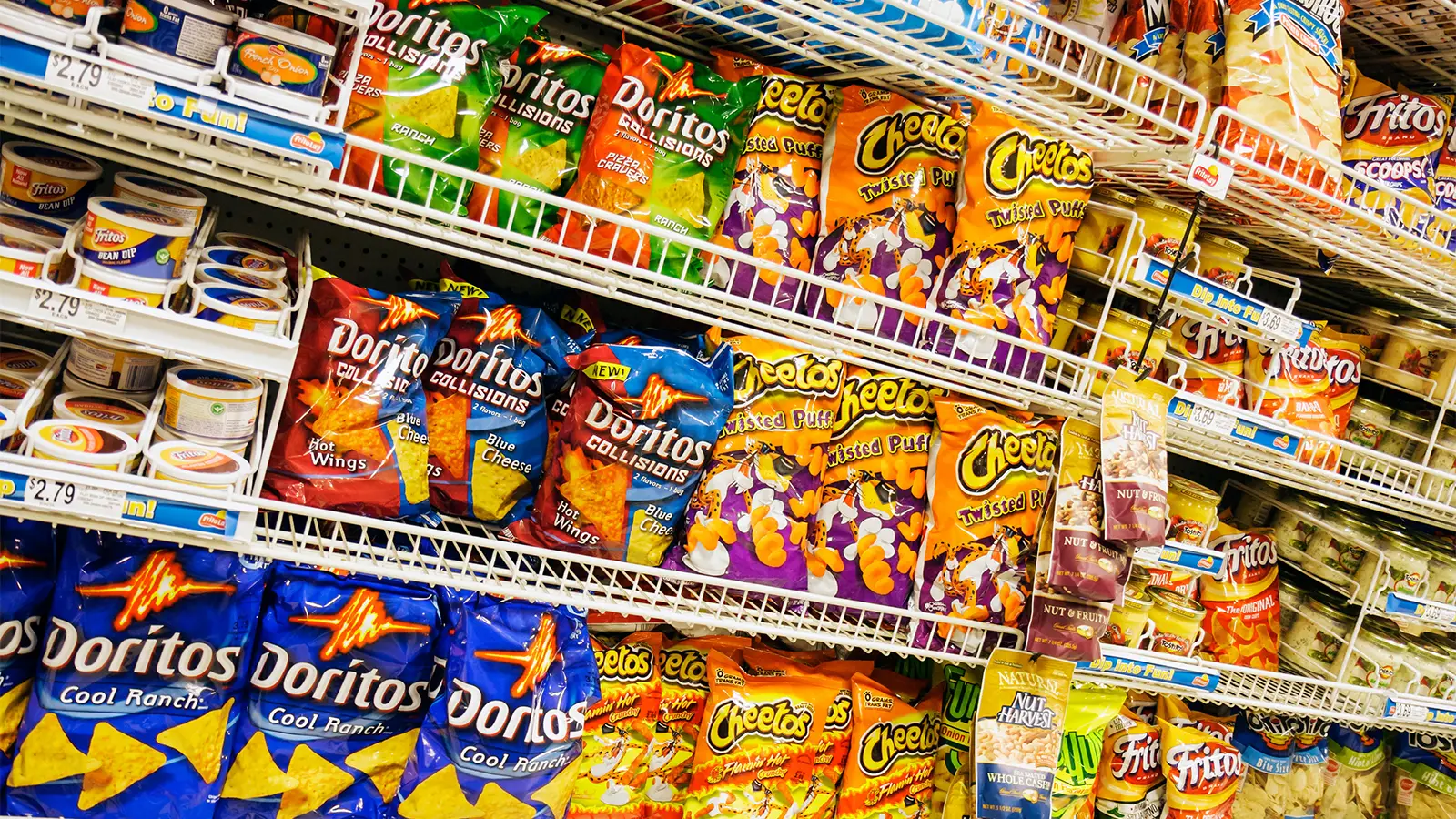
- A 10% increase in ultraprocessed food intake was tied to lower attention scores and greater dementia risk in a cross-sectional study.
- The relationships persisted even in people who followed a Mediterranean diet.
- No relationship emerged between ultraprocessed food intake and memory scores.
People who included more ultraprocessed foods — chips, candy bars, frozen meals, sugary cereals, or soda, for example — in an otherwise healthy diet had worse attention scores and a higher risk of dementia, an analysis of cross-sectional data in Australia suggested.
Each 10% increase in ultraprocessed food intake was associated with a 0.05-point decrease (95% CI -0.09 to -0.01, P=0.012) in composite attention scores among adults 40 and older, reported Barbara Cardoso, PhD, of Monash University in Notting Hill, Australia, and co-authors.
For each 10% rise in ultraprocessed food consumption, the risk of dementia rose by 0.24 points (95% CI 0.16-0.32, P<0.001) on the modified CAIDE (Cardiovascular Risk Factors, Aging, and Incidence of Dementia) scale, a tool designed to estimate a middle-age person's long-term risk of developing dementia, Cardoso and colleagues said.
The relationships persisted even in people who followed a Mediterranean diet, the researchers wrote in Alzheimer’s & Dementia: Diagnosis, Assessment & Disease Monitoring.
A 10% increase in ultraprocessed food intake corresponds to approximately 150 g/day, equivalent to a standard packet of potato chips, Cardoso and colleagues observed.
“For every 10% increase in ultraprocessed food a person consumed, we saw a distinct and measurable drop in a person’s ability to focus,” Cardoso said in a statement. “In clinical terms, this translated to consistently lower scores on standardized cognitive tests measuring visual attention and processing speed.”
The findings indicate that food processing itself may influence cognitive health beyond nutrient displacement, she noted. Food ultraprocessing often destroys the natural structure of food and introduces potentially harmful substances, she pointed out.
“We demonstrated that the association between ultraprocessed foods and attention is not related to diet quality, which reinforces the notion that food processing, per se, is a factor in the association between diet and cognitive health,” Cardoso told MedPage Today.
Earlier research tied ultraprocessed food to dementia risk, indicating that replacing these foods with unprocessed or minimally processed alternatives may reduce dementia risk. Other work showed that people who ate more ultraprocessed foods in midlife had faster rates of cognitive decline.
Ultraprocessed foods make up an estimated 60% of Americans’ diets. They have been linked with early colon cancer, cardiovascular and all-cause mortality, lung cancer, and other adverse health outcomes, even in young children.
Cardoso and colleagues aimed to investigate how ultraprocessed food consumption was associated with cognitive performance and dementia risk scores and to determine whether these links were independent of overall diet quality.
The researchers evaluated data from 2,192 dementia-free adults ages 40 to 70 in the Healthy Brain Project in Australia. The average age of participants was 56.6 years and 75.4% were women.
Diets were assessed with validated online food frequency questionnaires. Foods and beverages were classified according to the Nova system into one of four groups: unprocessed/minimally processed foods, processed culinary ingredients, processed foods, and ultraprocessed foods.
All participants completed the Cogstate Brief Battery online; results were computed into two composite scores, one for attention and one for memory.
Dementia risk was estimated using two CAIDE risk scores for a subgroup of 1,891 participants. CAIDE is a validated assessment of dementia risk based on a combination of modifiable and non-modifiable factors.
The researchers found no significant link between ultraprocessed food intake and memory in this study. “Given that attention is foundational to many cognitive operations, such as learning, problem-solving, and memory formation, it is plausible that early disruptions in attention may precede broader cognitive impairments,” they wrote. “However, the evidence base remains inconclusive, and further research is needed to clarify the temporal dynamics of these associations.”
The findings were based on self-reported food frequency questionnaire data, which have limitations, Cardoso and co-authors noted. The sample had a large percentage of female respondents who had more education and higher socioeconomic status compared with the broader Australian population, and results may not apply to other groups.
Source link : https://www.medpagetoday.com/neurology/dementia/121075
Author :
Publish date : 2026-05-01 18:25:00
Copyright for syndicated content belongs to the linked Source.