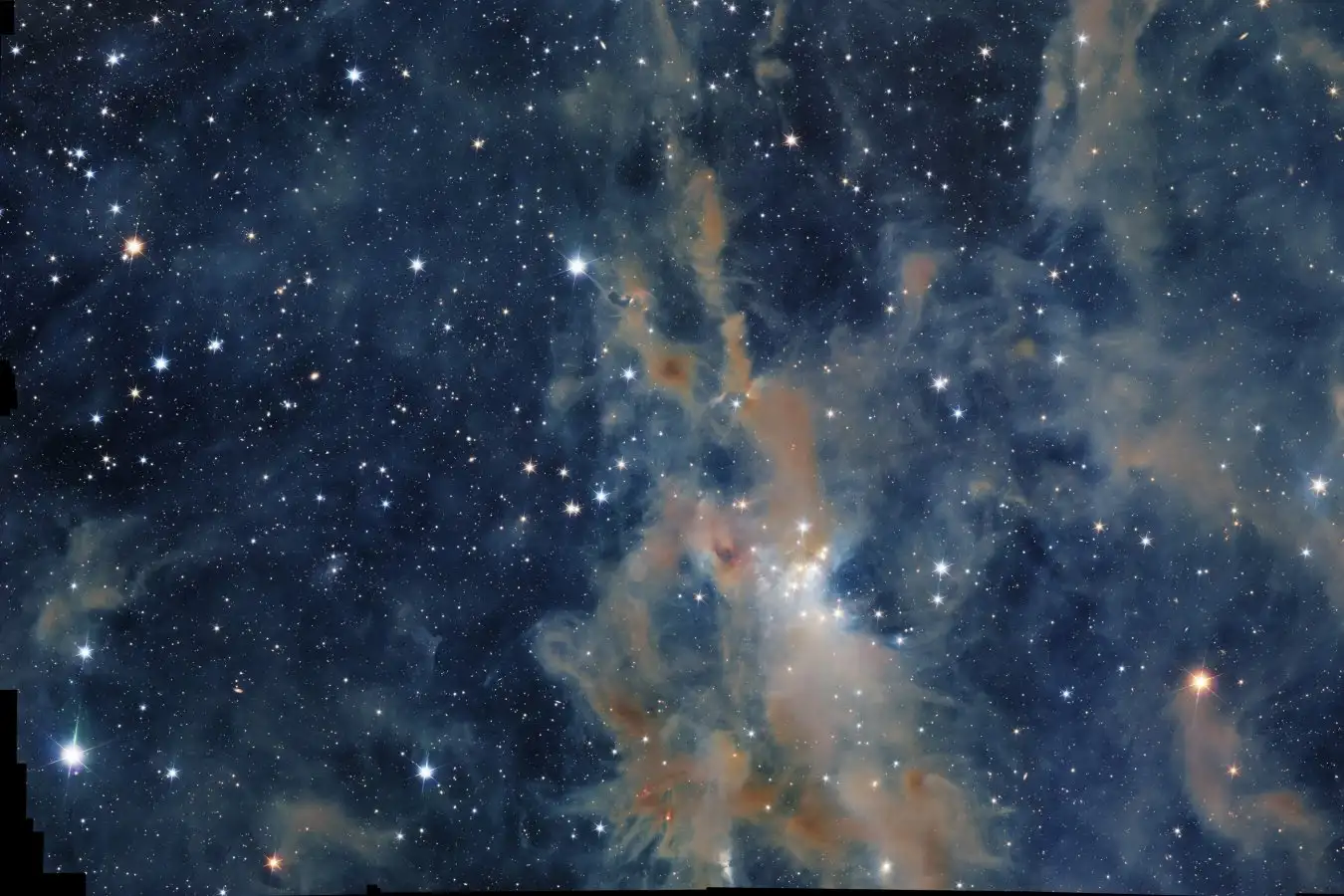
Dark matter makes up more of our universe than ordinary matter
ESA/Euclid/Euclid Consortium/NASA, image processing by M. Schirmer (MPIA, Heidelberg)
A centuries-old experiment could help accelerate the search for new and exotic particles, including those that make up dark matter.
In 1773, British scientist Henry Cavendish set up a simple experiment aimed at uncovering the nature of electromagnetism. It involved measuring the electric potential at the surface of two nested metal shells to discern how charged particles affect each other within them.
Now, Peter Graham at Stanford University in California and his colleagues say that reviving Cavendish’s experiment could help reveal an even more mysterious feature of our cosmos – the particles that make up dark matter.
Though dark matter comprises much more of our cosmos than the ordinary matter, we don’t know what it is made of. There are many theoretical proposals for what it could be, and experiments trying to find out range from using particle colliders to elaborate underground detectors.
Graham and his colleagues focused on one dark matter candidate called millicharged particles (mCPs), which, as the name suggests, have unusually tiny charges. The property of being charged makes them a good match for Cavendish’s centuries-old setup.
The team propose to replicate his nested shell design, apply voltage to the bigger, outer shell then measure the difference in voltage between it and the inner shell. Because mCPs are electrically charged, this measurement would reveal whether any are present in the experiment.
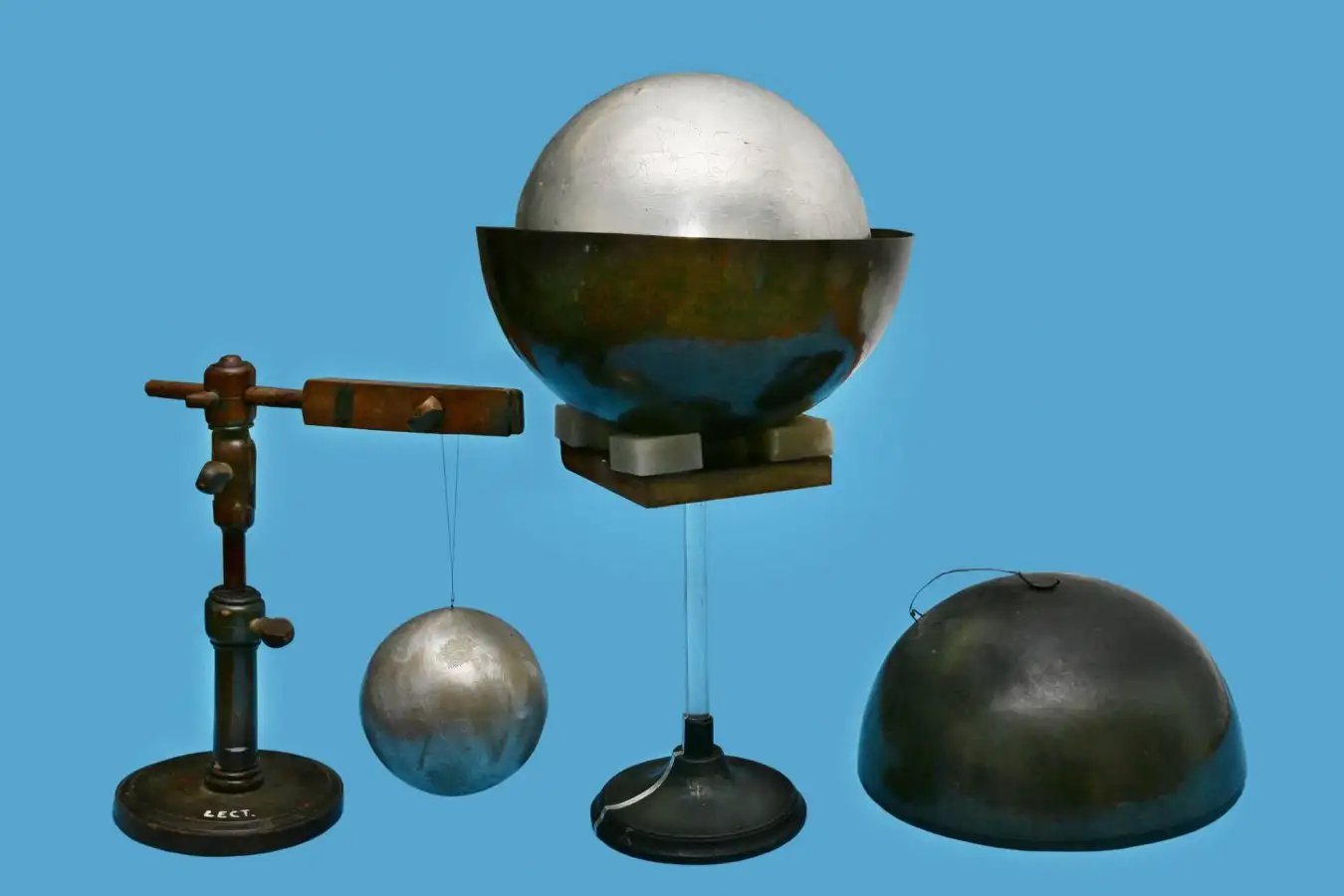
Henry Cavendish’s 18th century experiment was designed to explore electromagnetism
Cavendish Laboratory
To aid this, the new experiment would include an accumulator device which would suck up all the charged particles from the room like a vacuum cleaner, bringing all potential mCPs into the setup, says team-member Harikrishnan Ramani at the University of Delaware.
The design is simpler and more affordable relative to other mCP searches, with its cost estimated to be under a million dollars or a thousandth of operating a particle accelerator for a year. The researchers’ calculations also show that it could be more sensitive than some particle accelerator experiments that will come online in the future.
Kevin Kelly at Texas A&M University says that some of the estimates in the researchers’ calculations are probably conservative, so the proposed experiment could ultimately be between 100 and 10,000 more sensitive than past methods, allowing them to detect mCPs with charges even tinier than previously assumed.
“This technique could be better than some of the things that me and others are [already] doing,” says Christopher Hill at the Ohio State University. Like Graham and Ramani, he estimates that the experiment could be built and completed much more quickly than, for example, a particle accelerator experiment, thus significantly shortening the time to a possibly huge discovery. “It would be a big step to understanding what much of the universe is made of, and how it works,” says Hill. He says that he is contemplating whether he could build a similar experiment with his own team.
The team are now ironing out the details of building and securing funding for the experiment. If it works, which Ramani says could happen as soon as two or three years, it will have one more benefit – mCPs could be extracted from the Cavendish device and studied afterwards. “You could store and gift people millicharged particles,” he says.
Topics:
- dark matter/
- particle physics
Source link : https://www.newscientist.com/article/2524958-300-year-old-experiment-could-become-worlds-best-dark-matter-detector/?utm_campaign=RSS%7CNSNS&utm_source=NSNS&utm_medium=RSS&utm_content=home
Author :
Publish date : 2026-05-04 13:00:00
Copyright for syndicated content belongs to the linked Source.