[ad_1]
- In a randomized trial, the MC4R agonist setmelanotide reduced BMI and hunger in patients with acquired hypothalamic obesity.
- After 1 year, participants lost 36.4 lb with setmelanotide but gained 5.3 lb on placebo.
- The findings supported setmelanotide’s recent label expansion.
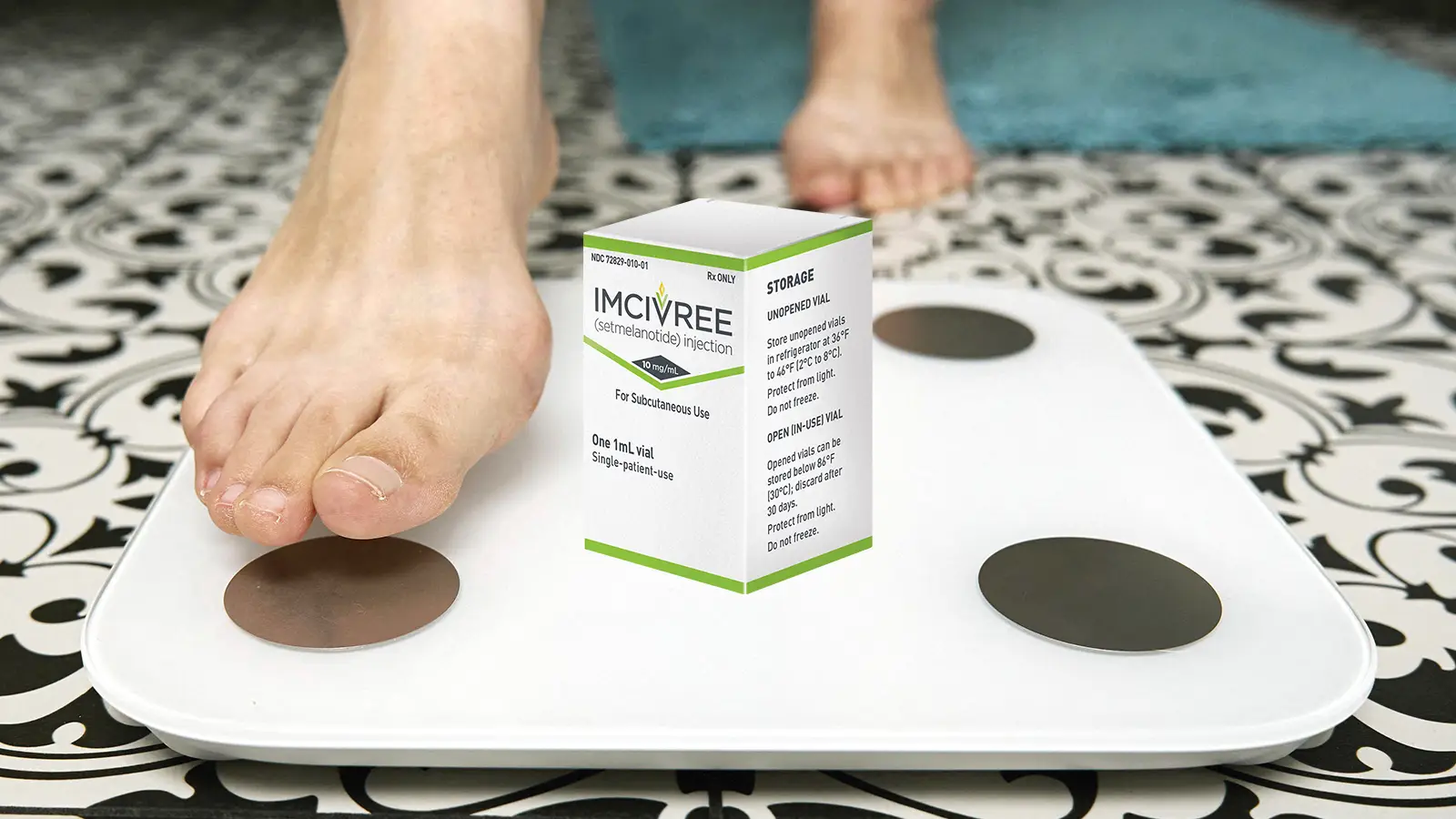
Treatment with setmelanotide (Imcivree), a melanocortin-4 receptor (MC4R) agonist, led to significant reductions in body mass index (BMI) and hunger in individuals with acquired hypothalamic obesity, the phase III TRANSCEND trial showed.
By week 52, adult and pediatric participants as young as 4 years who received setmelanotide had a mean BMI reduction of 16.5% compared with a 3.3% increase in the placebo group (P<0.001), reported Christian Roth, MD, of Seattle Children's Research Institute in Washington, and colleagues.
This equated to 36.4 lb of weight loss with setmelanotide compared with a 5.3 lb increase with placebo. Treatment also reduced the weekly average of maximum daily hunger scores (-2.73 vs -1.45 points, P=0.009), the authors wrote in the New England Journal of Medicine.
Based on the trial data, the once-daily injection was approved earlier this year as the first therapy specifically for acquired hypothalamic obesity in patients 4 years and older.
Acquired hypothalamic obesity is a rare condition where individuals experience rapid, intractable weight gain after the hypothalamus is damaged by tumors, surgery, head injuries, or inflammation. This damage triggers a myriad of symptoms including hyperphagia, hormone deficiencies, severe fatigue, sleep and body temperature disruptions, and a slowed metabolism.
“Patients with acquired hypothalamic obesity and their families face an urgent need for effective treatment options,” Roth said in a statement from the drugmaker.
Currently, those options are limited. Typical obesity management strategies like GLP-1 receptor agonists or bariatric surgery do not directly address the underlying hypothalamic dysfunction driving the condition, sometimes leading to varied results.
Setmelanotide acts as a functional analogue of the body’s natural α-MSH hormone to bypass the damage and address impaired MC4R signaling. The MC4R pathway plays a critical role in the homeostatic control of body weight by regulating hunger, satiety, food consumption, and energy expenditure.
In an accompanying editorial, I. Sadaf Farooqi, MBChB, PhD, of the University of Cambridge in England, pointed out that it would have been reasonable to predict that setmelanotide would fail in these patients due to the structural damage to their hypothalamus.
“Had the investigators not carried out this trial, patients with a complex condition for which no other therapies exist would have been denied the opportunity to benefit from an effective drug,” she wrote.
Farooqi noted that the effectiveness of GLP-1 drugs in people with MC4R mutations suggests the two drug classes target largely independent brain pathways, raising the possibility that patients might benefit from a combination of setmelanotide and a GLP-1 agent.
“It is a salutary reminder to physicians, researchers, and regulators that experimental medicine studies and early-phase clinical trials are sometimes the only means by which we can test hypotheses and ask critical questions about disease mechanisms to advance knowledge and transform human health,” she wrote. “There is little doubt that the results of this trial will do exactly that.”
Setmelanotide also holds indications for patients with Bardet-Biedl syndrome and for genetic obesity caused by mutations in the POMC, LEPR, or PCSK1 genes.
In the double-blind TRANSCEND trial, researchers randomized 120 patients (2:1) across 29 sites globally, including the U.S., between April 2023 and March 2025. Those randomized to the active arm received a daily dose of 1.5 to 3.0 mg following a dose-escalation period.
Participants ranged from ages 4 to 66 (average age 19.9), all with obesity and a history of hypothalamic injury. The majority (78%) had a craniopharyngioma tumor that caused the underlying damage.
Adverse events were typically mild to moderate. The most common side effects included skin hyperpigmentation (56% vs 8% with placebo), nausea (51% vs 31%), vomiting (40% vs 18%), and headache (38% vs 31%). The authors noted that while setmelanotide selectively targets MC4Rs, it can also activate melanocortin-1 receptors, which accounts for the high rates of skin hyperpigmentation.
A higher incidence of melanocytic nevi was also observed with the study drug (17% vs 5%). One serious adverse event was deemed related to setmelanotide: a participant experienced severe drug-induced nausea and vomiting, preventing them from taking oral desmopressin, which subsequently led to hypernatremia and hospitalization.
The authors acknowledged that while a significant decrease in hunger was demonstrated, the trial was not designed to assess changes in energy expenditure. A long-term extension trial is ongoing to evaluate the safety and efficacy of the treatment beyond 1 year.
[ad_2]
Source link : https://www.medpagetoday.com/endocrinology/obesity/122131
Author :
Publish date : 2026-07-09 21:44:00
Copyright for syndicated content belongs to the linked Source.