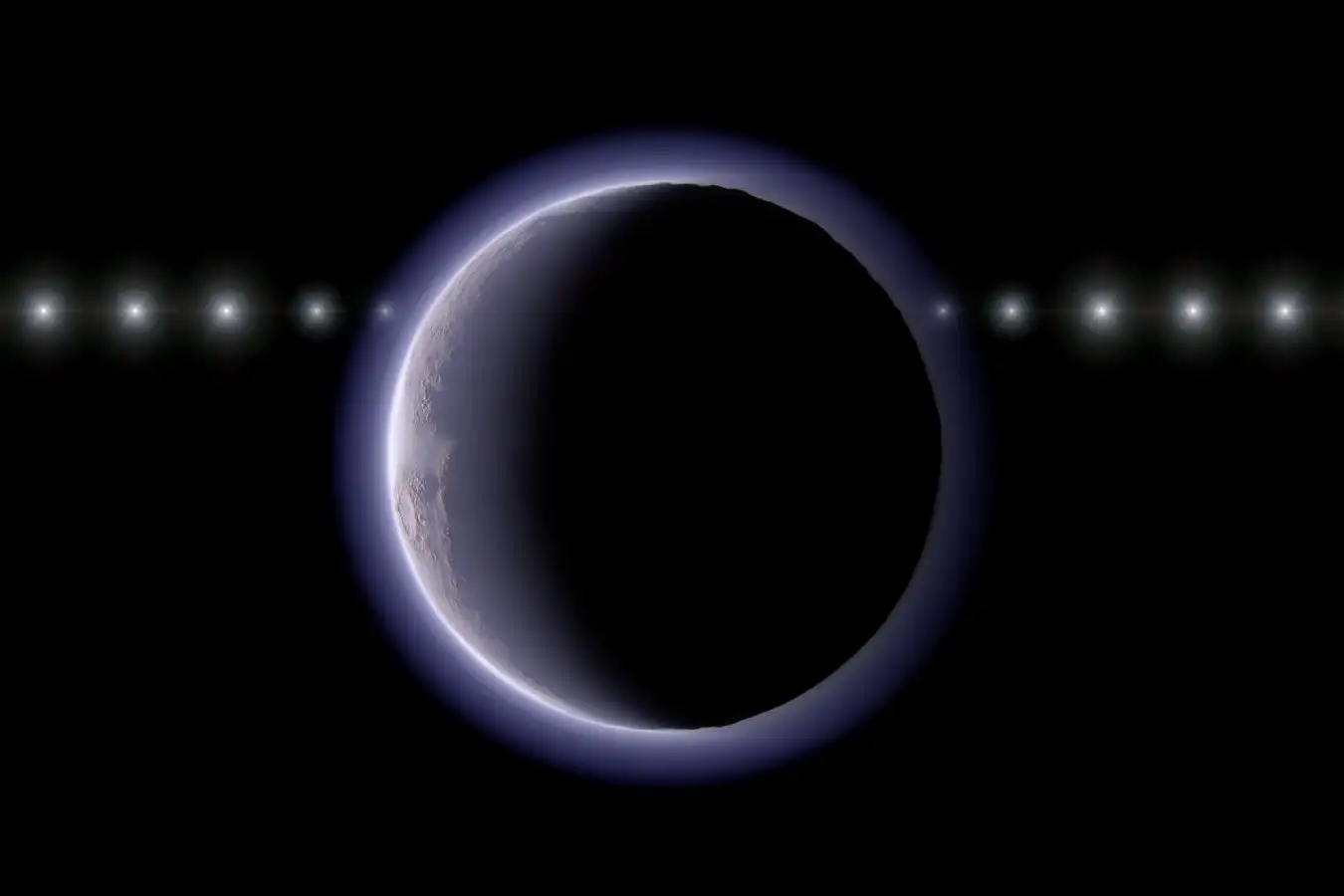
Artist’s impression of the trans-Neptunian object (612533) 2002 XV93 blocking the light from a distant star
NAOJ/Ko Arimatsu
A small icy body as far away as Pluto has stunned scientists with the revelation that it has an atmosphere.
The object, located in the Kuiper Belt of distant frozen bodies at the edge of the solar system, is formally named (612533) 2002 XV93, after the date of its discovery nearly a quarter of a century ago. It has a diameter of less than 500 kilometres.
The object also belongs to a class of objects known as plutinos because they are in the same stable orbit as Pluto, completing three revolutions around the sun for every two made by Neptune.
On 10 January 2024, 2002 XV93 passed in front of a distant star, causing what is called an occultation. Ko Arimatsu at Kyoto University and his colleagues observed this event from three locations in Japan.
If the body had no atmosphere, the star’s light would have disappeared and reappeared almost instantaneously when it went behind 2002 XV93.
But instead, the team saw the star gradually fade and recover over about 1.5 seconds near the edge of the shadow.
“These gradual changes are best explained if the star’s light was bent by a very thin atmosphere around 2002 XV93,” says Arimatsu.
The team estimates a surface pressure of about 100 to 200 nanobars, roughly 5 million to 10 million times thinner than Earth’s atmosphere and about 50 to 100 times thinner than Pluto’s tenuous atmosphere.
“You could not breathe it, feel wind from it, or see anything like Earth’s sky,” says Arimatsu. “But it is not negligible scientifically because even such a thin atmosphere can measurably bend starlight, and it tells us that volatile gases are present or being supplied around a very small icy body.”
The team couldn’t determine the composition of the atmosphere directly from the data. Arimatsu suggests methane, nitrogen and carbon monoxide are the most plausible candidates because they are among the few substances volatile enough to become gases at the very low temperatures of the outer solar system.
Another mystery is what has caused the atmosphere to form, with possibilities including volcanic activity, outgassing from the interior of 2002 XV93 or even a cosmic collision.
“This discovery challenges our conventional view of small worlds in the outer solar system,” says Arimatsu. “Until now, clearly detectable atmospheres in the solar system were essentially associated with planets, dwarf planets and some large satellites. 2002 XV93 appears to be one of the smallest solar system bodies yet with a clearly detected atmosphere.”
“There is an atmosphere, and we don’t understand why,” says Ben Montet at the University of New South Wales in Sydney, Australia.
“If you’re standing on the surface of this object, you’re not going to see a sky like [what] we have. But it certainly challenges the assumption that even a thin, transient atmosphere can’t exist on a body this small.”
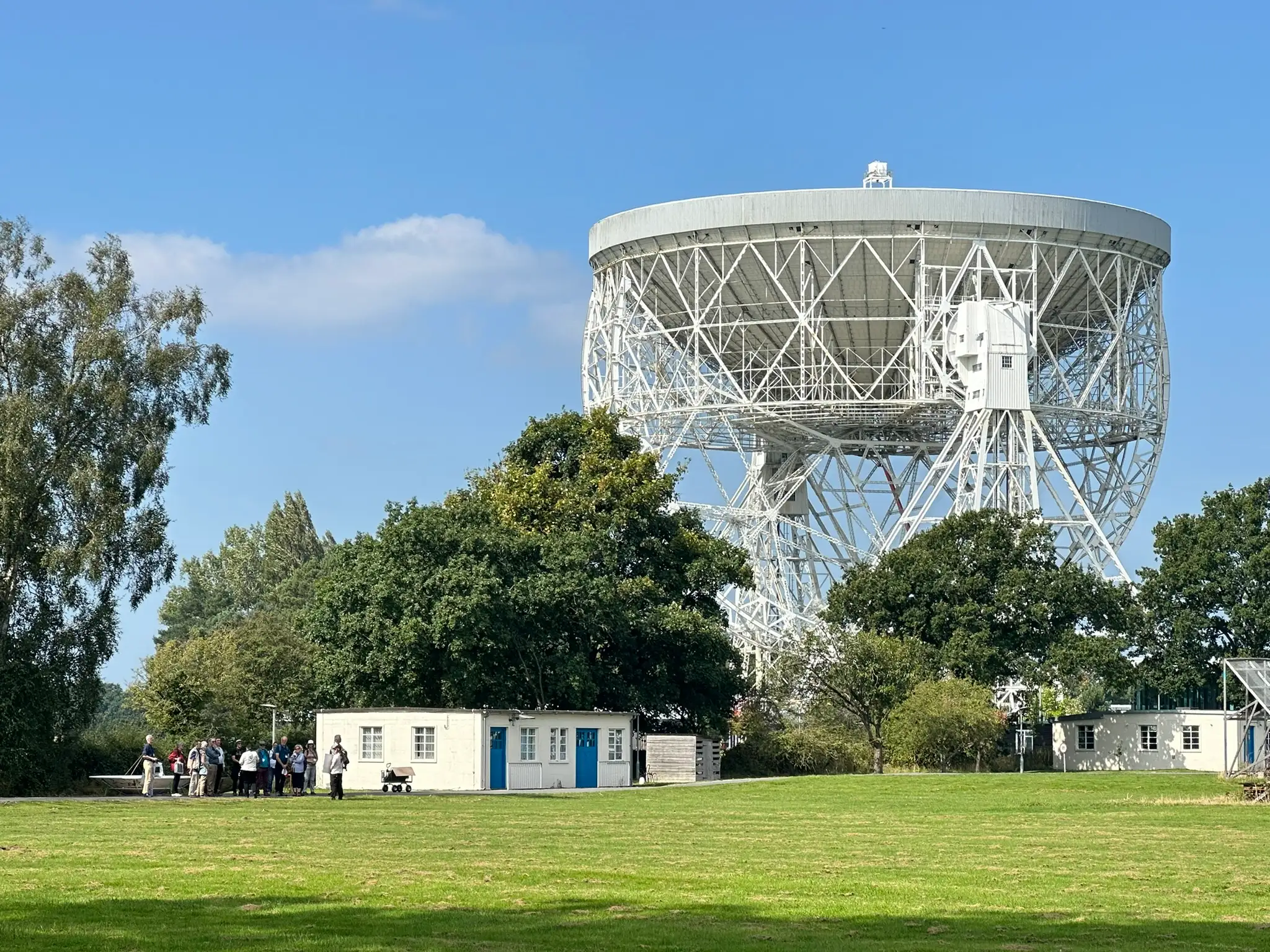
Mysteries of the universe: Cheshire, England
Spend a weekend with some of the brightest minds in science, as you explore the mysteries of the universe in an exciting programme that includes an excursion to see the iconic Lovell Telescope.
Topics:
Source link : https://www.newscientist.com/article/2525175-tiny-frozen-world-unexpectedly-appears-to-have-an-atmosphere/?utm_campaign=RSS%7CNSNS&utm_source=NSNS&utm_medium=RSS&utm_content=home
Author :
Publish date : 2026-05-04 16:00:00
Copyright for syndicated content belongs to the linked Source.