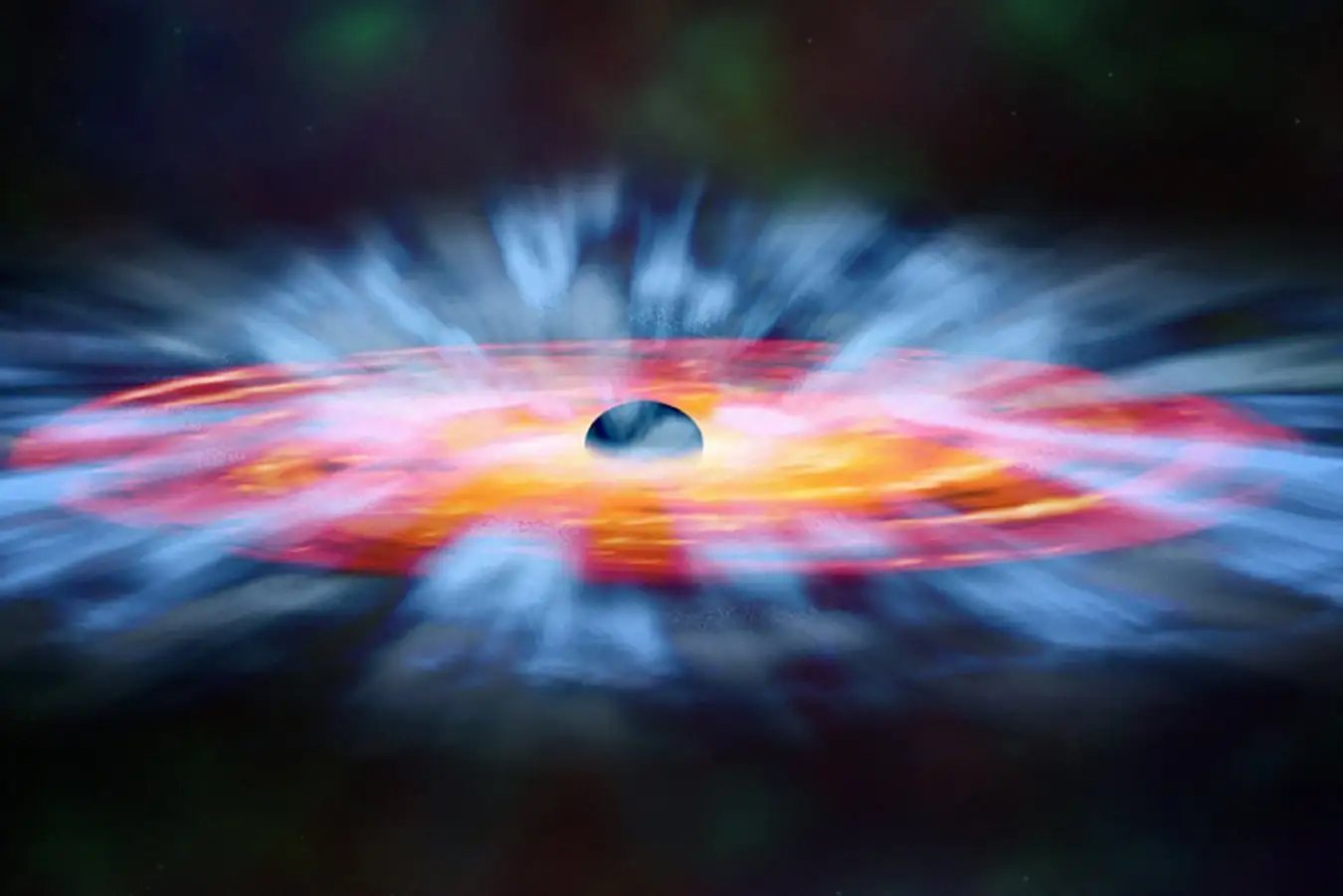
The disc of material swirling around a supermassive black hole may give birth to many planets
NASA and M. Weiss/Chandra X-ray Center
The active centres of galaxies might be regions of extraordinary planet formation, where millions of worlds are born.
Most galaxies in the universe, such as our own Milky Way, host a supermassive black hole at their centre. Most of the time, these black holes are quiescent, as there is no matter falling into them. But occasionally they become active and consume huge amounts of dust and gas, perhaps from a merger with another galaxy, becoming an active galactic nucleus for millions of years.
Barry McKernan at the City University of New York and his colleagues modelled the disc of dust and gas around a typical active galactic nucleus. They found it would be a prime location for planet formation, with the dust easily clumping together into bigger and bigger objects. Eventually planets would begin to grow in huge numbers, and with strange properties.
“This is a really amazing new pathway to form very alien planets,” says McKernan. “If these things exist, they’re quite unlike planets that we know and love.”
The planets would grow to enormous sizes because active galactic nuclei contain massive amounts of dust, much more than the protoplanetary discs around young stars that formed solar systems like our own. That could lead to giant rocky planets the size of Jupiter or even bigger forming, something not known to happen anywhere else in the universe, many with surfaces covered in lava because of frequent collisions with other worlds.
Some of the planets would become so large that they could ignite nuclear fusion at their cores, says McKernan, becoming “very weird alien stars” made of rock, or swallow up large amounts of nearby gas and collapse into objects known as intermediate-mass black holes.
The disc of dust around an active galactic nucleus can extend for dozens of light years, meaning this process would take place at huge scales. “You could get millions of planets around the central supermassive black hole,” says McKernan.
We knew that planets and stars can form around black holes, but planet formation of this scale has not been investigated before, says Sean Raymond at the University of Bordeaux, France. It could make active supermassive black holes one of the best places in the universe to form new worlds.
“With that much stuff around a supermassive black hole, what else is going to happen?” says Raymond. “It seems pretty much unavoidable.”
Many of the planets would be scattered into the black hole or ejected out into the galaxy because of their repeated interactions with each other. Any that remain might be detectable, perhaps by noticing their gravity warp the light of more distant stars, a technique called microlensing.
Telescopes such as NASA’s Nancy Grace Roman Space Telescope, which is expected to launch in September, could make this possible. “We are going into the age when microlensing is very much a thing,” says Benne Holwerda at the University of Louisville, Kentucky.
McKernan also notes that many active galactic nuclei have been observed to flicker, which could be due to a “swarm of little things that are passing in front”, such as planets. “These things should exist,” says McKernan. “So can we see them?”
Topics:
Source link : https://www.newscientist.com/article/2528091-millions-of-planets-might-form-around-supermassive-black-holes/?utm_campaign=RSS%7CNSNS&utm_source=NSNS&utm_medium=RSS&utm_content=home
Author :
Publish date : 2026-05-28 08:00:00
Copyright for syndicated content belongs to the linked Source.