Following is a partial transcript of the video (note that errors are possible):
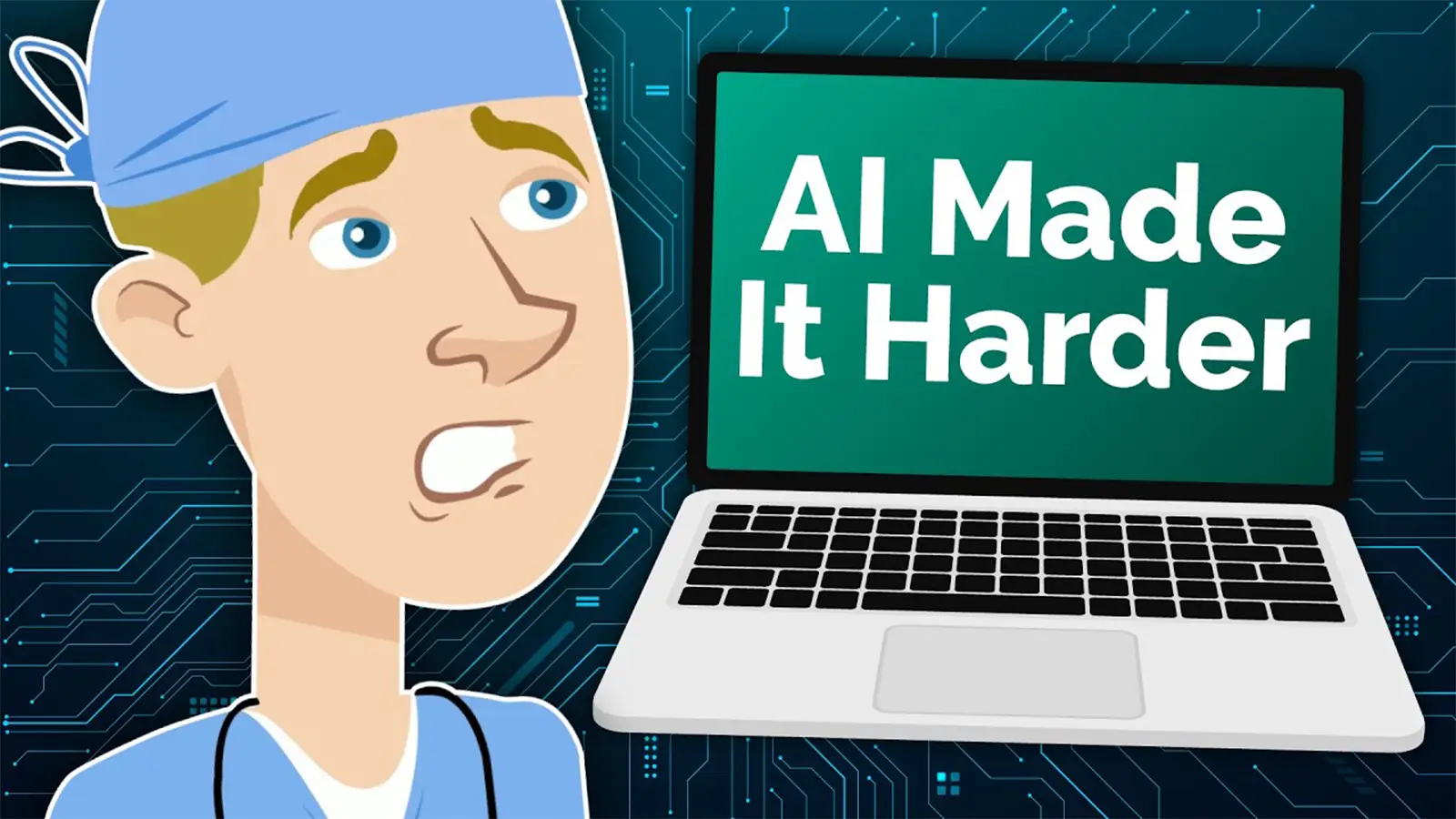
If you think artificial intelligence (AI) makes applying to medical school easier, think again. AI just killed your writing advantage and made it harder than ever before to stand out.
When everyone can sound perfect, perfect isn’t enough. After reviewing thousands of applications over the past decade, we’re seeing a pattern that didn’t exist 2 years ago.
This is how AI changed what separates acceptances from rejections, and what you need to do differently.
1. Your Writing Advantage Just Died
Being a strong writer used to be a competitive advantage. Not anymore.
ChatGPT can write a compelling personal statement in 30 seconds, with perfect grammar, a compelling structure, and a balanced blend of humility and confidence.
Every premed now has access to the same writing quality that once separated top applicants from average ones. The floor rose, meaning what used to impress is now the baseline. When everyone can sound perfect, perfect isn’t good enough.
In 2026, admissions committees (adcoms) are reading hundreds of excellently written personal statements that all sound eerily similar, with the same polished transitions, elevated vocabulary, and the same safe metaphors.
They may not be able to prove it’s AI, but they can feel it. What separates you now is what AI can’t generate, like hyper-specific details from YOUR experiences.
Not “I learned the importance of empathy” but “The patient in bed 7 kept asking why we couldn’t just fix her husband’s heart valve, and watching the attending draw diagrams on a napkin for 20 minutes taught me more about compassion than any textbook definition.”
AI can polish your grammar, but it can’t create authentic moments from your life. Use AI for ideation and brainstorming, to test ideas, organize thoughts, polish grammar, and tighten sentences. But write the content yourself. Get your story down in your actual voice with your specific details.
And this is a word of caution: If AI is inventing grand stories from your life out of thin air, that’s a huge red flag. Remember that anything you put in your application is fair game for interview questions. Fabricating stories will catch up with you eventually.
Test yourself by swapping your name for someone else’s. If the essay still works, it’s too generic.
But it’s not just personal statements. The AI problem is contaminating the one component you don’t even write yourself.
2. Your Letter Writers Are Using AI (And You Can’t Stop Them)
Even your strongest relationships can produce letters that destroy your application, and you have close to zero control over them.
Professors are buried under a mountain of work, in addition to writing letters for other applicants. They could have 12 letters to write in 2 weeks.
ChatGPT offers to “write a strong letter of recommendation for a premed student who worked in my research lab.” Done in 3 minutes. But generic and devastating to your application.
A professor who thinks you’re exceptional might tank your application simply by trying to save time. You can’t control whether they use AI, but you can control their inputs. The shift is making the authentic version easier than the AI version.
Instead of just asking for “a strong letter,” provide a letter support packet: a timeline of your work together, 3-4 specific stories for them to choose from that you’d value them mentioning, and your application narrative so that they can reinforce it, not contradict it.
What you’re really doing is feeding them the raw material that’s harder for AI to generate convincingly.
Specific anecdotes about the Western blot that failed three times and how you troubleshooted it beats “dedicated and hardworking student” every time.
Start this 6 months before you need letters. Don’t wait until application season. Frame the packet diplomatically: “Recent adcom feedback shows the most effective letters include specific examples rather than general praise. I’ve included a few stories from our time together that might be helpful to reference.”
You’re not accusing them of using AI. You’re making their job easier while ensuring authenticity.
Letters validate your story. Activities prove it. But in 2026, even your activities sound like everyone else’s.
3. Your Activities Sound Like Everyone Else’s
Every single activity description now sounds professionally optimized.
For example, “I developed leadership competencies through strategic coordination of a 15-person interdisciplinary team, resulting in 30% operational efficiency improvement.”
ChatGPT turned volunteering into corporate speak. Adcoms are reading this hundreds of times per cycle. They see the polish without the substance. The activities section isn’t about sounding impressive. It’s about showing how you think and what you learned.
Not “Assisted with patient care in the emergency department,” but what you actually accomplished and what that experience taught you about yourself and medicine.
Use specifics. Use transformation. Use real moments that reveal your growth.
For each of your 15 activities, you have 700 characters. Use about 500 to describe what you did. Use the last 200 to show what it taught you.
For your three Most Meaningful, you get an extra 1,325 characters on top of that. Don’t use this space to describe your responsibilities in more detail. Show how your thinking evolved. What did you believe or understand at the start? What specific moments shifted your perspective? What do you understand now that you didn’t before?
The transformation should be genuine and specific to your experience. Use real moments that changed how you think about medicine, not generic statements about learning teamwork or gaining skills. If ChatGPT could have written your description without knowing you personally, rewrite it with clearer details.
Personal statements are AI-polished. Letters are AI-drafted. Activities are AI-optimized. That leaves secondary essays.
4. When All Secondary Essays Are Perfect
In 2026, every secondary is grammatically flawless with perfect structure and elevated language.
Students are using AI to craft school-specific responses. The problem is that AI-polished secondaries all sound identical, with the same transitions and sophisticated vocabulary.
When everyone sounds perfect, nobody stands out. Speed still matters, but perfection and generality are worse than slight roughness and specificity. The new differentiator is hyper-specific proof that you actually researched the school.
Not “interested in your global health programs” but “I sat in on Dr. Chen’s Global Health Policy seminar during my campus visit, and the discussion about bilateral aid structures completely reframed how I think about health equity.”
The more specific you can get, the better. Move beyond what AI could say of any hard-working student to the experiences and transformations you’ve actually experienced.
Use AI to organize thoughts and fix grammar. Don’t use it to generate and write your essays.
Use this as a test: could you swap the school name and submit this elsewhere? If so, add specific details, such as the faculty research you read, the programs you investigated, or the conversations from your campus visit. Make it impossible to recycle without changes.
AI can polish writing. It can optimize descriptions. It can even draft letters. But there’s one thing it absolutely cannot fake.
Watch the video above for more and visit Med School Insiders for videos like this.
Source link : https://www.medpagetoday.com/popmedicine/popmedicine/121477
Author :
Publish date : 2026-05-28 18:56:00
Copyright for syndicated content belongs to the linked Source.