[ad_1]
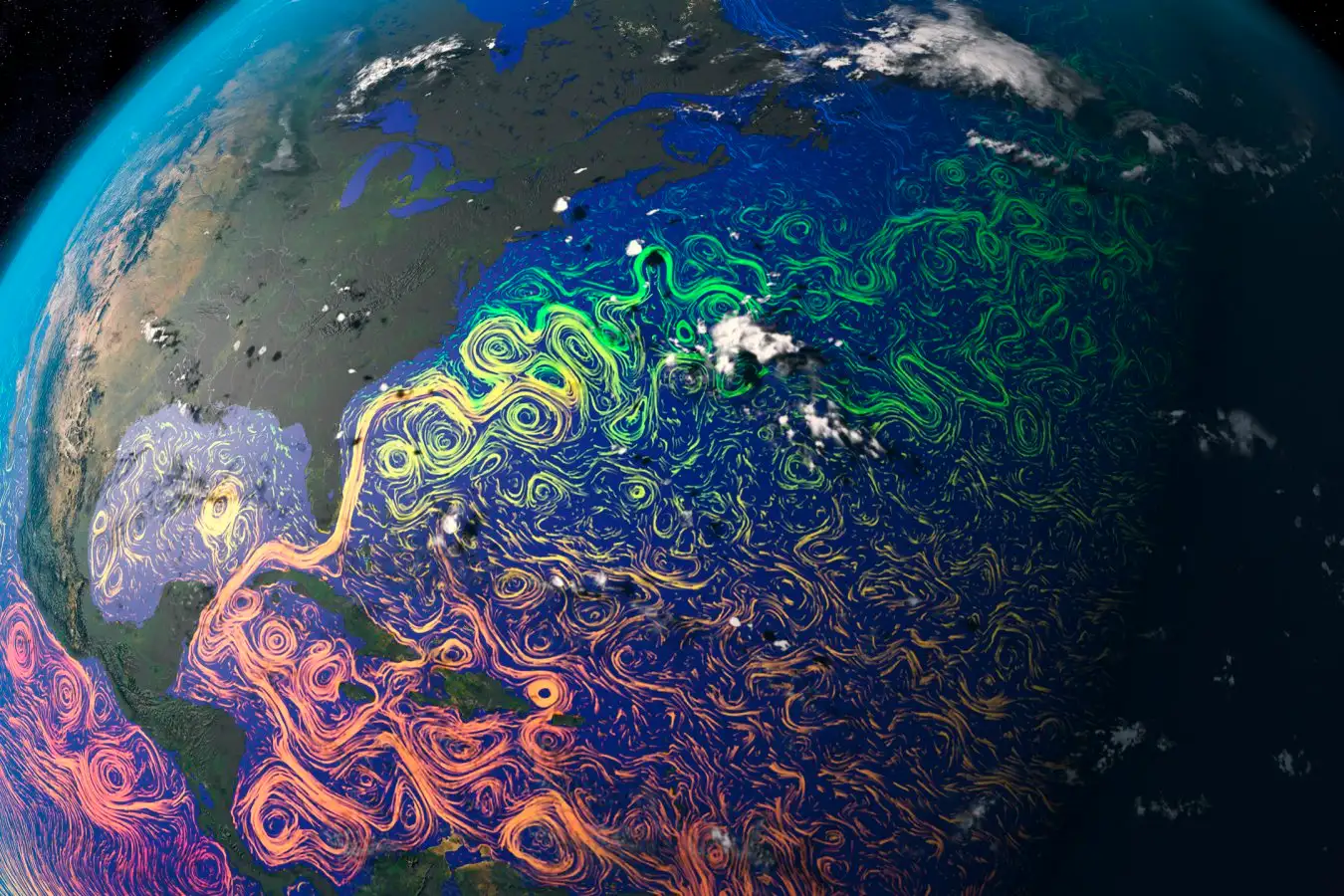
A visualisation of Atlantic Ocean currents based on satellite imagery
KARSTEN SCHNEIDER/SCIENCE PHOTO LIBRARY
The Atlantic Meridional Overturning Circulation (AMOC) could weaken under a flood of Greenland meltwater, but this slowdown would be gradual and it would reverse if global warming were halted, according to a state-of-the-art climate model.
The AMOC is a system of currents that brings warm, salty, tropical water into the North Atlantic Ocean, where it cools, sinks and returns southwards along the seabed. Fresh water melting from the Greenland ice sheet appears to be mixing with this dense seawater and slowing its cascade down to the ocean floor.
Because Greenland is now losing 30 million tonnes of ice every hour, some scientists fear the AMOC could face an abrupt and irreversible collapse, plunging Europe into near-Arctic conditions. One study found the AMOC could cross a tipping point within decades.
But modelling research by Oliver Mehling at Utrecht University in the Netherlands and his colleagues has found that while continued rapid Greenland melt could steadily weaken the AMOC under global warming, this decline wouldn’t mark a point of no return.
“The conventional wisdom that the melting of the Greenland ice sheet could trigger an irreversible collapse of the AMOC in the future, this is definitely too simplistic a picture,” says Mehling. “Greenland meltwater alone is not sufficient to push the AMOC across a tipping point.”
Besides helping to melt Greenland, the warming atmosphere is thought to be weakening the AMOC directly because it doesn’t cool the salty water in the North Atlantic as much as before. It can also hold more moisture, which eventually falls as rain, which freshens the salty water and reduces ocean mixing. This warming and freshening slows the sinking motion.
Most modelling of future climate change has focused on the impact of atmospheric warming on the AMOC, but not Greenland meltwater. Mehling and his colleagues’ model showed that atmospheric warming alone would weaken the AMOC by 60 per cent by 2300. Adding a large and increasing amount of Greenland meltwater would reduce its strength by another 20 per cent.
However, the researchers found that if levels of carbon dioxide in the atmosphere decrease by 1 per cent per year starting in 2250, the AMOC would fully recover by about 2400. While this modelling isn’t meant to predict how much the AMOC will change and when, it does suggest the growing influx of freshwater from Greenland won’t push the AMOC across a tipping point.
An 80 per cent decrease in the AMOC could still freeze crops in western Europe, cover the North Sea in ice and disrupt monsoon rains in the tropics. But the study implies the decrease will be gradual, predictable and reversible if humanity stops burning fossil fuels, according to Louise Sime at the British Antarctic Survey, who wasn’t involved in the research.
“This possible future scenario where then AMOC falls off a cliff, that doesn’t occur,” she says. “Instead… AMOC is really strongly linearly dependent on cumulative CO2 emissions.”
Nonetheless, these findings can’t rule out a tipping point. In a previous study by René van Westen, also at Utrecht University, and his colleagues, a different model found that massive Greenland melt would irreversibly collapse the AMOC. That experiment, however, added meltwater at a constant rate rather than simulating an increase over time, which is what’s happening in the real world.
“Other climate models do cross the tipping point under 21st-century climate change, so the results are model-dependent,” says van Westen.
Besides Greenland melt, several other climate-related changes could potentially disrupt the AMOC. For example, fresh meltwater from Antarctica could weaken the global salinity- and temperature-driven circulation of which the AMOC is a part. But these impacts remain uncertain. Depending on the timing of Antarctic melt, it could also help preserve the AMOC.
The new study is “another contribution to the evidence base, rather than one that settles the question of AMOC tipping point risk”, says Jonathan Baker at the Met Office, the UK’s national weather service.
Topics:
[ad_2]
Source link : https://www.newscientist.com/article/2532392-slowdown-of-amoc-ocean-current-may-be-gradual-and-reversible/?utm_campaign=RSS%7CNSNS&utm_source=NSNS&utm_medium=RSS&utm_content=home
Author :
Publish date : 2026-07-01 09:27:00
Copyright for syndicated content belongs to the linked Source.