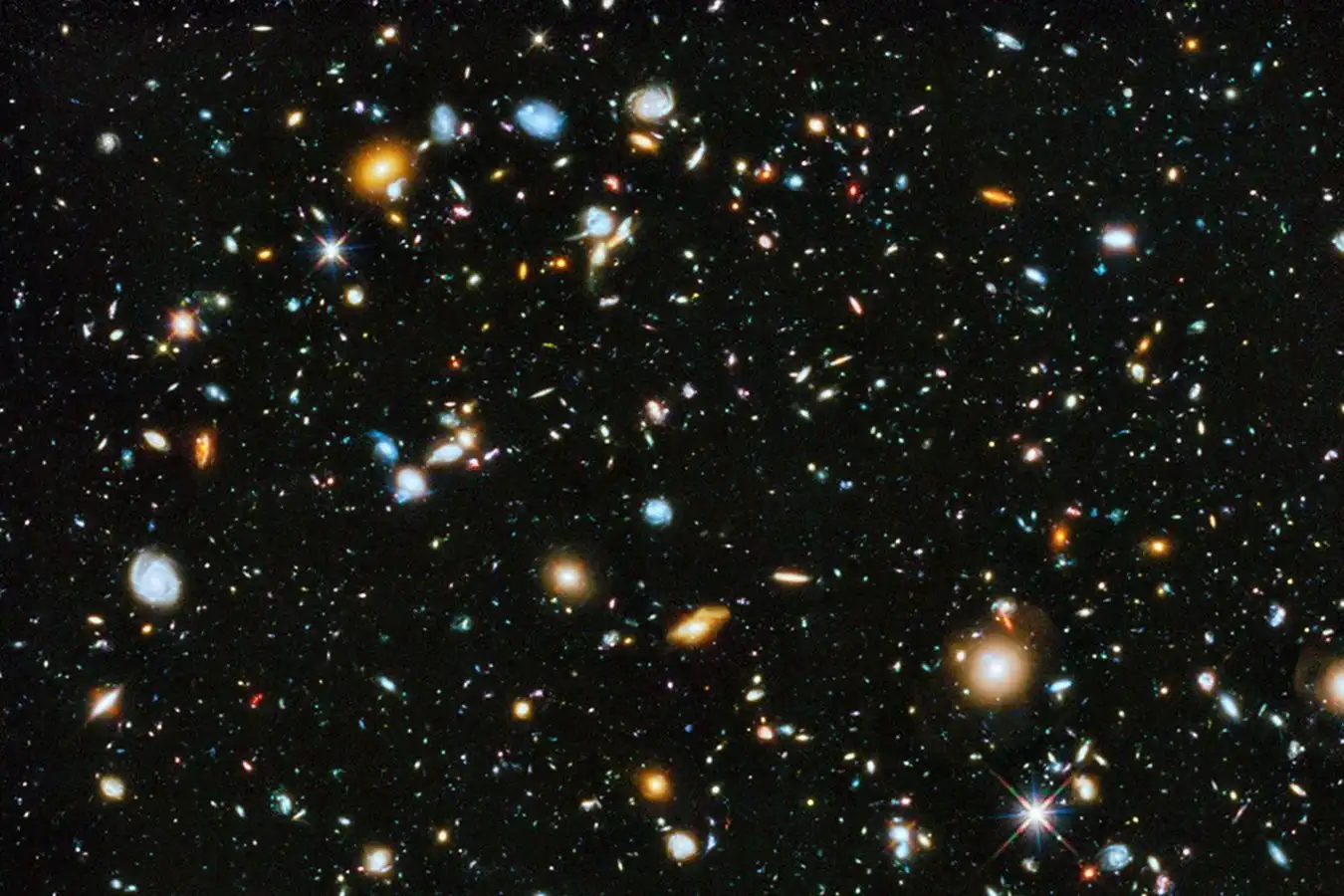
Our surprisingly lumpy universe
NASA, ESA, IPAC/Caltech, STScI, Arizona State University
Assumptions that physicists have made about the universe for over a century may be about to be overturned. Evidence is emerging that it is far lumpier than we had thought – a finding that could solve some of today’s most puzzling cosmological mysteries.
When modelling the universe, cosmologists can’t describe every single galaxy, so they make simplifications. Typically, they assume that the universe on the largest scales is homogeneous and isotropic, meaning that it is roughly the same no matter where you look.
This view is known as the FLRW model, named after Alexander Friedmann, Georges Lemaître, Howard Robertson and Arthur Geoffrey Walker, who developed it in the 1920s. Nearly all cosmological observations are interpreted using the model, but evidence is emerging that the underlying assumptions are wrong, outlined in three preprint papers published this month.
In the first, Timothy Clifton at Queen Mary University of London and Asta Heinesen at the University of Copenhagen, Denmark, propose a new way to tell whether the FLRW model can accurately describe our universe.
The test uses combinations of different formulas for cosmic distances, constructed from observations of supernovae and fluctuations in the density of matter. The combinations are carefully chosen to be zero if the FLRW model holds, so any nonzero result would suggest that a new model is needed. Other tests have previously been proposed, but haven’t managed to give a clear signal that there is something wrong with FLRW.
In the second and third papers, Heinesen and Sofie Marie Koksbang at the University of Southern Denmark tried the test out on existing cosmological data.
Doing so isn’t straightforward, so the pair first had to work out how to obtain the relevant distance measurements from the data without assuming FLRW, as past analyses would have. They then used an AI-based method called symbolic regression to find formulas that fit those distance measurements, which they could use for the test. The outcome was a clear nonzero result, suggesting that FLRW is flawed.
“I was surprised by our result because it breaks with much of what’s come before,” says Heinesen.
“It suggests that the universe may not be as simple as it appears,” says Clifton. He says that it may be the first piece of evidence that FLRW isn’t strong enough, which “opens a world of new and interesting possibilities”.
While the new results are suggestive, they have not yet reached the full standard of statistical evidence that cosmologists require for a discovery. For that, the team must wait for more astronomical data to be produced in the coming years.
Nonetheless, this emerging picture could have dramatic implications. Cosmologists have long been baffled by discrepancies in the expansion rate of the universe, a mismatch between its early history and its current behaviour, and recent measurements suggest that dark energy could be changing over time, surprising many.
Clifton says that these fundamental mysteries in cosmology could be explained by a lumpy universe without homogeneity; these measurements are just averages and so cannot be expected to hold for any particular time, he says.
Subodh Patil at the University of Leiden in the Netherlands thinks the researchers need to be cautious to avoid overinterpreting the data, but he is impressed by the overall approach. “My first impression is, fantastic, they’re asking the right questions,” says Patil.
Topics:
Source link : https://www.newscientist.com/article/2524208-100-year-old-assumption-about-the-universe-may-soon-be-overturned/?utm_campaign=RSS%7CNSNS&utm_source=NSNS&utm_medium=RSS&utm_content=home
Author :
Publish date : 2026-04-27 07:00:00
Copyright for syndicated content belongs to the linked Source.