
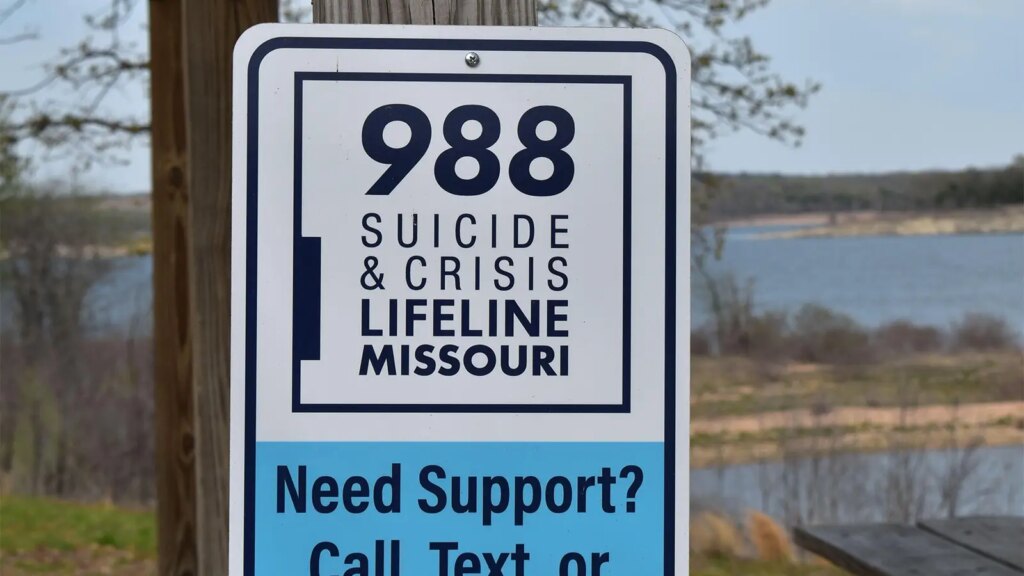
- Suicide deaths among individuals ages 15 to 34 declined by 11% across the U.S. after the launch of the 988 Suicide and Crisis Lifeline in July 2022.
- Differences in observed-to-expected suicide deaths among those ages 15 to 34 were markedly greater in the 10 states with the strongest uptake versus the 10 with the lowest uptake.
- After the elimination of the specialized service for LGBTQ+ youth in 2025, the researchers plan to monitor suicide mortality in this subgroup.
Suicide deaths among adolescents and young adults declined across the U.S. after the launch of the 988 Suicide and Crisis Lifeline in 2022, according to an observational study.
From July 2022 through December 2024, 35,529 suicides among individuals ages 15 to 34 were observed compared with 39,901 expected suicides based on trends before the launch of the lifeline, corresponding to an 11% reduction (95% CI 8.7-13.1), reported Anupam B. Jena, MD, PhD, of Harvard Medical School in Boston, and co-authors in a research letter in JAMA.
After replacing the previous 10-digit number for suicide and crisis services with the 3-digit number and investing more than $1.5 billion to expand crisis center capacity and workforce nationwide, “988 appears to be working where it matters most, in reducing suicide deaths among the young people who use it the most … saving lives, at scale, within a few years of launch,” said co-author Vishal R. Patel, MD, MPH, also of Harvard Medical School.
“Prior evidence for the lifeline was mostly indirect: higher call volumes, positive caller surveys, reductions in same-day distress,” Patel told MedPage Today. In contrast, this study shows that the lifeline actually affects suicide mortality at the population level, he noted.
The authors reported that the 10 states with the biggest increases in answered 988 calls after the launch had a 146.2% increase in monthly calls (from 32,635 to 80,338), while the 10 states with the smallest increases had a 23.6% increase in monthly calls (from 39,835 to 49,226).
Differences in observed-to-expected suicide deaths among those ages 15 to 34 were markedly greater in the 10 states with the strongest uptake versus the 10 with the lowest uptake (-18.2% vs -10.6%).
“However, sustained access to suicide and crisis services is contingent on continued investment, and existing funding is estimated to be insufficient to meet service demand in nearly half of all states,” Jena and team noted.
Chase Anderson, MD, of the University of California San Francisco, told MedPage Today that since suicidality remains a taboo topic, “by having a suicide hotline that is known to be a suicide hotline, [we are] maybe helping people speak up and get the life-saving care that they need.”
He noted that he was pleased to see the study authors acknowledge the elimination of the specialized service for LGBTQ+ youth in 2025, who are at higher risk of suicide compared with their peers.
In the future, he said, it would be interesting to see how many LGBTQ+ people are still accessing the lifeline, since some may be dissuaded by the lack of the dedicated line. (Patel said his team has plans to monitor suicide mortality in this subgroup.)
In his treatment of teens experiencing suicidality, Anderson said he has them put 988 in their phones for “ease of access.”
Now that it’s clear people are using the lifeline, policymakers must ensure that people get the right care when they do access it, he added.
For this study, Jena and team examined quarterly suicide mortality among individuals ages 15 to 34 using the National Vital Statistics System, a registry of all U.S. death certificates. The team used data from January 1999 to June 2022 to project the expected number of suicide deaths before the launch of the lifeline.
They also used Substance Abuse and Mental Health Services Administration state-level performance reports of the lifeline to rank states based on the relative difference in total number of answered 988 calls each month from October through December 2024 compared with July through September 2022.
The authors conducted multiple sensitivity analyses, one of which found an expected significantly smaller decline in suicide mortality among adults 65 and older after the launch of the lifeline (-4.5%, 95% CI -7.1 to -1.8). They found no decline in deaths from malignant neoplasms, and no comparable reductions in suicide deaths in England, which left its own crisis services unchanged. Modeling that excluded the period of the COVID pandemic from the baseline model showed that suicide deaths among individuals ages 15 to 34 remained lower than expected based on trends before the initiation of the lifeline.
One limitation of the study was its observational design, which could not account for changes in mental health services, public awareness, or socioeconomic conditions.
Longer-term research on the 988 lifeline will focus on the “broader crisis-care continuum,” including mobile crisis teams and stabilization centers to understand “where it works and where it breaks down,” Patel said.
Please enable JavaScript to view the comments powered by Disqus.
Source link : https://www.medpagetoday.com/psychiatry/generalpsychiatry/120907
Author :
Publish date : 2026-04-22 17:00:00
Copyright for syndicated content belongs to the linked Source.