[ad_1]
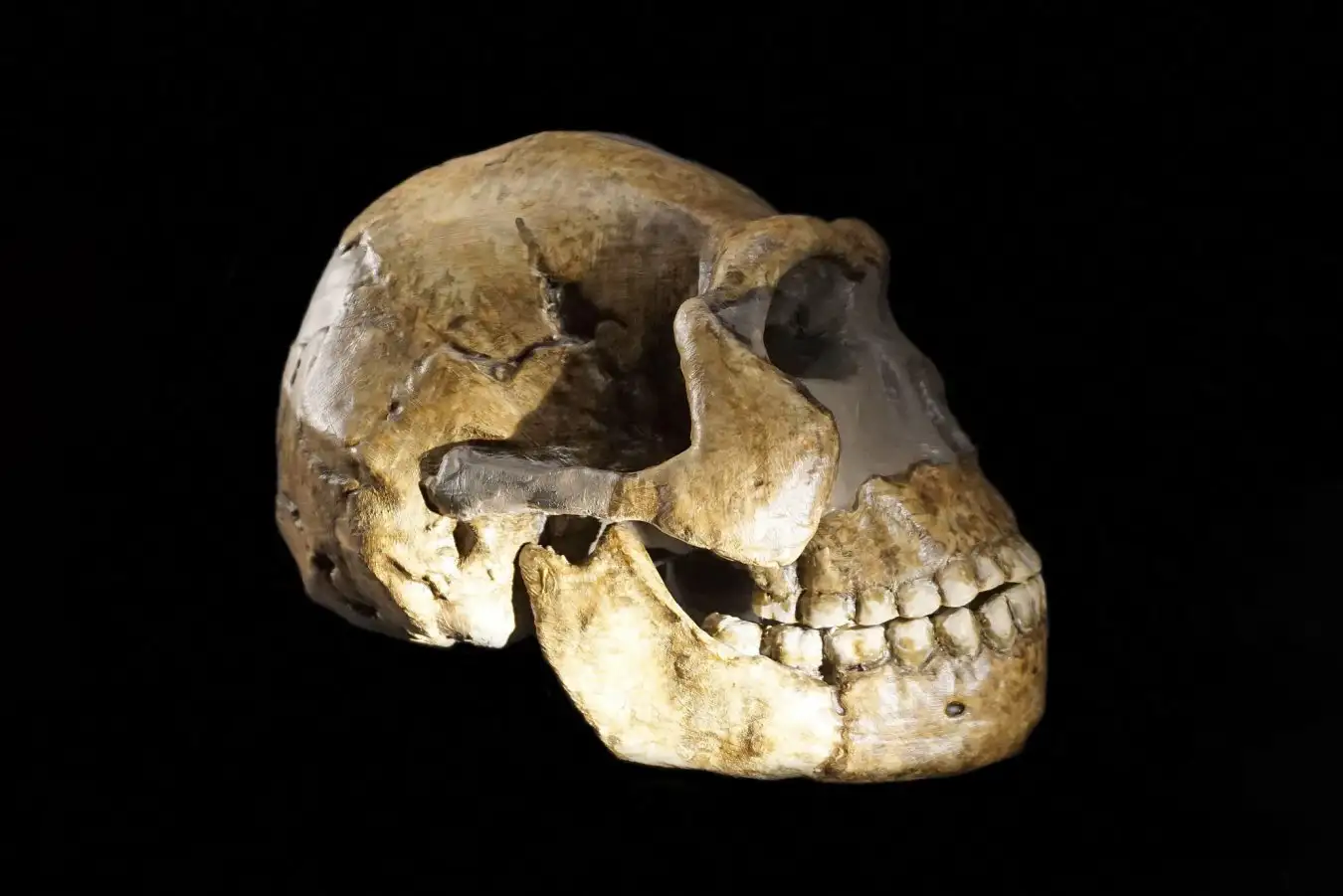
A Homo naledi skull
Peter van Evert/Alamy
The Homo naledi fossils discovered in a South African cave 13 years ago are even more remarkable than we thought. An analysis of proteins in the skeletons suggests they are all female. The discovery may be the clearest evidence yet that H. naledi really did treat its dead in an unusual way.
A couple of cavers stumbled upon the H. naledi fossils in 2013 as they explored the Rising Star cave system, about 40 kilometres north-west of Johannesburg. The fossils were in a series of deep and difficult-to-access cave chambers. Since then, researchers have been grappling with the mystery of how they got there.
A prominent but controversial idea first suggested in 2015 is that H. naledi deliberately dragged its dead through the cave system and deposited them in the chambers. In the years that followed, the researchers working at the site – led by Lee Berger at the University of the Witwatersrand, South Africa – expanded on this hypothesis. They say that archaeological evidence inside the cave suggests H. naledi dug graves for its dead in the dirt floor of the rock chambers, that it used flaming torches to light the way through the dark caves and that it left rock art on the chamber cave walls. All of these ideas have been met with extreme scepticism.
For the latest analysis, a team led by Palesa Madupe at the University of Copenhagen, Denmark, extracted ancient proteins from H. naledi tooth enamel. Proteins are built using information stored in DNA, so the analysis offered a window into the genetics of the ancient human species, which is thought to have existed between about 335,000 and 236,000 years ago.
Tooth enamel contains just a dozen or so distinct protein types, says Madupe, and so reveals relatively little about evolutionary history. What the proteins can do, however, is reveal the sex of an ancient individual. This is because amelogenin proteins in enamel may carry a signal from the AMELX gene on the X chromosome or the AMELY gene on the Y chromosome. Female individuals carry only an AMELX signal in their tooth enamel, whereas male individuals typically carry both AMELX and AMELY signals.
Madupe and her colleagues analysed proteins from all 23 known H. naledi individuals. For 20 of them, it was possible to recover amelogenin proteins. None of them carried any AMELY, suggesting all 20 individuals were female – an exceptionally unusual result. “Honestly, it was very scary. I thought we were doing something wrong,” says Madupe. But even when the researchers repeated the analysis, the outcome was the same. “Then we are like: OK, what is the story? Why is it that we’re not getting male individuals here?”
One possibility is that the AMELY protein degrades more rapidly than AMELX, and so had originally been present in some of the H. naledi individuals but was no longer detectable. Madupe thinks we can discount this explanation: last year, she and her colleagues published an analysis of enamel protein from 2-million-year-old hominin teeth also uncovered in South Africa, some of which contained AMELY.
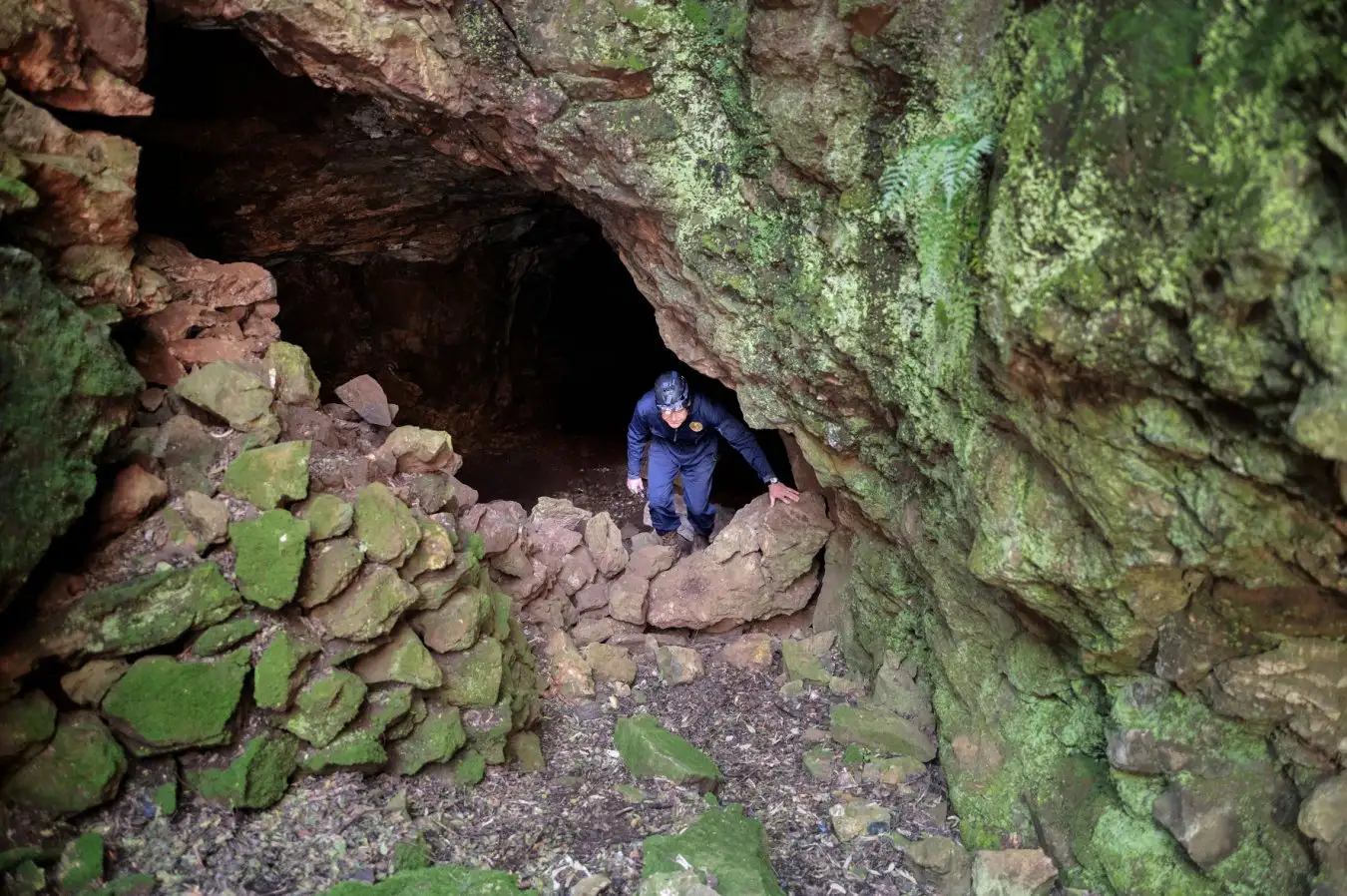
Lee Berger at the entrance to the Rising Star cave system
LUCA SOLA/AFP via Getty Images
Another possibility is that the H. naledi population experienced a deletion of the AMELY gene, meaning male individuals wouldn’t necessarily express AMELY in their enamel. After reviewing the literature, the team found that such deletions do occur in modern human populations, but they are exceptionally rare. Even when there is an AMELY deletion, it affects no more than 10 per cent of men and boys in the population, meaning plenty still carry AMELY. The researchers calculated how likely it would be that there was an AMELY deletion in the H. naledi population, and that a random sample of 20 individuals – 10 male and 10 female – would recover no AMELY. They say there is just a 0.0000954 per cent chance of this happening.
This leaves only one plausible scenario: the 20 ancient humans really are all female. For Berger, a collaborator on the study, that conclusion means it is no longer tenable to argue that they ended up in the cave through a natural process. Instead, he thinks the result shows H. naledi deliberately deposited dead female bodies in the cave.
Several other researchers are inclined to agree. “The explanations would likely be either that there are problems with this analytical approach or that there is some intentional selection here by other naledi individuals,” says Emma Pomeroy at the University of Cambridge.
“My guess is that there is a behavioural aspect to this, and for some reason they were putting the female cadavers into this cave and they weren’t putting any males in there,” says Bernard Wood at the George Washington University in Washington DC.
Others are still cautious. Kimberly Foecke at George Mason University in Virginia points out that the cave chambers may have been as difficult to access in the past as they are now. If so, it might simply have been more difficult for larger-bodied male H. naledi to explore the caves, explaining the female bias. Indeed, the first archaeologists to work in the caves a decade or so ago were all women.
Michael Petraglia at Griffith University in Brisbane, Australia, offers another explanation. “It is entirely possible that H. naledi, being a small-brained hominin and similar to non-human primates, had groups with high female-to-male sex ratios foraging in particular places on the landscape,” he says. If the fossils in the cave were drawn from such a group, there would naturally be a large female proportion.
Other researchers make a similar point, although Eric Crubézy at the University of Toulouse, France, sees a potential problem with that scenario. Even in primate social groups that contain many adult females and only one or two males, the infants include equal numbers of males and females. But the 10 or so juvenile H. naledi individuals in the cave all appear to be female too. “If confirmed, a strongly female-biased assemblage spanning several age classes would be difficult to explain as a normal demographic slice of a living community,” he says.
Berger argues that the results provide additional evidence in favour of his proposal that H. naledi intentionally buried its dead in the cave. Other researchers insist that they don’t. “To dump bodies through a crevice in a rock is not the same as burying them,” says Wood, and it doesn’t necessarily imply H. naledi had any elaborate culture of the dead or had developed a belief system. “I have no idea what this behaviour meant, and nor does Lee Berger,” he says.
“As ever, H. naledi surprises us and raises fascinating questions that are not easy to resolve,” says Pomeroy.
One of the most obvious of those questions is: what did male H. naledi look like? Wood wonders whether they were similar in appearance to female individuals, but they may also have been distinct. In some hominin species, particularly Paranthropus boisei, male individuals had larger skulls with a prominent bony crest. “My guess is that these creatures didn’t have a sagittal crest, but I have no idea,” he says.
Topics:
[ad_2]
Source link : https://www.newscientist.com/article/2531654-all-known-homo-naledi-skeletons-seem-to-be-female/?utm_campaign=RSS%7CNSNS&utm_source=NSNS&utm_medium=RSS&utm_content=home
Author :
Publish date : 2026-06-24 16:00:00
Copyright for syndicated content belongs to the linked Source.