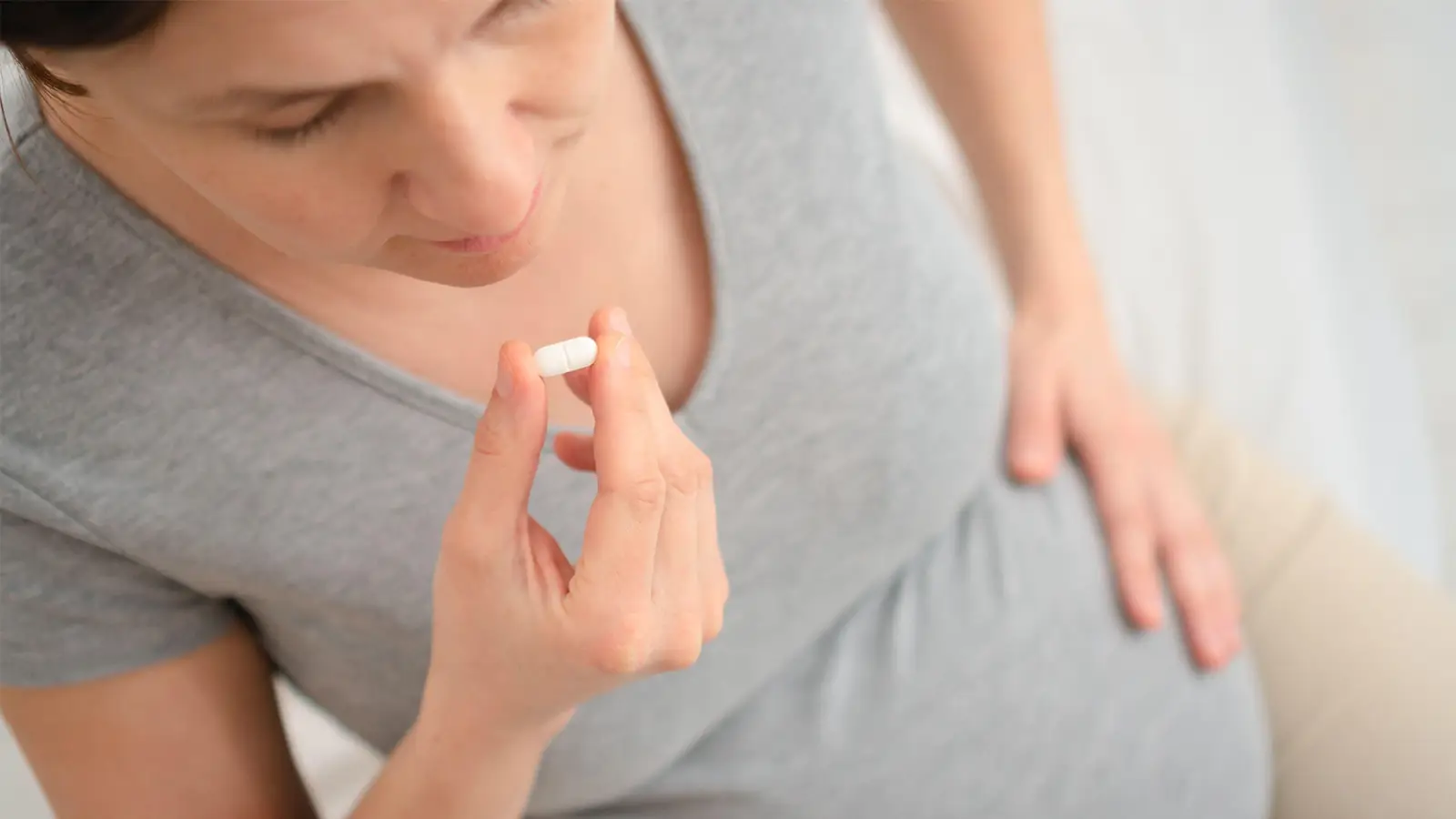
- A meta-analysis found no clear link between prenatal antidepressant exposure and autism or ADHD in kids after adjusting for maternal mental health and other factors.
- Before accounting for confounding variables, the study found a modest association between antidepressant use during pregnancy and autism or ADHD.
- The study evaluated more than 600,000 pregnancies with antidepressant use.
Children exposed to prenatal antidepressants had an increased risk of autism or attention deficit-hyperactivity disorder (ADHD) that was not significant after adjusting for confounding factors, a systematic review and meta-analysis showed.
Overall, prenatal antidepressant use was associated with a modestly increased risk of neurodevelopmental disorders in offspring (relative risk [RR] 1.13, 95% CI 1.08-1.18, P=0.051), reported Wing Chung Chang, MD, of the University of Hong Kong, and co-authors.
This was mainly driven by increased risks for autism (RR 1.69, 95% CI 1.24-2.30, P<0.0001) and ADHD (RR 1.35, 95% CI 1.24-1.47, P<0.0001), Chang and colleagues wrote in Lancet Psychiatry.
However, similar associations were found for preconception exposure. They also emerged for paternal use of antidepressants, suggesting the relationships reflected parental mental health and genetics, not antidepressants, the researchers said.
No significant difference in autism risk was found between high- and low-dose antidepressant exposure, they noted. Both selective serotonin reuptake inhibitor (SSRI) and non-SSRI antidepressants were associated with increased risks for autism and ADHD.
Prenatal antidepressants were not associated with intellectual disabilities, motor disorders, or speech and language disorders, they added.
“Our study showed a small association between prenatal antidepressant exposure and ADHD or autism spectrum disorder, which was attenuated or became non-significant after adjusting for confounding factors — in particular, confounding by treatment indication (i.e., underlying maternal psychiatric illness),” Chang said in an email to MedPage Today.
“In other words, our findings do not provide strong evidence that prenatal antidepressant exposure causes neurodevelopmental disorders. Given the risk of untreated maternal depression in pregnant women and their offspring, antidepressant treatment should be continued for pregnant women with moderate to severe depression,” he stated.
“Our results also indicate that optimizing both maternal and paternal mental health is essential for the child’s long-term neurodevelopment,” Chang added.
Antidepressants are facing growing scrutiny from the Trump administration. Earlier this month, HHS Secretary Robert F. Kennedy Jr. announced initiatives to reduce SSRI prescribing. Last year, a panel selected by former FDA Commissioner Marty Makary, MD, MPH, raised concerns about risks associated with SSRI use during pregnancy, though experts disputed those claims.
Evidence about the relationship between prenatal antidepressant exposure and autism risk is mixed, with some studies finding no clear link and others suggesting a possible association.
Previous meta-analyses were limited by small study numbers and insufficient assessments of confounding by treatment indication, Chang noted. Until now, no reviews have comprehensively evaluated antidepressant classes and maternal and paternal antidepressant exposure shortly before or during conception, he added.
“This is a well-done meta-analysis, though they bury the lede,” noted David Mandell, ScD, of the University of Pennsylvania Perelman School of Medicine in Philadelphia, who wasn’t involved with the study.
“Most of the studies they include used administrative data to assess the association between antidepressants and neurodevelopmental disorders. In these data, it is very difficult to separate out the effects of medications from the reasons that people take those medications,” Mandell told MedPage Today.
“The most important part of their analysis is when they compare women diagnosed with depression and anxiety who don’t take an SSRI with women who do,” he pointed out. “There they find no association. They also don’t find any dose response, a critical element when interpreting causality, which further suggests that they are measuring the association between maternal psychiatric disorder and neurodevelopment, not the effects of SSRIs per se.”
Chang and co-authors identified 37 studies involving 648,626 antidepressant-exposed and nearly 25 million unexposed pregnancies. Among nine studies that reported mean maternal age, the weighted average was 28.8 years.
When confounding by indication was minimized, only amitriptyline and nortriptyline were associated with an increased risk of ADHD (amitriptyline RR 1.74, 95% CI 1.00-3.03) or autism (amitriptyline and nortriptyline RR 2.02, 95% CI 1.32-3.10), Chang and colleagues said. No significant associations were found for specific SSRIs or serotonin-norepinephrine reuptake inhibitors (SNRIs).
The association between autism and prenatal exposure to any antidepressants or SSRIs was not significant in analyses using sibling-matched controls, suggesting shared familial factors may play a role, the researchers added.
A strength of the meta-analysis is its adjustment for the existence of maternal mental health conditions, “a major factor only recently taken into account,” noted Gisele Apter, MD, PhD, of the University Rouen Normandy in France, and co-authors, in an accompanying editorial.
This study adds knowledge and “confirms some of the pre-existing knowledge on the use of antidepressants during pregnancy: that they should continue to be taken as they protect maternal mental health and do not harm fetal development,” the editorialists wrote. “This result is of considerable impact after many contradictory and controversial studies.”
The analysis had several limitations, Chang and colleagues said. There was substantial heterogeneity between studies, and data about socioeconomic status, lifestyle risk factors, and low birth weight were lacking. Women prescribed antidepressants may have more severe depression than those not taking medication and residual confounding may remain.
Source link : https://www.medpagetoday.com/neurology/autism/121279
Author :
Publish date : 2026-05-14 22:30:00
Copyright for syndicated content belongs to the linked Source.