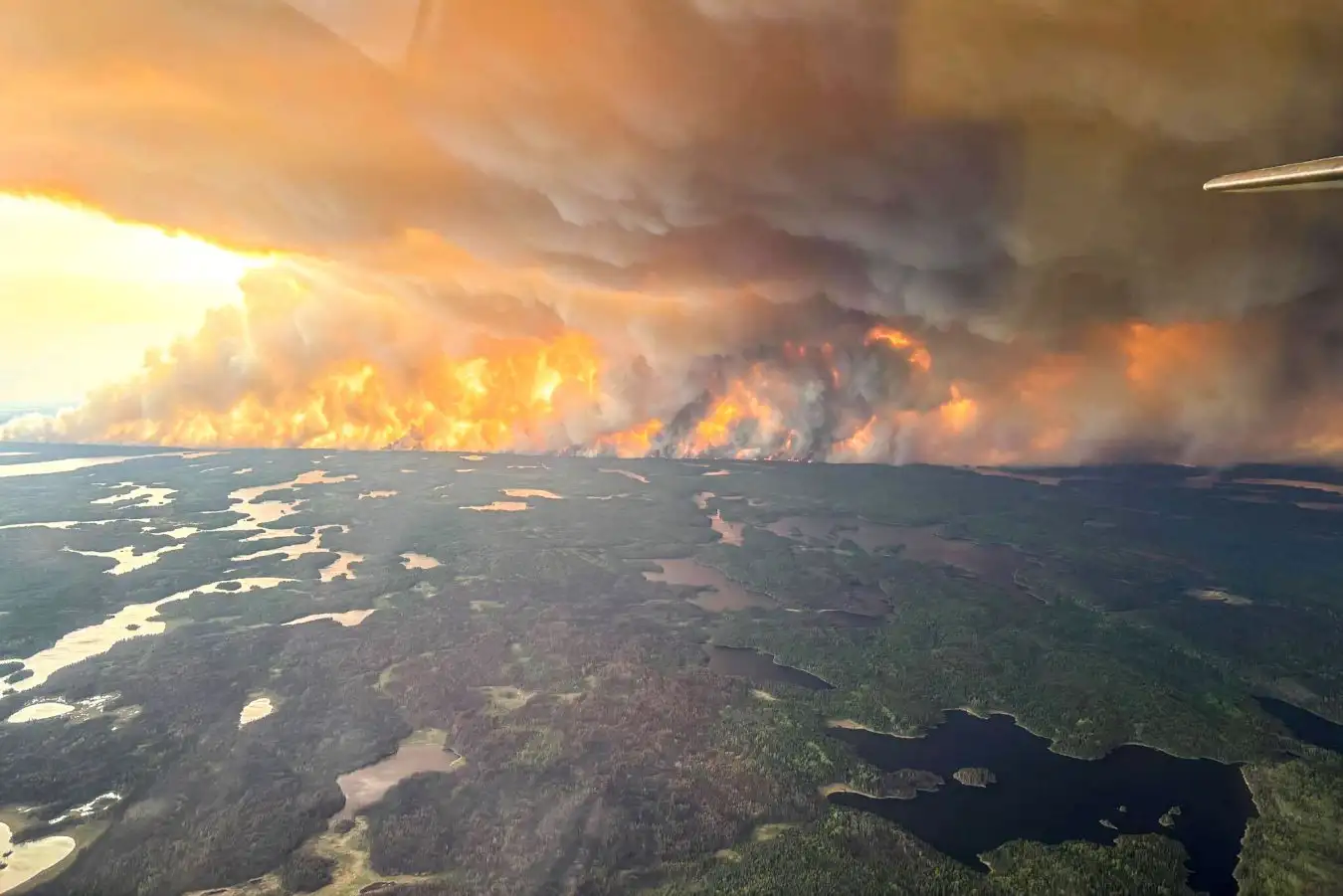
A wildfire rips through the boreal forest in Manitoba, Canada, in 2025
Anadolu via Getty Images
The wildfires that have been raging in many places around the Arctic in recent years could be contributing much more to global warming than currently thought. It has been assumed that what’s burning is mostly recent plant growth, but a study of soil cores from around the Arctic and boreal regions has shown that these fires are igniting stored carbon that is up to 5000 years old.
“Soil combustion could unlock long-stored carbon from soils that have been considered previously as carbon sinks,” says Meri Ruppel at the Finnish Meteorological Institute in Helsinki. Currently, climate models don’t take the release of this ancient carbon into account.
Plants grow slowly in the cold conditions of the Arctic, but their remains can accumulate in soil in forms such as peat, building up over centuries and millennia. This means soils in the Arctic and in the boreal forests nearby have been acting as a carbon sink – that is, helping to remove carbon dioxide from the atmosphere.
But with fires becoming larger and more frequent in the Arctic region, this may be changing. To investigate, Ruppel’s team collected soil cores from a number of areas where there have been recent fires.
The cores show that, in many places, the rapid burning of the surface vegetation is triggering much slower smouldering of old organic materials in the soil, releasing lots of soot, or black carbon, as well as CO2.
Black carbon absorbs heat from the sun, so it warms the atmosphere directly. What’s more, in cold regions, it can be deposited on ice or snow, darkening the surface and causing melting that wouldn’t have happened otherwise.
“Not surprisingly, we found that the age of combusted carbon is different in different environments since the organic soil depth and the depth of burn vary,” Ruppel told a meeting of the European Geosciences Union in Vienna last week.
The risk of ancient carbon release tends to increase towards the Arctic, she said, as Arctic soils are shallower and organic matter builds up closer to the surface. For instance, in the Northwest Territories in Canada, fires are burning several centimetres down into the soil and releasing carbon stored up to 400 years ago.
In Greenland, fires are burning 10 centimetres down into the soil, on average, releasing carbon that is up to 560 years old. In places, fires have burned 15 cm down, releasing carbon dating back 1000 years.
In the boreal forest in Quebec, Canada, the team found places where fires have released carbon from 5000 years ago. “But this was not at all widespread,” said Ruppel at the meeting.
The big question is just how much ancient carbon is now being released by fires. Ruppel said this work is just the start and much more needs to be done to get an idea of the quantities involved.
“I think her work makes an important point that people need to hear about,” says Sandy Harrison at the University of Reading in the UK, who was at Ruppel’s talk. “It is clear that there is a lot of old carbon in high-latitude soils and peats. As we move into new fire regimes that are destroying the top-soil layers and also burning in peatlands, there will be a release of old carbon.”
Topics:
Source link : https://www.newscientist.com/article/2526362-arctic-fires-are-releasing-carbon-stored-for-thousands-of-years/?utm_campaign=RSS%7CNSNS&utm_source=NSNS&utm_medium=RSS&utm_content=home
Author :
Publish date : 2026-05-13 18:00:00
Copyright for syndicated content belongs to the linked Source.