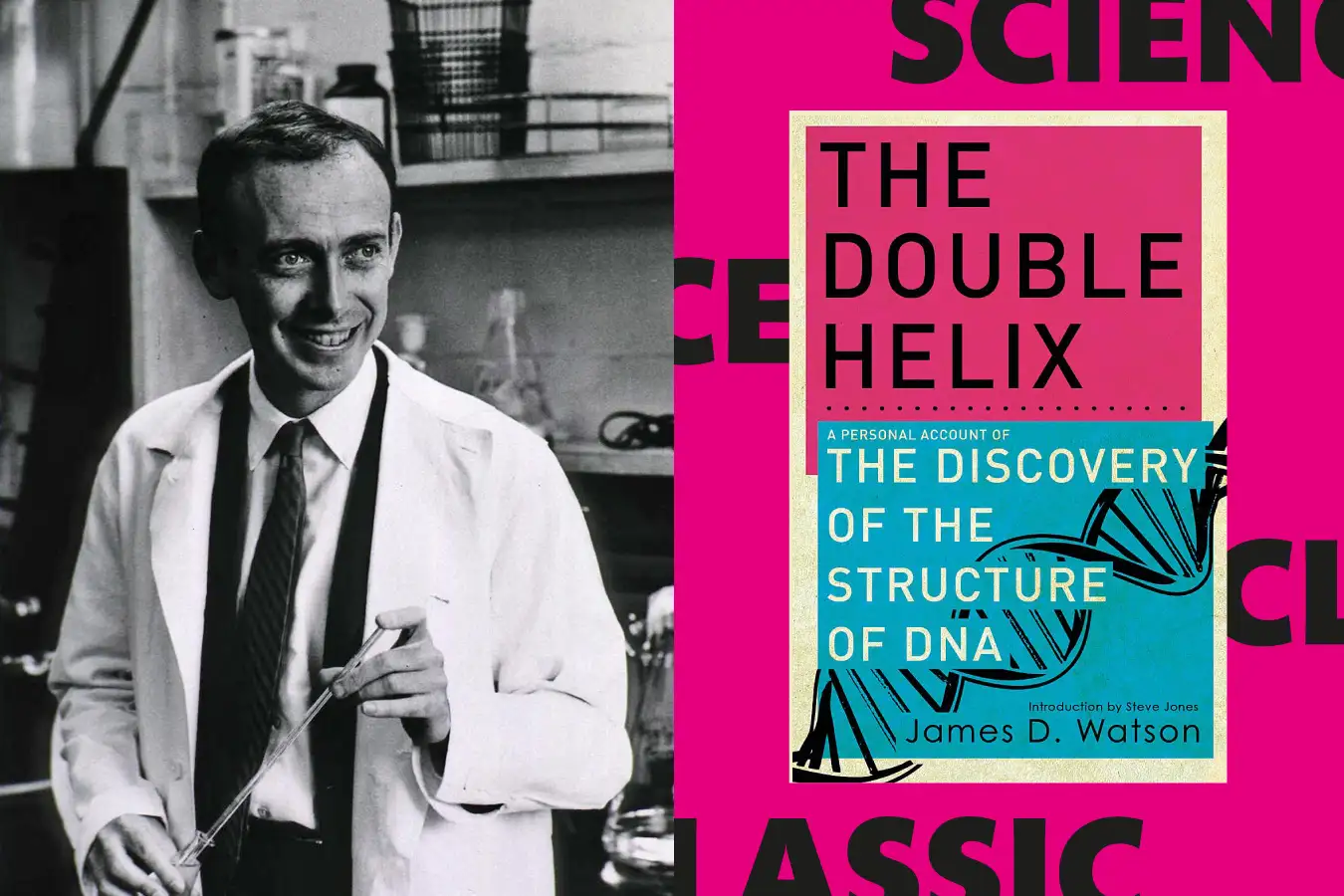
James Watson’s The Double Helix was first published in 1968. How does it stand the test of time?
There’s a strong case to be made that The Double Helix by James Watson is one of the greatest science books of all time– but I can’t recommend that anyone actually read it. Many parts of it are distasteful, especially in light of the odious old man that Watson became.
“The Double Helix reinvented the scientific memoir. Watson rendered science not as a bloodless march from Fact to Fact, but as a passionate adventure whose direction depends on the individual personalities of scientists,” says Nathaniel Comfort at Johns Hopkins University, who is writing a biography of Watson. “That was really new, and it drew countless young people into science, men and women alike, which was a big part of his intent with the book.”
The Double Helix is Watson’s account of how, between 1951 and 1953, he came to work on the structure of DNA with Francis Crick. The pair eventually cracked it with the help of data from Rosalind Franklin and her boss Maurice Wilkins– though if you believe Watson’s account it was pretty much all down to his brilliance.
The thing is, you shouldn’t believe Watson’s account. “It’s a novelisation, it’s not a memoir,” says biologist turned science historian Matthew Cobb, whose biography of Crick came out last year.
“The confounding thing about the book is that it’s a blend of fact and fiction, yet Watson doesn’t tell us this,” Comfort says.
Cobb says Watson was heavily influenced by the 1966 book In Cold Blood by Truman Capote, a dramatised account of a series of murders seen by some as the first “non-fiction novel”. Watson seems to have realised his book needed a villain, too, and he chose Rosalind Franklin.
“The real villain was probably Wilkins,” says Cobb.
When it came out in 1968, Watson’s disparaging and sexist remarks about “Rosy”, as he calls her, were very much in line with the zeitgeist. “I read the book as a science student when it first came out, and accepted its sexist attitudes as the daily normality that I encountered in the laboratory,” says Patricia Fara, a historian of science at the University of Cambridge.
But readers today will find it infuriating, or ought to. And that’s far from the only issue with the book. Watson is rude about pretty much everyone, and to me much of it comes across as nasty and schoolboyish, rather than gentle, warm-hearted digs at friends and colleagues.
“He’s amazingly immature,” says Cobb, who points out that Watson started university at age 15. “He was particularly obnoxious as a young man– and became obnoxious in different ways as he grew older.” Cobb is referring to Watson’s racist views that led to him being sacked in 2007.
But Comfort thinks the book has been almost universally misread. “What people miss in Watson’s book is that it’s a comedy, from its first, classic line, ‘I have never known Francis in a modest mood’, to its last, ‘I was twenty-five and too old to be unusual’.”
Comfort could well be right. For instance, one of the scenes that I find really jarring is a confrontation with Franklin where Watson says he was afraid she would hit him. This does make more sense if it is seen as an attempt at humour– but to me it’s not funny at all.
“I guess I should be explicit that all of the jokes definitely do not land,” says Comfort. “Many fall flat as a pancake.”
To give credit where it’s due, Jim Watson’s portrayal of himself is largely unfavourable too. “The Jim character is lazy, vain, clumsy, dishonest, deceptive, horny– an unreliable narrator in every sense,” says Comfort. In fact, Watson wanted the title of the book to be Honest Jim, which was meant to be ironic.
This unreliability may extend to the depiction of him essentially nicking Franklin’s data. Cobb and Comfort have found papers suggesting Crick and Watson’s relationship with Franklin and Wilkins was far more collaborative than the book portrays.
What cannot be denied is that for all its flaws, Watson did succeed in writing a gripping account, which is no mean feat for a book about chemistry. The Double Helix was a bestseller estimated to have sold over a million copies.
“It was a book that was incredibly influential at the time,” says Cobb.
“Is it one of the greatest scientific books? Yes, in terms of sales and impact,” says Fara. “But it can’t really be called ‘great’ when it overtly promotes an ethical position antithetical to science’s values and presents a false image of how research is conducted.”
Is still it worth your time today? Cobb’s recommendation is the opposite of mine. “I encourage everybody to read it, but to read it as a novel. Although sometimes you get very cross with the characters, because they’re not very nice.”
Topics:
Source link : https://www.newscientist.com/article/2519886-why-the-double-helix-is-such-an-extraordinary-but-infuriating-book/?utm_campaign=RSS%7CNSNS&utm_source=NSNS&utm_medium=RSS&utm_content=home
Author :
Publish date : 2026-04-08 12:00:00
Copyright for syndicated content belongs to the linked Source.