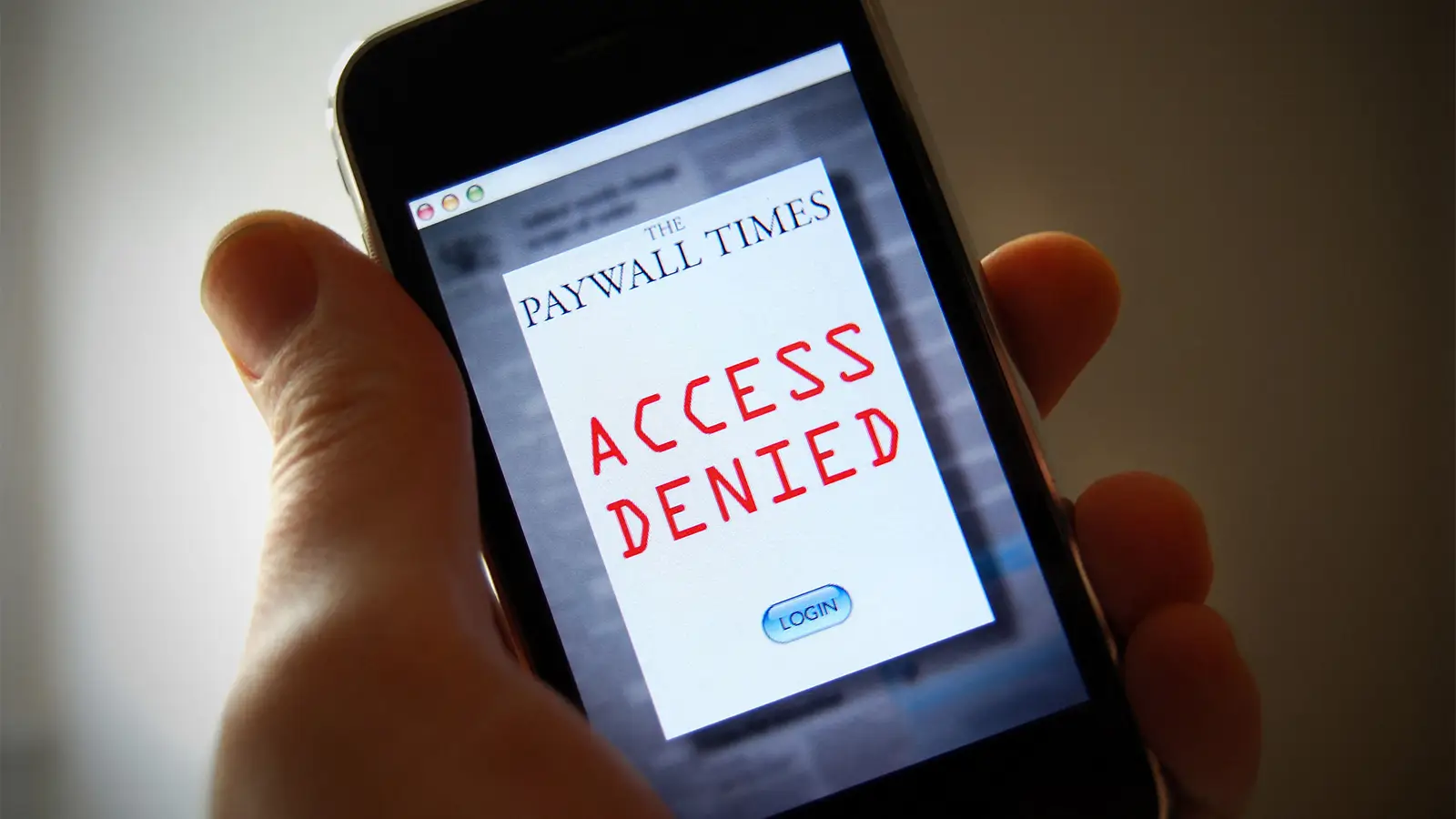
One of the small ironies of modern medical research reveals itself during a routine PubMed search. A promising article appears, often accompanied by two links: one leading to the publisher’s site and featuring only an abstract, the other — sometimes — to a freely accessible version. If the research is publicly funded, surely it should be publicly available. But, depending on the source, the full paper is often guarded by a paywall.
Paywalls and registration walls often come up for news coverage of research too.
One of my daily rituals is reviewing the morning newsletters from various health and clinical news sources, which provide concise summaries of newly published medical and policy research. These are, in many ways, a valuable service — curated, timely, and clinically relevant.
But there is also a recurring frustration. Many of these summaries include a direct link to what appears to be the full news article, inviting the reader to “learn more.” Too often, that invitation leads not to knowledge, but to a paywall. My own university library does not subscribe to all news sources, and I suspect I am not alone.
To be clear, I do not begrudge publishers their business model. They are, after all, in the business of making money. But the experience is akin to being shown the cover of a book that you cannot open. At times, I can “backdoor” my way to similar content by searching for related publications that are not behind a paywall. But this workaround underscores the larger issue: access to publicly relevant research should not depend on one’s skill at navigating around barriers.
If the morning newsletter experience represents the daily frustration of being led to a locked door, another encounter illustrates the cost of opening it.
The Cost of Access – and Lack Thereof
Recently, I attempted to access a paper on fentanyl from a journal published by Taylor & Francis. The price of admission? $104 — for a single paper.
Let that sink in. This was not a textbook, a comprehensive database subscription, or even a bundled issue of a journal. It was one paper — presumably of interest to clinicians, policymakers, and researchers grappling with one of the most pressing public health crises of our time.
The irony is difficult to ignore. Fentanyl, a substance at the center of national concern, is the subject of intense research, much of it supported directly or indirectly by public funding. Yet, access to that research can come with a price tag that places it out of reach for many who might benefit from understanding it.
If the price itself raises eyebrows, the nature of the content raises an even more fundamental question. As I recall, the article appeared in the “Expert Opinion” section in the journal — a format that emphasizes expert interpretation rather than original research. In other words, it was, quite literally, an opinion. Which leads to an uncomfortable thought: Why should I pay a premium price to read someone else’s opinion — particularly when the underlying science may already belong to the public?
To be sure, expert synthesis has value. A well-crafted review can save readers time, highlight key findings, and provide meaningful context. But when access to that synthesis is priced at levels that restrict readership, one must ask whether the model serves the advancement of knowledge — or its containment.
An even more egregious example of this is evidenced by the registration wall stymieing access to health policy statements in a top medical journal. In March 2025, FDA Commissioner Marty Makary, MD, MPH, and his (now former) top deputy, Vinay Prasad, MD, MPH, announced their new approach to COVID-19 vaccine approvals in a “Sounding Board” piece in the NEJM. In the February 2026 NEJM piece, Makary and Prasad said that FDA will drop its standard of requiring two rigorous studies to win approval for new drugs. While the content is technically “free,” accessing it still requires the price of an email address and other personal information. Shouldn’t essential science communication from federal leaders be made as easily accessible as possible?
Structural Inequity
It is worth acknowledging an uncomfortable truth: my own experience with access to the medical literature may not be typical. As a longtime university faculty member, I have benefited from a well-funded library system that provides access to a vast array of journals. Over time, this access becomes almost invisible — the reader clicks, and the article appears. It is easy to assume this is simply how the system works.
But that assumption does not hold. I am reminded of this whenever a former student of mine reaches out and asks if I can retrieve a paper she cannot access on her own. The same article that opens seamlessly for me is, for her, locked behind a paywall.
This contrast highlights a structural inequity. Access to scientific knowledge is not determined solely by curiosity or professional need, but by institutional affiliation. Those within academic or well-resourced systems operate with a kind of “all-access pass,” while others must navigate a fragmented and often costly landscape.
Access, Eventually
Another barrier, less visible but equally frustrating, is the use of publication embargoes. Even when research is destined to become publicly accessible, access is often delayed by embargo periods — sometimes 6 months, sometimes longer. In fast-moving areas of medicine, yesterday’s data can quickly become outdated. Waiting months for access to research that has already been completed and reviewed undermines the very purpose of disseminating scientific knowledge.
This reality also complicates the widely held belief that federally funded research is freely available to the public. In principle, that belief has merit. U.S. policy does require that the results of federally funded research be made publicly accessible. In practice, however, “accessible” has often meant eventually accessible.
Although recent policy updates aim to eliminate embargo periods and provide immediate access upon publication, implementation remains uneven. The result is a system in transition — one that aspires to openness, but continues to operate with legacy constraints. At a time when evidence-based practice is increasingly emphasized, ensuring timely and equitable access to that evidence is a matter of professional and public responsibility.
Identifying these issues is, in many ways, the easy part. The more difficult task lies with those who shape, manage, and profit from the current system — publishers, policymakers, and the intermediaries who connect readers to research. Each plays a role in determining how scientific knowledge is disseminated, accessed, and ultimately used. Collectively, this reflects a system that is not fully aligned with the needs of clinicians, educators, and the public.
This is not a call to dismantle the system, nor to disregard the legitimate economic realities of academic publishing. It is, rather, a call for reflection.
Those with influence over the dissemination of scientific knowledge would do well to ask a simple question: does the current model serve the broader goals of advancing science and improving public health — or does it, at times, stand in the way?
The answer may not be simple. But the question is worth asking.
Paul L. Doering, MS, is a distinguished service professor of Pharmacy Practice, Emeritus, in the College of Pharmacy at the University of Florida in Gainesville.
Source link : https://www.medpagetoday.com/opinion/second-opinions/120638
Author :
Publish date : 2026-04-04 16:00:00
Copyright for syndicated content belongs to the linked Source.