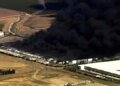
A case study of an elderly man exposed to dense smoke from a forest fire in China revealed extensive black bronchial casts in both lungs.
Bronchial casts are solid branching structures, made of mucus and other materials, that mirror the shape of the airways they block. Xiangdong Mu, MD, of Beijing Tsinghua Changgung Hospital, told MedPage Today the presentation was “extremely rare,” while also emphasizing the importance of properly assessing patients for such a possibility.
When a patient in acute respiratory failure requiring mechanical ventilation develops “marked elevation” of airway pressure, a “timely bronchoscopy” should be conducted, Mu said.
“Fire smoke inhalation can cause severe bronchial casts leading to life-threatening acute respiratory failure,” Mu noted.
An 87-year old man came to the emergency department with severe breathing difficulties, having inhaled thick smoke for several hours, according to the “Images in Clinical Medicine” published in the New England Journal of Medicine by Mu and Yuling Wang, MMed, of the Daxing Teaching Hospital of Capital Medical University in Beijing.
The man’s respiratory rate was 29 breaths per minute, and he had low oxygen saturation at 85% on room air.
The medical team initially suspected airway thermal injury or bronchial stenosis. However, physical exam showed no evidence of burns in the airway.
Listening to the sound of his breathing, the team heard crackles all over the lungs. A chest x-ray likewise showed diffuse patchiness of interstitial infiltrates in both lungs. The patient’s carbon monoxide blood level was normal.
When the patient’s breathing worsened, he was intubated and placed on mechanical ventilation. Because of the difficulty getting air into his lower airways, the team chose to do flexible bronchoscopy to assess for blockages to his airway — an uncommon procedure, though standard of care, said Mary Meyer, MD, MPH, an emergency physician at The Permanente Medical Group in Dublin, California, and contributing writer for MedPage Today.
The patient was diagnosed with bronchial casts made from particulate matter from forest fire smoke. When the lungs get plugged with this sticky material, there’s likely not only mechanical obstruction but also inflammation and bronchospasm that further cut off the airway, Meyer said.
“So the basic process of breathing is completely undone,” Meyer told MedPage Today.
The man’s bronchial casts were removed using a cryoprobe. This flexible cooling device used during bronchoscopy, Mu noted, “rapidly freezes and adheres to bronchial casts, allowing atraumatic, en bloc removal of large casts.”
Even for very elderly patients, the procedure is “safe and effective, and in this patient’s case, was life-saving,” he said.
In reflecting on the case, Mu noted that the patient lived in a community near the forest and was a smoker.
“The fire occurred in winter with dry weather … and was likely accidentally caused by smoking,” Mu said. “Due to old age and limited mobility, [the patient] was exposed to dense smoke for a prolonged period near the fire, leading to severe inhalation injury.”
This extent of exposure is unusual in someone who is not a firefighter, Meyer said. She called the case a “graphic demonstration of an emergent concept: the idea that wildfire smoke exposure in lay people can be severe and have dramatic impacts on health.”
“It’s not simply a risk for firefighting professionals or individuals trapped within or in the vicinity of burning buildings,” she told MedPage Today.
Wildfires are increasingly occurring at the “wildland urban interface,” she said, and their smoke is “significantly more toxic” than ambient air pollution.
“Increasingly, we are seeing people breathing in not just organic but also inorganic matter … like burned cars and tires and computer parts and trees,” Meyer said. “Those particles go down into the lower lungs. Because they’re so tiny, they can get really far down, where they cause a horrific reaction.”
The patient was extubated 3 days after the casts were extracted and treated for concurrent pneumonia. He was discharged after 1 week in the hospital, and 2 weeks later his breathing had returned to normal.
“However, as an elderly smoker, this acute smoke inhalation event may still cause some adverse impact on his long-term pulmonary function,” Mu noted.
Source link : https://www.medpagetoday.com/casestudies/pulmonology/120968
Author :
Publish date : 2026-04-27 15:37:00
Copyright for syndicated content belongs to the linked Source.