
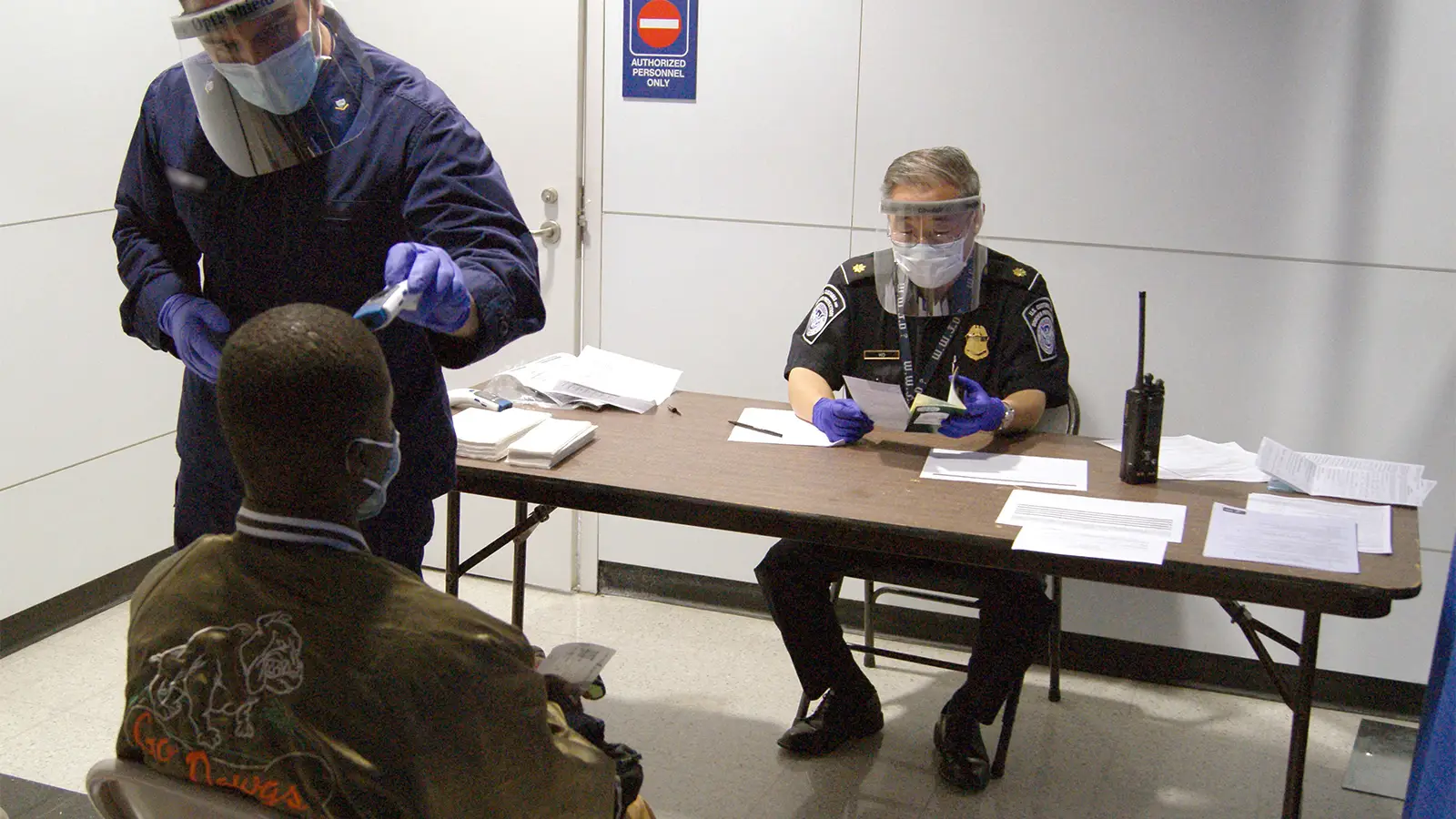

In response to the Ebola outbreak linked to scores of deaths, the CDC is blocking entry to the U.S. from people who have been in Ebola-affected African nations.
Non-U.S. passport holders will not be allowed entry if they’ve spent any time in the prior 21 days in the Democratic Republic of the Congo, Uganda, or South Sudan, regardless of country of origin.
The order, invoked under the public health law Title 42, “is necessary to protect the health of the United States from the serious risk posed by the introduction of Ebola disease into the United States,” said the order signed by Jay Bhattacharya, MD, PhD, the senior official carrying out the duties of CDC director.
The order will take effect for the next 30 days.
As of Monday, more than 300 suspected cases and 118 deaths in Congo and one death in neighboring Uganda have been linked to the large Ebola outbreak that the World Health Organization (WHO) has declared a public health emergency of international concern (PHEIC). The current outbreak is caused by the Bundibugyo strain, which has no approved vaccines or therapies.
At least seven Americans have been exposed in the outbreak, according to the CDC, one of whom is a symptomatic American doctor who tested positive on Sunday after working in Congo. The physician has been sent to Germany for care.
The virus is not airborne but spreads between people through direct contact with infected blood, secretions, and other bodily fluids, as well as contaminated surfaces.
During a briefing Monday, Satish Pillai, MD, of the CDC, deflected a question about how the CDC and federal health authorities would handle travel concerns or enhance screening during next month’s World Cup soccer tournament, hosted by the U.S., Canada, and Mexico. Congo’s team is slated to play in Houston June 17 and Atlanta June 27.
“This is an evolving situation, and we’re going to continue to work with our interagency colleagues to lock down the final plans on that,” he said.
The CDC recommends people reconsider nonessential travel to Congo and cautioned those traveling to the nation’s northeastern Ituri province — the outbreak’s epicenter — to monitor themselves for Ebola symptoms while there and for 21 days after leaving. Travelers to Ituri should avoid symptomatic people and not use healthcare facilities for non-urgent medical care. The U.S. State Department issued a strengthened travel advisory Sunday warning people not to travel to Congo.
‘Diseases Don’t Recognize Passports’
The Infectious Diseases Society of America (IDSA) expressed caution against travel crackdowns.
“International interventions like quarantining people who may have been exposed to Ebola, or limiting travel, can be valuable if they are part of a carefully coordinated, scientifically informed process done in coordination with other countries and global health organizations,” said IDSA CEO Jeanne Marrazzo, MD, in a statement. But “public health policies that single out non-U.S. citizens won’t prevent viruses from crossing our borders. Diseases don’t recognize passports.”
WHO said there should be no international travel by Bundibugyo virus disease contacts or cases, unless it is part of a medical evacuation. Under the PHEIC announcement, the WHO called for exit screening of everyone at international airports, seaports, and major land crossings in affected countries for potential Bundibugyo symptoms. Countries without cases but that border Congo or Uganda should increase their surveillance.
Countries that don’t share borders with either affected nation shouldn’t close borders, conduct airport entry screening, or implement travel and trade restrictions. “No country should close its borders or place any restrictions on travel and trade,” the WHO said in its PHEIC announcement. “Such measures are usually implemented out of fear and have no basis in science.”
The U.S. left the WHO in January, and the Trump administration has slashed funding for public health programs in Africa in the last year. During three recent briefings, CDC officials mentioned no coordination with the WHO to manage the outbreak.
“The United States needs to make a sustained investment in public health and research for preventing, monitoring, and responding to infectious diseases here and abroad,” Marrazzo added. “We also need respectful, expert coordination with peers across the globe.”
Source link : https://www.medpagetoday.com/publichealthpolicy/publichealth/121327
Author :
Publish date : 2026-05-18 21:45:00
Copyright for syndicated content belongs to the linked Source.