
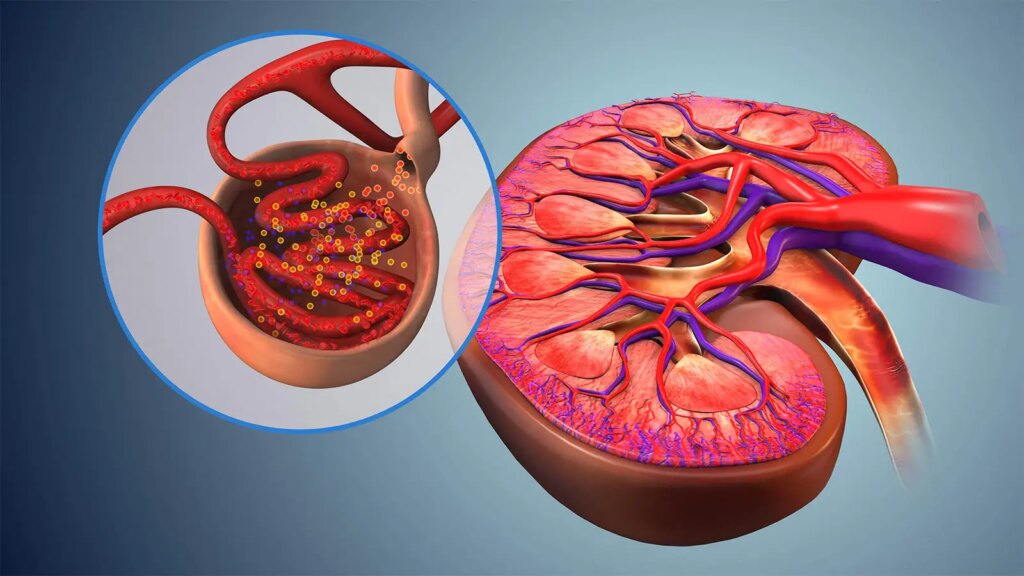
- IgA nephropathy is a rare condition caused by excessive buildup of immunoglobulin A in the kidneys, slowly but progressively degrading renal function to the point of requiring dialysis or transplantation.
- Treatment has historically focused on manifestations such as high blood pressure, but more targeted therapies have been introduced in recent years.
- This phase III trial with telitacicept, a dual-action biologic drug that inhibits B-cell activating factor and the so-called APRIL protein, showed that it outperformed placebo in reducing proteinuria in a 39-week interim analysis.
Patients with immunoglobulin A (IgA) nephropathy had less protein in their urine — a key surrogate marker for the renal impairment caused by the condition — after treatment with a dual-acting biologic agent that inhibits two regulatory cytokines, researchers said.
Urinary protein-to-creatinine ratio fell by 58.9% after 39 weeks of therapy with telitacicept, a drug already approved in China for lupus, compared with an 8.8% decline in those treated with placebo injections, according to Hong Zhang, MD, PhD, of Peking University First Hospital in Beijing, and colleagues.
Telitacicept also appeared to be safe. Few adverse events tracked in the study were substantially more common with the drug versus placebo; the only exceptions were injection site reactions and some diminution in titers of other immunoglobulins, the researchers reported in the New England Journal of Medicine.
These results come from a prespecified interim analysis; the full trial is slated to last out to 104 weeks, with the annualized rate of estimated glomerular filtration rate (eGFR) decline at that point as the final primary outcome.
IgA nephropathy stems from a still-mysterious buildup of immunoglobulin A in the kidneys. It’s considered the most common type of primary glomerulonephritis in the world and among the most frequent causes of renal failure in young people. The estimated U.S. prevalence is roughly 60 per 100,000 population with somewhat higher rates seen in eastern Asia.
Yet despite this relative rarity, IgA nephropathy has attracted considerable attention from drug developers. That’s partly because, historically, treatment has focused on its later-stage manifestations such as high blood pressure; targeted therapies focusing on inflammatory and immune system pathways have only come along in the last few years, with the 2024 approval of the complement inhibitor iptacopan (Fabhalta), followed last year by sibeprenlimab (Voyxact), an inhibitor of the cytokine known as “a proliferation-inducing ligand” (APRIL). Three other drugs also carry a formal IgA nephropathy indication, a delayed-release form of budesonide (Tarpeyo), the endothelin inhibitor atrasentan (Vanrafia), and the endothelin/angiotensin II blocker sparsentan (Filspari).
Telitacicept has a dual mechanism of action: a fusion protein, it targets B-cell activating factor (BAFF, also known as B lymphocyte stimulator or BLyS) along with APRIL. Both are thought to help drive the underlying pathology in IgA nephropathy as well as lupus.
These cytokines are also the target for a rival IgA nephropathy drug called atacicept, for which phase III trial results were reported last year. Its developer has applied for accelerated U.S. approval that could come within the next few weeks. Although telitacicept was developed in China and its clinical studies have been mostly conducted there, its sponsor, RemeGen, has laid the groundwork for FDA submissions.
In the current trial, called TELIGAN, Zhang and colleagues randomized 318 patients with persistent proteinuria in equal numbers to telitacicept or placebo, given in weekly injections for 39 weeks. In the second phase with results still to come, the dosing interval is extended to 2 weeks.
Just over half the sample were women; mean patient age was about 38. Disease duration averaged about 3 years. Mean eGFR values at baseline were about 75 mL/min/1.73 m2, with some 13% having values in the 30-45 mL/min/1.73 m2 range. Protein-to-creatinine ratio in urine averaged approximately 1.5 at enrollment, although with a more than 10-fold spread in the standard deviation, it varied greatly in the sample. Only a few patients were on steroids and just one was using an endothelin inhibitor.
Urinary protein-to-creatinine ratio declined quickly with the active drug, falling 20% in the first 4 weeks and 40% by week 13, whereas values in the placebo group hardly budged. Encouragingly, the ratio had not fully plateaued at the 39-week evaluation.
Values for eGFR were also tracked during this initial phase. Zhang and colleagues found that 27% of the placebo group saw eGFR fall by 30% or more by week 39, compared with 6% of those on telitacicept.
Some 90% of the telitacicept group and 79% of the placebo group had adverse events of some kind. Those rated as serious were seen in four patients assigned to the active drug (none considered attributable to the drug) and 13 of those on placebo.
Infections occurred at similar rates in the two arms. However, half of the telitacicept group developed injection site reactions (two serious) compared with 14% of the placebo group. Levels of immunoglobulin G and M declined in about one-quarter of participants on telitacicept versus almost none receiving placebo. Also, nine patients on the active drug had weight gain, versus three on placebo.
Limitations included the trial’s conduct in China and the relatively short duration for this interim analysis.
Please enable JavaScript to view the comments powered by Disqus.
Source link : https://www.medpagetoday.com/nephrology/generalnephrology/121250
Author :
Publish date : 2026-05-13 21:00:00
Copyright for syndicated content belongs to the linked Source.