[ad_1]
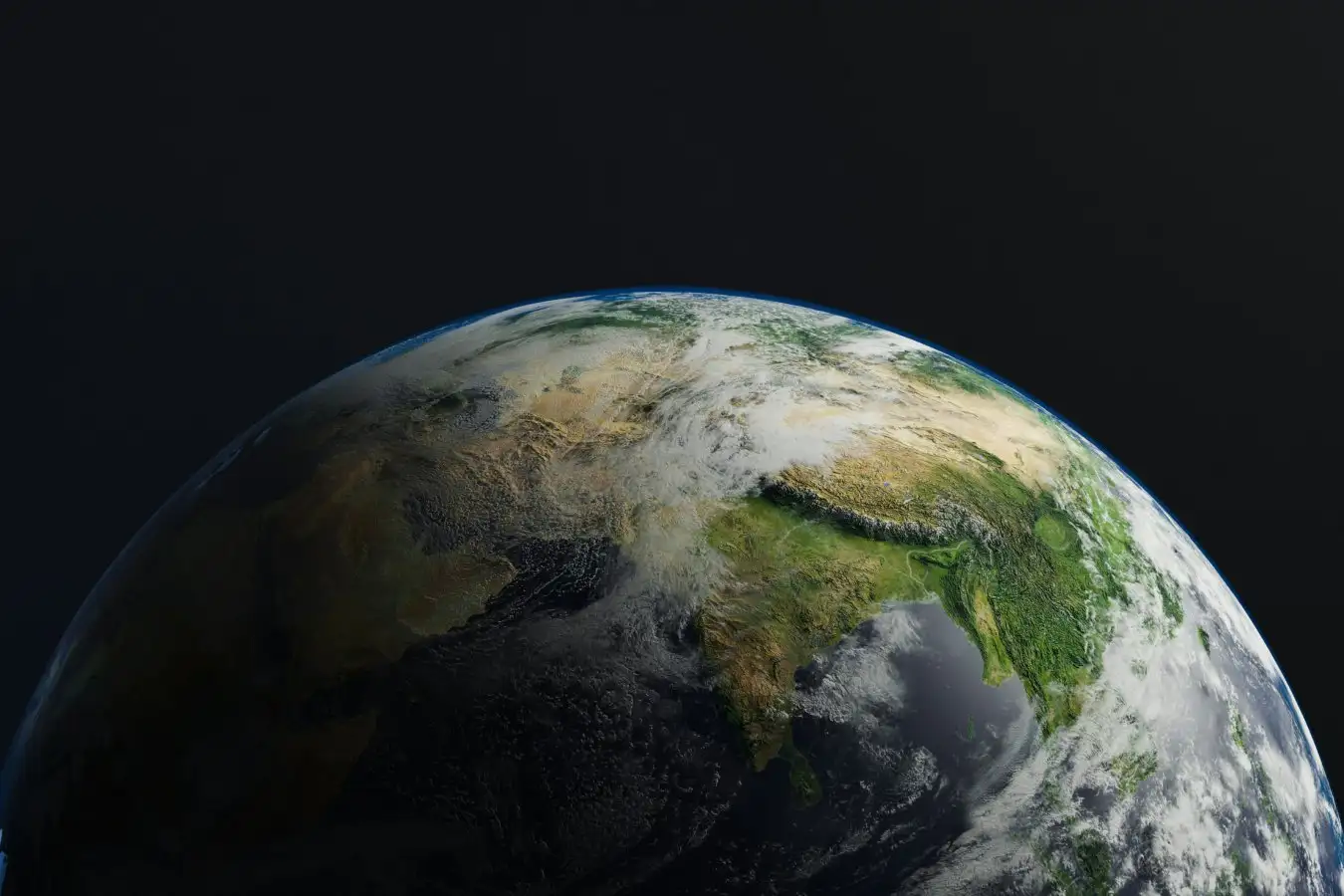
What might Earth look like in the far future?
Vimal-S/Unsplash
The sun is getting brighter and expanding as it ages, and will one day begin to cook our planet before engulfing it altogether – but complex life may be able to hold on in this hellish Earth scenario for much longer than we previously thought.
Estimates based on looking at other stars suggest that our sun is maturing into a red giant, a process that will destroy Earth in around 5 billion years, but it remains an open question as to how long the planet will remain habitable. As far as complex life goes, the last standing will be the vegetative biosphere – plants, both aquatic and terrestrial. Their ability to continue thriving will be mediated in part by the temperature of the planet, but mainly by the levels of carbon dioxide, which is necessary for photosynthesis.
“The thermostat on the planet is the greenhouse effect: it keeps the amount of CO2 in balance to roughly keep Earth’s temperature in a nice habitable range,” says Jacob Haqq-Misra at Blue Marble Space in Washington. When temperatures get very hot, CO2 is drawn down into rocks, lowering the amount in the atmosphere and letting some of that heat escape.
That means that, as the sun expands, CO2 becomes the main limiting factor for vegetation. Previous work has put the limit at about 10 parts per million of atmospheric CO2, below which plants will die off and only microbes will remain. That is expected to happen about 1.35 billion years from now. We don’t know exactly how long microbes will last after that, but it will probably be far longer.
However, a new set of simulations from Haqq-Misra and his colleague Eric Wolf suggests that plants might get an extra 500 million years. Their simulations were more detailed than those that had been performed in the past, and took into account the fact that certain plants, such as cacti and pineapples, use a type of photosynthesis called crassulacean acid metabolism, which is more efficient in gathering CO2 from the atmosphere. This could lower the CO2 starvation limit to 1 part per million and allow the vegetative biosphere to persist for more than 1.8 billion years.
“Life on Earth can do a lot more than we thought,” says Haqq-Misra. He points out that, when looking at such long timescales, evolution may also allow organisms to persist for even longer, as they will have plenty of time to adapt to the slow warming brought on by the expanding sun.
“These models suggest that we’re not really at the end of the complex biosphere on Earth as some less optimistic scenarios suggested, or the middle, but that we may be closer to the beginning,” says Edward Schwieterman at the University of California, Riverside.
That’s pleasant news on its own, but it also suggests that if we can take Earth as a representative example of a habitable world, our chances of finding a biosphere on another planet might be better than expected, he says. “This isn’t some completely philosophical question – there is a giant practical outcome, and that is that they are modeling the analogs to future Earth that we can potentially observe within the next two decades.”
Topics:
[ad_2]
Source link : https://www.newscientist.com/article/2530639-complex-life-on-earth-may-last-500-million-years-longer-than-expected/?utm_campaign=RSS%7CNSNS&utm_source=NSNS&utm_medium=RSS&utm_content=home
Author :
Publish date : 2026-06-18 12:00:00
Copyright for syndicated content belongs to the linked Source.