
[ad_1]
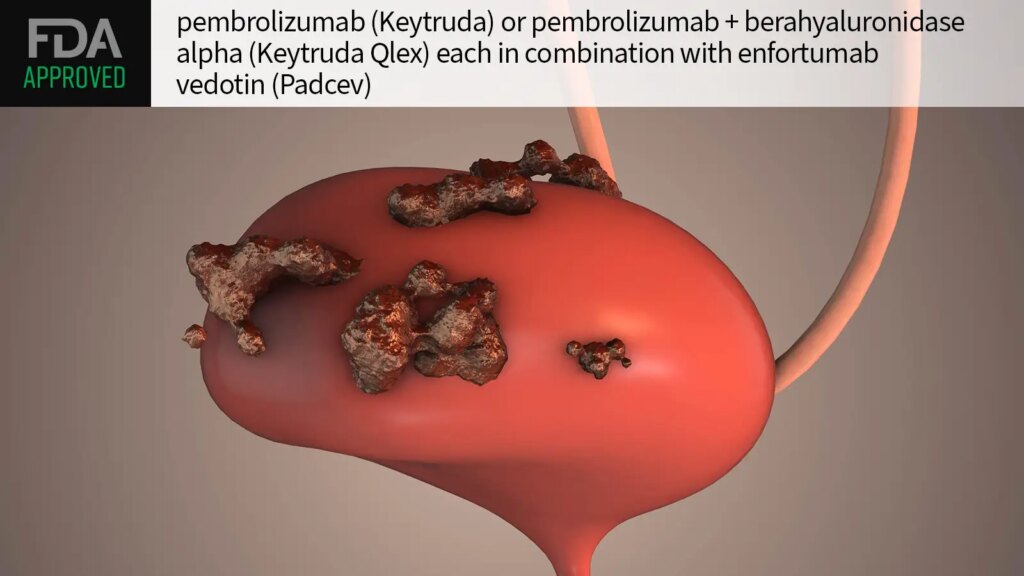
The FDA approved pembrolizumab (Keytruda) or pembrolizumab and berahyaluronidase alfa (Keytruda Qlex) in combination with enfortumab vedotin (Padcev) as perioperative treatment for adults with muscle-invasive bladder cancer (MIBC), regardless of cisplatin eligibility.
This extends the prior approval for the regimen in this setting from patients who are cisplatin-ineligible to all patients with MIBC who are candidates for cystectomy.
Approval for the expanded indication was based on data from KEYNOTE-B15/EV-304, an open-label, randomized, multicenter trial that included 808 patients with previously untreated MIBC who were candidates for radical cystectomy with pelvic lymph node dissection and were eligible for cisplatin-based chemotherapy.
In this study, median event-free survival (EFS) was not reached in those treated with the PD-1 inhibitor and antibody-drug conjugate versus 48.5 months for those treated with gemcitabine and cisplatin (HR 0.53, 95% CI 0.41-0.70, P<0.0001).
EFS rates at 12 months were 86% with the combination versus 75.4% with standard chemotherapy, and 79.4% and 66.2%, respectively, at 24 months.
Median overall survival (OS) was not reached in either treatment group, but patients in the intervention group had a 35% reduced risk of death compared with patients in the control group (HR 0.65, 95% CI 0.48-0.89), with 24-month OS rates of 89.6% and 81.3%, respectively.
“For muscle-invasive bladder cancer, a comprehensive treatment approach is important; the neoadjuvant phase can help shrink the tumor and target undetectable cancer cells early before surgery, while the adjuvant phase can be critical in eliminating residual, undetectable cancer cells following surgery,” said Christopher Hoimes, DO, of the Duke Cancer Institute in Durham, North Carolina, in a press release. “These data from [KEYNOTE-B15/EV-304] and this approval show that by delivering this regimen across both the neoadjuvant and adjuvant phases, without platinum-based chemotherapy, we can significantly reduce the risk of recurrence and improve overall survival — offering a potential new standard of care for adult patients with muscle-invasive bladder cancer.”
The overall safety profile observed in KEYNOTE-B15/EV-304 with pembrolizumab and enfortumab vedotin was similar to that seen in prior trials of this combination in bladder cancer.
The prescribing information for pembrolizumab includes warnings and precautions for immune-mediated adverse reactions, infusion-related reactions, complications of allogeneic hematopoietic stem cell transplantation, and embryo-fetal toxicity. The prescribing information for enfortumab vedotin includes warnings and precautions for skin reactions, hyperglycemia, pneumonitis/interstitial lung disease, peripheral neuropathy, ocular disorders, infusion site extravasation, and embryo-fetal toxicity.
Please enable JavaScript to view the comments powered by Disqus.
[ad_2]
Source link : https://www.medpagetoday.com/hematologyoncology/othercancers/122147
Author :
Publish date : 2026-07-10 19:03:00
Copyright for syndicated content belongs to the linked Source.