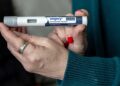
- The association between psoriasis and obesity is well established.
- In this randomized trial, patients with plaque psoriasis and overweight or obesity had significantly better outcomes in terms of skin clearance and weight loss with ixekizumab plus tirzepatide versus the psoriasis drug ixekizumab alone.
- The results may offer a new approach for the dual management of obesity and psoriasis.
Adding a dual GLP-1/GIP receptor agonist to the psoriasis drug ixekizumab (Taltz) significantly improved outcomes in adults with difficult-to-treat plaque psoriasis due to overweight or obesity, the open-label TOGETHER-PsO trial indicated.
At 36 weeks in the phase IIIb study, 27.1% of patients randomized to ixekizumab plus tirzepatide (Zepbound) achieved the primary endpoint — a composite of complete skin clearance and at least a 10% reduction in weight — as compared with 5.8% of patients assigned to ixekizumab alone (P<0.001), reported researchers led by Mark Lebwohl, MD, of the Icahn School of Medicine at Mount Sinai in New York City.
More patients assigned to tirzepatide also met criteria for complete skin clearance alone (Psoriasis Area Severity Index [PASI] 100), with respective rates of 40.6% and 29% (P=0.04). Further benefits were seen in skin-related quality of life and in triglycerides and blood pressure as well, according to findings published in JAMA Dermatology and presented at the Society for Investigative Dermatology annual meeting in Chicago.
No new safety signals were identified, with gastrointestinal tract events and injection site reactions being the most common adverse events (AEs).
“These findings support elevating the standard of care from treating psoriasis in isolation to a therapeutic approach that addresses the immunologic and metabolic (especially obesity) components of psoriasis-associated inflammation,” Lebwohl and colleagues wrote in conclusion.
“This trial complements the findings for TOGETHER-PsA, which demonstrated clinically meaningful improvement of psoriatic arthritis, physical function, and quality of life and reductions in weight,” they added.
Beyond diabetes and weight management, GLP-1 agonists have picked up indications in sleep apnea, metabolic dysfunction-associated steatohepatitis, and cardiovascular risk reduction.
The therapeutic potential of these agents increasingly has attracted the interest of clinicians and researchers in psoriatic disease as well, and the National Psoriasis Foundation now provides information on GLP-1 agonists in psoriasis.
Despite the paucity of hard evidence, interest in GLP-1 agonists in psoriatic disease has a strong rationale based on the drugs’ proven effects on obesity and metabolic syndrome, two common comorbidities of patients with psoriasis and psoriatic arthritis. A recent retrospective chart review of 1,500 patients with psoriasis or hidradenitis suppurativa showed that 60% qualified for use of GLP-1 agonists.
Psoriasis is recognized as a promoter of hypertriglyceridemia and a cardiovascular risk enhancer, but no treatments are specifically indicated to reduce that risk, noted authors of an editorial accompanying the study results.
The TOGETHER-PsO findings should be a “call to action for dermatologists,” according to Michael Garshick, MD, MS, a cardiologist at New York University School of Medicine in New York City, and Joel Gelfand, MD, MSCE, a dermatologist at the University of Pennsylvania Perelman School of Medicine in Philadelphia.
“Cardiovascular disease in patients with psoriasis starts early with endothelial damage (a precursor to clinical atherosclerosis), potentiated by proinflammatory cytokines, dyslipidemia, insulin resistance, and overactivated platelets (thromboinflammation),” they wrote. “Despite the breadth of evidence linking psoriasis in a dose-response manner with cardiometabolic disease, pervasive and persistent underdiagnosis and undertreatment of cardiovascular risk factors in patients with psoriasis continues to result in preventable morbidity and mortality.”
The editorialists did note some limitations of the study — including the open-label design, the composite primary endpoint, and the lack of a placebo comparator for tirzepatide — and called for placebo-controlled trials to clearly define the potential benefits of incretin agonists on skin outcomes.
“For some patients, particularly those with obesity and mild to moderate psoriasis, it is possible that their psoriasis may remit with incretin agonists alone, which would establish a new paradigm in which a patient with overweight or obesity and psoriasis is first treated with incretin therapy, and if psoriasis does not remit, then skin-targeted treatments can be added as needed,” wrote Garshick and Gelfand.
Study Details
TOGETHER-PsO was a 52-week trial conducted at 72 sites in the U.S. Enrollment included adults with moderate to severe plaque psoriasis with obesity or overweight plus a weight-related comorbidity. Overall, 274 patients were randomized 1:1 to ixekizumab plus tirzepatide or ixekizumab alone.
Participants had a mean age of 46 years, 55% were men, and their mean body mass index (BMI) at baseline was 39.2. Patients had their psoriasis for nearly 15 years on average, with a mean PASI of 19.7.
Further efficacy results showed higher rates of achieving both PASI 75 and at least a 5% reduction in body weight with the two-drug combination (79.9% vs 17.9% with ixekizumab alone, P<0.001) or PASI 75 plus at least a 10% reduction in weight (69.2% vs 9.1%, P<0.001). Overall, 69% of patients in the tirzepatide arm had a 10% or greater reduction in weight versus 9.1% of those in the control arm (P<0.001). Differences in PASI 75 and PASI 90 alone were not significant.
In terms of metabolic endpoints, significant improvements were observed with the addition of tirzepatide versus ixekizumab alone for the following:
- Systolic blood pressure: -9.9 vs -1.4 mm Hg (P<0.001)
- Diastolic blood pressure: -3.6 vs 0.3 mm Hg (P<0.001)
- Total cholesterol: -10 vs -1.3 mg/dLd (P=0.02)
- Triglycerides: -32.2 vs -0.2 mg/dLd (P<0.001)
- HbA1c: -0.5% vs 0.1% (P<0.001)
Treatment-emergent AEs were more common with tirzepatide (71% vs 66.4%), but were mostly mild to moderate in severity, according to Lebwohl and co-authors. Serious AEs occurred in 3.6% and 6%, respectively. No deaths were reported. AEs leading to treatment discontinuation occurred in 3.6% of the tirzepatide-ixekizumab arm and 1.5% of the ixekizumab-alone arm.
Senior Editor Charles Bankhead contributed to this report.
Source link : https://www.medpagetoday.com/dermatology/psoriasis/121299
Author :
Publish date : 2026-05-15 21:38:00
Copyright for syndicated content belongs to the linked Source.