[ad_1]
- A new study found that females using GLP-1 drugs had about a 30% lower risk of developing breast cancer.
- The effect may be related to the metabolic improvements associated with this class of medications.
- More research is needed before GLP-1 drugs can be recommended for breast cancer prevention.
- Experts say that regular screening and a healthy lifestyle remain important preventive measures.
A new study from the University of Pennsylvania has found that women who take GLP-1 medications are about 30% less likely to develop breast cancer.
Semaglutide, the active ingredient in GLP-1 drugs like Ozempic and Wegovy, mimics a hormone called glucagon-like peptide-1, which helps regulate blood sugar and appetite. GLP-1 medications were originally developed to treat type 2 diabetes, but are also widely prescribed for weight loss.
The new research raises hope that GLP-1 drugs could serve as a strategy for breast cancer prevention, especially among higher-risk females with overweight and obesity.
The findings come at a moment when scientists are exploring the use of GLP-1 drugs to treat other conditions beyond type 2 diabetes and obesity, such as sleep apnea and addiction.
The research team conducted a retrospective cohort study using electronic health records from the University of Pennsylvania Health System, which includes both academic and community medical sites across Pennsylvania and New Jersey.
During this process, they identified 217,624 females who underwent breast imaging between January 1, 2022, and June 30, 2025. The study focused on 111,646 females ages 45 to 80 who were overweight or obese (BMI ≥ 25) and had documented breast imaging outcomes.
Among these participants, 15,264 (13.7%) had been prescribed GLP-1 medications prior to their imaging exam, while 96,382 (86.3%) had no record of GLP-1 use.
To ensure a fair comparison and reduce bias, the researchers performed a one-to-one case-control matching.
Each woman taking GLP-1 drugs was matched with a woman not taking the drugs, based on factors such as age, race, ethnicity, BMI, breast density, and diabetes status. This matching process helped control for variables that could independently influence breast cancer risk, independent of GLP-1 use.
The primary outcome measured was the diagnosis of new breast cancer during the study period.
Statistical modeling was used to analyze the association between GLP-1 exposure and breast cancer incidence.
The researchers’ analysis found a significant association between GLP-1 use and reduced breast cancer risk.
Females taking GLP-1 medications had about 35% lower odds of developing breast cancer compared to those who did not use these drugs in the full cohort.
In the matched cohort, which controlled for potential confounding factors, GLP-1 use was associated with a 30.5% reduction in breast cancer incidence.
Specifically, among the 15,264 females on GLP-1 drugs, 1.62% were diagnosed with breast cancer during the study, compared to 2.47% of the 96,382 females who did not use GLP-1 medications. This translated into an absolute risk reduction of about 0.69%.
The protective effect of GLP-1 medications was consistent across racial groups, including Black and white females, and was independent of diabetes status, age, BMI, and breast density.
The researchers believe several mechanisms could explain these findings.
GLP-1 drugs not only promote weight loss, which is known to reduce breast cancer risk, but they also reduce systemic inflammation, a known contributor to cancer development.
Laboratory studies have also shown that GLP-1 agonists may directly inhibit cancer cell growth and alter metabolic pathways essential to tumor survival.
While the study was observational and cannot prove causation, its large sample size and rigorous matching lend weight to the results.
However, the researchers emphasized that prospective clinical trials are necessary to definitively determine whether GLP-1 medications can prevent breast cancer and to understand the underlying biological mechanisms.
This study opens the door to exploring GLP-1 drugs as a potentially safer alternative to existing breast cancer preventive medications, which often have significant side effects.
Given the widespread use of GLP-1 medications for weight management and diabetes, the findings could have significant public health implications.
Monique Gary, DO, a breast surgical oncologist at St. Luke’s University Health Network who wasn’t part of the research team but did attend the conference, said that GLP-1 could be exerting this effect because multiple factors influence breast cancer risk.
“GLP-1s may be influencing breast cancer risk indirectly by improving some of the metabolic factors we know matter, including weight, insulin resistance, inflammation, and the hormonal environment,” she told Healthline.
Gary further noted that adipose tissue is metabolically active and can affect estrogen production and inflammatory signaling, both of which are involved in breast cancer biology.
At the same time, she said it’s important to note that what was seen was simply a statistical association.
“It does not prove that GLP-1s prevent breast cancer, and these medications are not FDA-approved for cancer prevention or cancer treatment,” Gary explained.
Nevertheless, these findings are important, she said, because they reinforce that breast cancer prevention involves looking at “the full risk picture” rather than just one factor.
“GLP-1s may become part of a larger prevention conversation for some patients in the future,” said Gary, “but they are not a replacement for screening, risk assessment, or individualized medical guidance.”
While GLP-1s may play a future role in breast cancer prevention, Mia Kazanjian, MD, a board certified radiologist and director of Women’s Imaging at Norwalk Radiology Consultants, said there are several steps women can take right now to help reduce their risk. Kazanjian wasn’t involved in the study.
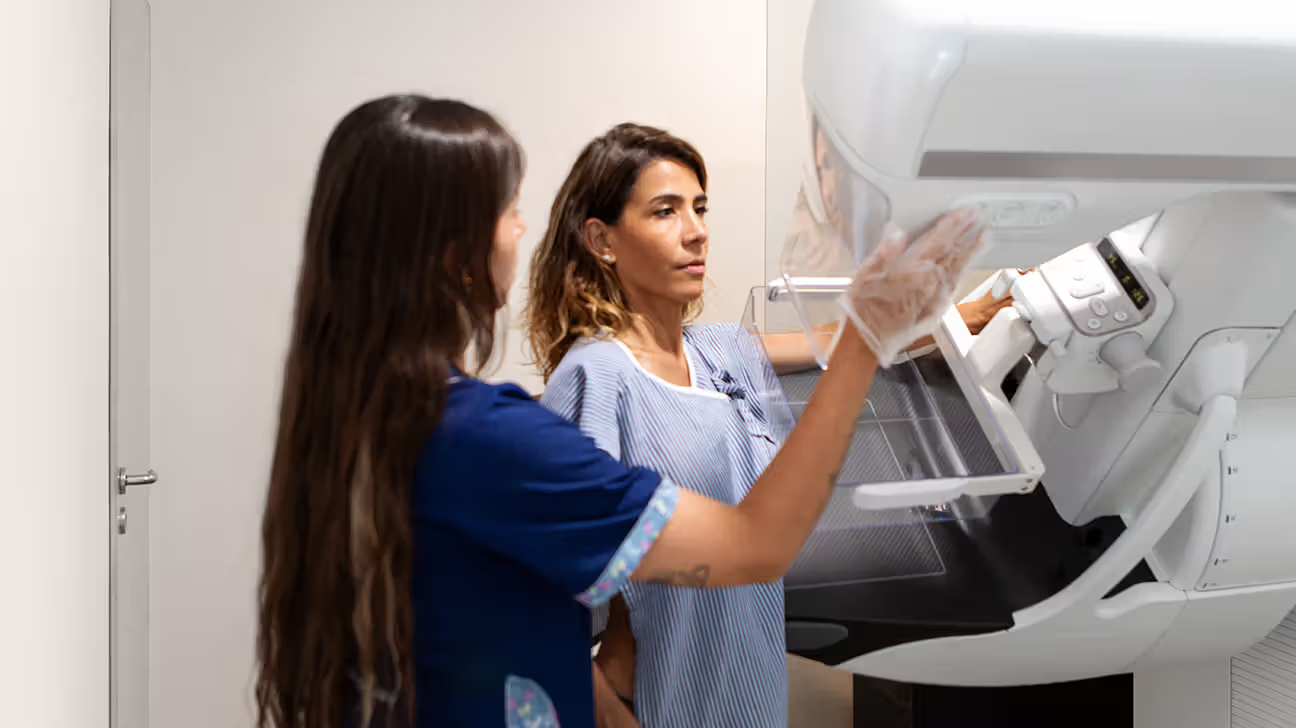
Breast cancer screening is an important part of this process, she told Healthline. Females should generally get annual mammograms, along with an ultrasound if they have dense breast tissue.
“Societies recommend starting at age 40 if average risk, though I recommend a baseline at 35 yo as I practice in CT, which has the highest rate of early onset breast cancer in the U.S.,” said Kazanjian.
She added that females may wish to consider a breast cancer risk assessment using the Tyrer-Cuzick Model by the age of 25, or even sooner if they’re at high risk.
The value of breast cancer risk assessment made headlines in 2024 when actor Olivia Munn shared that it led to her early breast cancer diagnosis.
Additionally, Kazanjian suggested embracing a healthy lifestyle as a part of your prevention plan.
“About 30 minutes of moderate activity a day is ideal,” said Kazanjian. “This can be divided into smaller chunks of time for busy people.”
Kazanjian also suggested following a plant-based diet with lean protein. “Avoid ultra-processed foods,” she added.
Finally, Kazanjian said it’s important to avoid cigarettes and alcohol. “Any amount [of alcohol] increases risk of breast cancer,” she warned.
[ad_2]
Source link : https://www.healthline.com/health-news/glp-1-drugs-lower-breast-cancer-incidence
Author :
Publish date : 2026-06-03 11:55:40
Copyright for syndicated content belongs to the linked Source.