
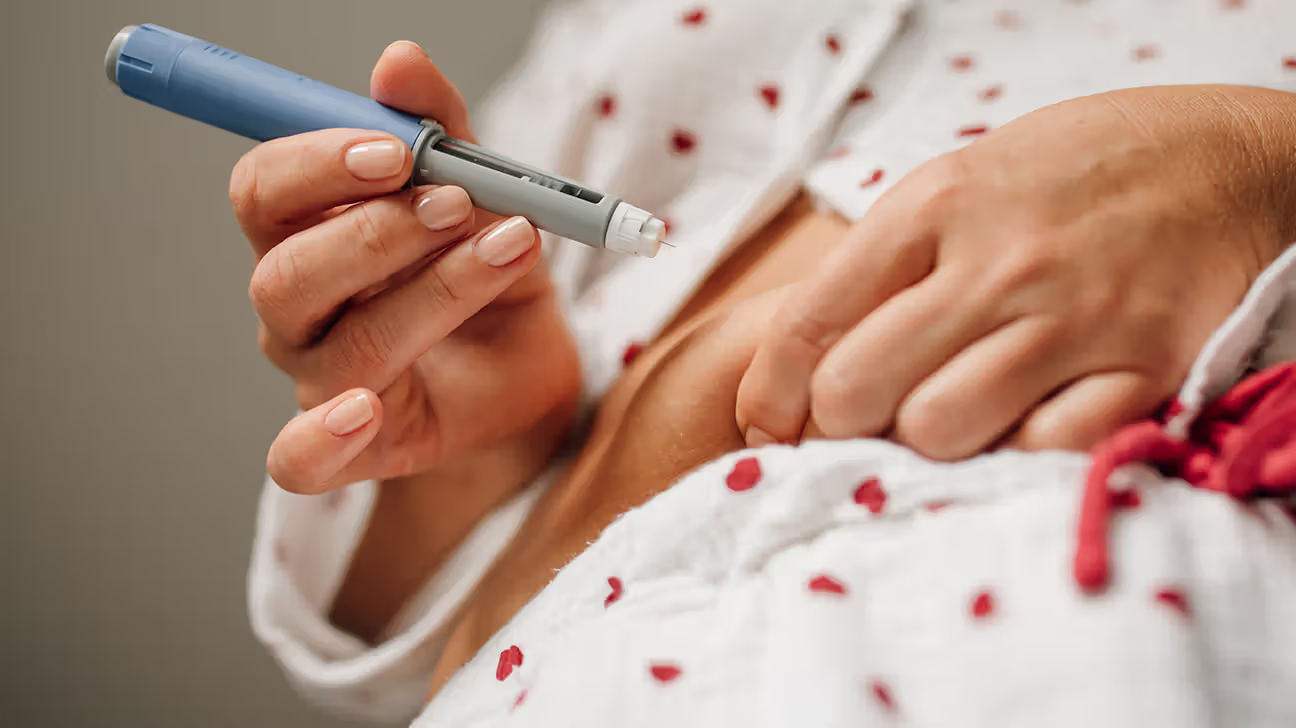
- A recent study found that GLP-1 drugs like Ozempic and Wegovy may improve breast cancer survival and recurrence in those with obesity and related health conditions.
- The findings suggest that GLP-1 medications were associated with a lower risk of mortality in those with type 2 diabetes than insulin or metformin alone.
- Experts say that while the findings are promising, more research is still needed.
Breast cancer is one of the most common cancers in the United States, accounting for
As GLP-1 medications become a widespread option for the treatment of obesity and type 2 diabetes, a recent study examined their effects on breast cancer outcomes.
The findings, published in
“[Breast cancer] patients with obesity or pre-existing type 2 diabetes often face more complex breast cancer journeys,” said lead study author Kristina L. Tatum, PsyD, MS, an instructor in the Department of Social and Behavioral Sciences at the School of Public Health at Virginia Commonwealth University.
“Our findings are encouraging because they suggest that GLP-1RA use may be associated with improved survival and lower recurrence among these patients,” Tatum told Healthline.
“While causation cannot be confirmed from this observational study, the findings provide important data for clinicians and patients with obesity and/or type 2 diabetes to consider as we continue to learn more about the possibilities of GLP-1RA therapies in breast cancer survivorship,” she said.
With around 1 in 8 U.S. adults having used a GLP-1, like Ozempic, Wegovy, and Mounjaro, at some point, including 40% with diabetes and 25% with heart disease, the broader health implications of this class of drugs are of increasing interest to researchers.
While the effects of GLP-1 drugs on breast cancer warrant further investigation, the relationship between obesity and cancer may play a role.
GLP-1 medications, which are highly effective for weight loss, could therefore help lower these risks, as the new study suggests.
Amy Bremner, MD, breast surgical oncologist and medical director of breast surgical oncology at MemorialCare Saddleback Medical Center in Laguna Hills, CA, who wasn’t involved in the study, said the findings were promising.
“We know that obesity is well-established as an obesity-associated cancer risk factor. Fat produces estrogen, which promotes certain breast cancer subtypes. By reducing body weight and fat mass, this could potentially reduce recurrence risk,” Bremner told Healthline.
Study co-author Bernard F. Fuemmeler, PhD, MPH, professor and Gordon D. Ginder, MD Chair in Cancer Research, said they were encouraged by the findings. “They tell us there is a story here with GLP1 RAs and cancer survivor outcomes that deserves more attention,” he told Healthline.
“We plan to continue this work to help build a clearer understanding of these therapies and support providers and cancer survivors as the science continues to evolve,” he said.
The recent study included 841,831 participants with breast cancer and an average age of 69. After taking into account any exclusions, the researchers identified three cohorts:
The 5-year survival probability for those with obesity and breast cancer using a GLP-1 was 97.4%, with the 10-year survival being 96%.
This compares to a 5-year survival rate of 93.2% for those not using a GLP-1 and a 10-year survival rate of 88.6%.
GLP-1 use was also associated with a lower risk of all-cause mortality in the 10-year follow-up period.
“This paper adds to growing evidence that GLP-1 receptor agonists may have an oncologic impact by improving metabolic health,” said Paunel Vukasinov, MD, a dual board certified internist and obesity medicine specialist at Medical Offices of Manhattan. Vukasinov wasn’t involved in the study.
“We should use appropriate caution when interpreting these results. This is an observational, retrospective study, not a prospective randomized trial,” Bremner said.
“Problems with this type of study include selection bias and confounding variables. In addition, could the benefit be a result of factors such as improved metabolic health, weight loss, or even differences in the types of patients selected for these drugs?” she noted.
The researchers compared breast cancer survival for GLP-1 drugs with that of current diabetes therapies. Survival rates among those taking diabetes medications were slightly lower compared to the GLP-1 group.
Metformin and insulin
For participants taking insulin or metformin, the 5-year breast cancer survival rate was 82.3%, and the 10-year survival rate was 76.4%, compared to 97.4% and 96%, respectively, in the GLP-1 group.
SGLT2 inhibitors
Those with breast cancer and type 2 diabetes using SGLT2 saw a 5-year survival rate of 88.9% and a 10-year survival rate of 73.4%.
For those using a GLP-1, the 5-year survival rate was 86.3%, and the 10-year survival rate was 75.5%.
In this group, GLP-1 use also saw a lower hazard of all-cause mortality.
“The survival benefit appeared stronger versus insulin or metformin, but less so when compared with SGLT2 inhibitors,” Vukasinov said.
“That raises the possibility that improving overall metabolic health may be a major part of what we are seeing.”
Source link : https://www.healthline.com/health-news/glp-1-drugs-improve-breast-cancer-survival-rates
Author :
Publish date : 2026-05-15 04:23:09
Copyright for syndicated content belongs to the linked Source.