


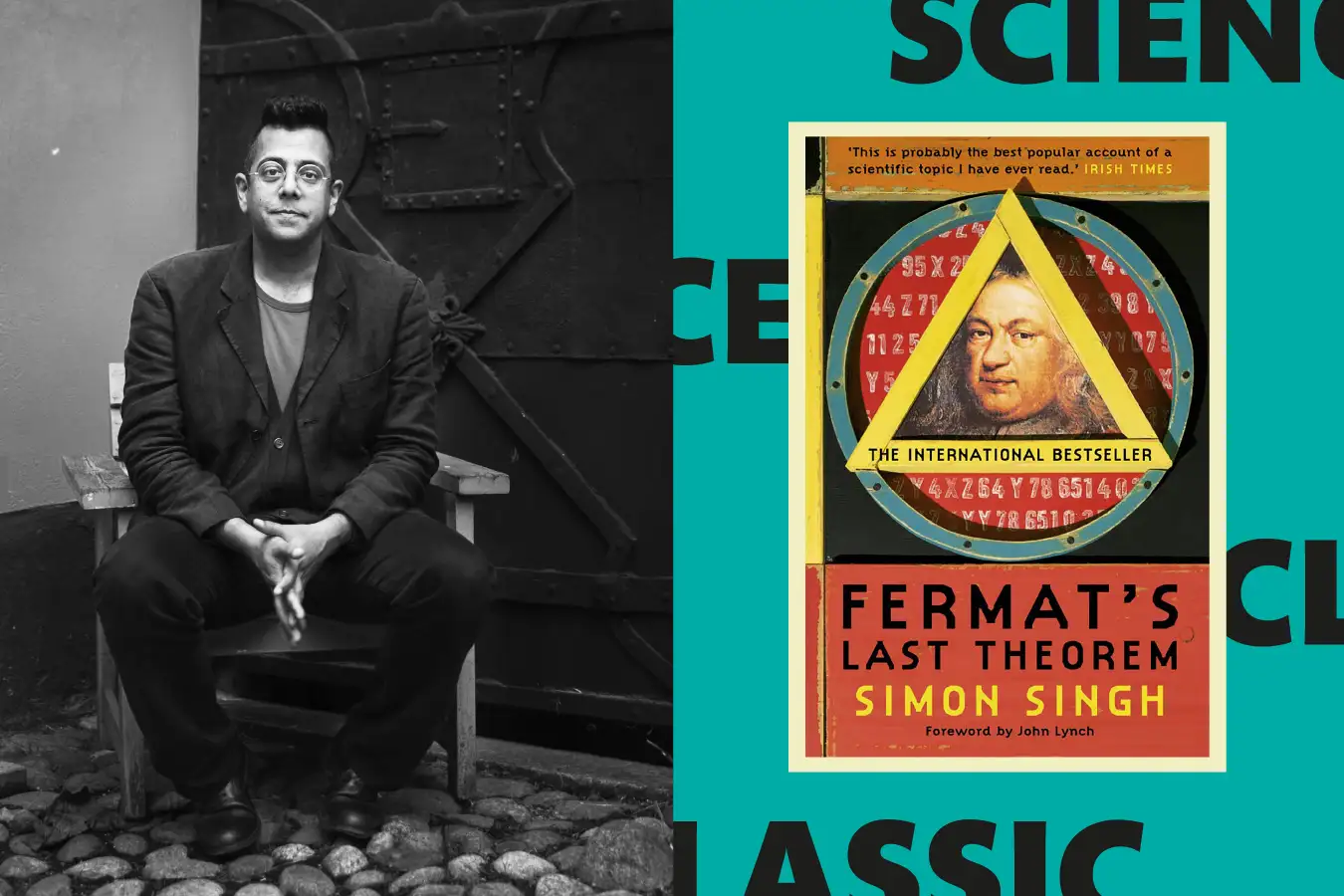
How does Simon Singh’s classic popular science book Fermat’s Last Theorem hold up today?
Did you know the number 26 is rather special? It is the only number that sits directly between a square number (25 or 52) and a cube number (27 or 33). And to be clear, it’s not merely that we’ve never found another case of this square-cube sandwich. We know for certain that there isn’t another one between zero and infinity.
Simon Singh’s 1997 book Fermat’s Last Theorem is an exploration of mathematical proof – what it means, how it’s obtained, and what drives those who so passionately seek it. It tells the story of the quest for one particularly beguiling proof, which makes it a compelling read. But given that this proof took 350 years to emerge, it also ends up being a wonderful history of mathematics. For many of us, the meat of mathematics lies in a realm of abstract reasoning far beyond us. But for me, what makes this book an absolute treasure, even almost 30 years after Singh wrote it, is the way it transports us into the heart of this beguiling world.
Singh starts right at the beginning with Pythagoras, of triangle-related fame. Everyone has heard of Pythagoras’s theorem, which says that if you add together the squares of the lengths of the two shorter sides of a right-angle triangle they are equal to the square of the longest side’s length (an idea that can be expressed as: x2 + y2 = z2). Others had used this method to work with triangles before, but what set Pythagoras apart, Singh writes, was that he proved it was true for every right-angled triangle. He did it not by trial and error or experiment, but by using incontrovertible logic. “The search for a mathematic proof,” writes Singh, “is the search for a knowledge that is more absolute than [that] accumulated by any other discipline.”
The story of Pythagoras was actually one of my favourite parts of the book. I hadn’t realised that he was the founder of a secret brotherhood of proof-seekers. And I read with wide eyes how a man named Cyclon was denied entry to the brotherhood and conspired to have Pythagoras killed in revenge.
The man who kicks off the story properly, though, is Pierre de Fermat. He was a judge who lived in France in the first half of the 17th century – and a prodigious mathematical talent. One thing he proved was the aforementioned uniqueness of the number 26. What made him famous, however, was his so-called last theorem, which amounts to a simple extension of Pythagoras’s theorem. We know there are an infinite array of whole numbers that can be successfully fitted into Pythagoras’s standard equation, but Fermat conjectured that if you tweak the equation to xn + yn = zn, where n can be any whole number, then there are no whole number solutions at all. In around 1637, he cheekily claimed to have a “truly marvellous” proof of this – but didn’t write it down.
Cue 350 years of mathematicians driving themselves half mad trying to discover the secret. Singh guides us through it all with style and ease, taking in an incredible cast of characters along the way. Among my favourites were Sophie Germaine, the French mathematician who worked in secret under a man’s name; Évariste Galois, the hot-tempered revolutionary who made a giant maths breakthrough, then promptly got killed in a duel; and Yutaka Taniyama, the brilliant young Japanese mathematician who helped lay the groundwork for finally proving Fermat’s conjecture, then tragically took his own life.
The main star of our story, however, is mathematician Andrew Wiles, who (spoiler alert) finally proves Fermat’s theorem to be true in 1994. Singh paints a wonderfully rich picture of Wiles, which is all the more impressive given that Wiles clearly doesn’t relish the limelight. As I read, I had the illusion that I roughly understood what Wiles did. Put briefly, it involved building a logical bridge between one branch of mathematics called elliptic curves and another called modular forms, which were previously thought to be chalk and cheese. To say more than that here would be impossible – this is arcane, if riveting, stuff.
There is a tense coda to the story, though, which is that Wiles original proof contained an error. It is the nightmare scenario, but – perfectly – Wiles rises from the ashes to eventually fix the flaw. My only slightly criticism of the book would be that this fixing part of the story could have been shorter.
Singh’s book has aged well, and its themes remain relevant to modern mathematics. One of the ideas that undergirds both the book and Wiles’ proof is something called the Langlands program, which originated with the mathematician Robert Langlands in 1967. He conjected that, deep down, all areas of mathematics are connected. The hope is that by finding these connections, insoluble problems in one area of maths will suddenly fall as an arsenal of tools from another area can suddenly be turned upon them. Wiles’ work was an early hint that the Langlands program might be on to something – and more have emerged recently. In 2024, mathematicians presented a proof of one aspect of the Langlands conjecture connected to an area of maths called harmonic analysis.
When I finished the book and put it down, I couldn’t help feeling almost as if I had been wandering about a gallery filled with abstract art. Mathematical proofs are a bit like art, I think. You observe them in a hush, wondering how the wizards who created them ever pulled it off, and emerge feeling like you have glimpsed something that goes beyond the surface of everyday experience. For managing to create such a feeling, I can only give this book the highest praise.
Topics:
Source link : https://www.newscientist.com/article/2523771-fermats-last-theorem-still-a-must-read-about-a-350-year-maths-secret/?utm_campaign=RSS%7CNSNS&utm_source=NSNS&utm_medium=RSS&utm_content=home
Author :
Publish date : 2026-04-22 12:00:00
Copyright for syndicated content belongs to the linked Source.