
Developed in partnership with the Our Partner
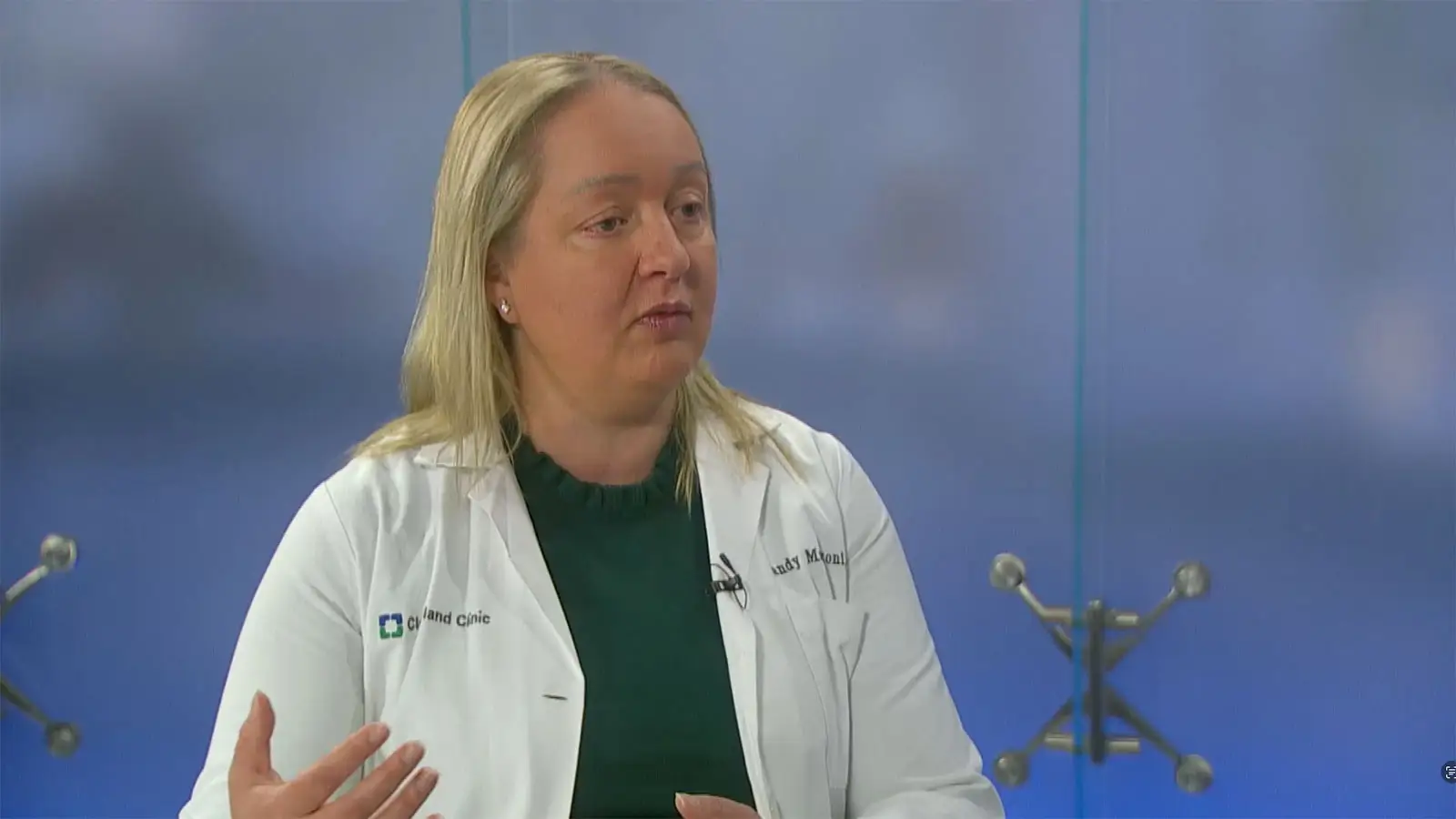
In “Beyond Diagnosis: Multiple Myeloma,” Cleveland Clinic hematologist Sandra Mazzoni, DO, and host John Mangels continue their conversations on communicating effectively and empathetically with patients facing a complex, chronic blood cancer.
Each monthly installment examines an aspect of multiple myeloma care, including delivering the diagnosis, building trust, navigating treatment decisions, and supporting patients through an evolving disease course.
This second of six episodes focuses on how clinicians introduce treatment goals early, tailor decisions based on patient priorities, and navigate complex discussions around transplant, clinical trials, and prognosis.
The following is a transcript of their remarks:
Mangels: Welcome to “Beyond Diagnosis,” where we talk with doctors about talking with patients. I’m your host, John Mangels. Multiple myeloma is a complex disease with many decision points over the course of treatment. Today, we’ll explore how a hematologist approaches discussions about diagnosis, therapy, prognosis, and patient autonomy. Our guest is Cleveland Clinic hematologist, Dr. Sandy Mazzoni. We’ll talk about how she supports multiple myeloma patients during a difficult journey. Dr. Mazzoni, thanks so much for being here.
Mazzoni: Thank you, John. Happy to be here and looking forward to our conversation today.
Mangels: Explaining multiple myeloma requires navigating complexity and uncertainty. When and how do you start talking with patients about their goals for treatment?
Mazzoni: I think at the very beginning, not typically at the very first appointment, but I do try to touch on it even at the appointment where we’re talking about the diagnosis, a little bit on prognosis, because one of the decision points I have to make fairly early on is, is this someone who’s going to be eligible for a more intense upfront regimen going into what’s called a stem cell transplant? Or is this someone who their goals are very different?
They may want to be able to focus more on spending time with family or they are traveling a lot and they know upfront that I can’t break away from work and other obligations in order to go through transplant that requires typically a month of downtime in order to recover from it fully. Sometimes you really want to get someone onto a clinical trial and that’s a whole other conversation.
You look at their chart, you meet them in person and you think, “This person’s going to be a great candidate, a great fit for a trial we have.” But just because they look great in person and on paper, you’re missing really the important key information, which is what’s their family support like? What resources do they need in order to be successful in a clinical trial? Do they understand what a clinical trial is? There’s a whole lot that I think we sometimes breeze over when it comes to the difference between going on a standard-of-care option versus a clinical trial.
Mangels: And as you said, this relationship has to be a partnership. Both sides have to be invested in it, which it sounds like is important in this goal-setting conversation.
I’m guessing one of the first questions you get from patients are, “Doc, what’s my prognosis?” How do you answer that question, particularly when you don’t have enough data to be able, at least at that point, to stratify what their risk is?
Mazzoni: Yeah. So some people, they come to us at different stages within their diagnostic workup, meaning some people, they come to us and all they’ve had are labs that are abnormal enough that they meet criteria for multiple myeloma plus maybe a bone image, for instance, but they’ve never had a diagnostic bone marrow to kind of confirm and help us differentiate between what’s called standard risk and high-risk disease. That’s what we call a cytogenetic risk profile.
So that has to do with the findings within the bone marrow biopsy. Whereas what I personally think is probably even more important is what’s the clinical behavior? How did the patient present? Did they present with minimal involvement with organs, like bone involvement, kidney involvement, and it was just more of a diagnosis based on couple small bone lesions or even just having over 60% involvement in their bone marrow biopsy?
Those patients tend to behave very differently than someone who presents and they have large, what we call plasmacytomas or masses of these abnormal plasma cells outside of the bone marrow that are setting up shop in organs like the liver, spleen, etc., or just different clinical presentations tend to be a little more high risk.
Mangels: So that’s a lot of information that you need. What do you say to a patient who asks that before you have that information?
Mazzoni: At that point, I have to explain, well, we’re going to do the following things in order to kind of find a whole picture of how we’re going to categorize this disease to the best of our knowledge. There’s a lot of patients that when you do this full workup with this advanced imaging, bone marrow biopsies, lab work, and everything there tells you this should be standard risk disease, it isn’t until you get the treatment started that you really learn clinically what is this going to behave like.
So that’s a conversation that you don’t always have upfront because you don’t know how it’s going to play out. So to the best of your ability, you try to distinguish standard-risk versus high-risk disease, have conversations with patients about their particular presentation and what you may predict it to behave like.
Mangels: Underlying that question about prognosis is basically the patient’s hope. In your experience, what does constitute hope in multiple myeloma?
Mazzoni: I think there’s a lot of things that constitute hope in myeloma. We’ve come so far with new therapies in multiple myeloma. It’s literally exploding in the world of cell therapy for multiple myeloma. I think that there’s a lot of acknowledgement about access to these new drugs.
I think that when I first started doing this, I was careful on giving patients timelines because I didn’t know for sure what kind of a timeline I could predict for patients. And oftentimes patients would ask, “Well, how many years do I have to live?” And it was really difficult to tell patients. I would say back then, “This is an incredibly treatable disease. It’s chronic. There’s no cure, but my goal is for us to get this disease under control and allow you to live as long as possible with this disease, with good quality of life.”
Now, I think that there’s… we’re getting close. We’re getting close to, I think, the standard-risk patients using some of our best cell therapies upfront right now; that’s in the setting of a clinical trial. I think that we may have a functional cure for these patients, but I don’t want to be overly optimistic. I’m a bit of a realist as well, but I think we’re getting close.
Mangels: I guess that’s the tightrope that you as the clinician have to walk between too much hope, too little hope. We’re talking about pretty complex treatments, cell therapies, autologous stem cell transplants. How do you handle talking about those complex treatments to a patient?
Mazzoni: Well, it gets tricky. So right now with doing things the way that they are — FDA-approved standard of care — you have some time to kind of allow your patients to digest these things. So right now, stem cell transplant, it’s given typically after 4 to 6 months of standard, what we call induction therapy. So that’s either a three- or four-drug regimen, typically four-drug regimen these days. So you have that time to kind of set the stage, explain all of this, and we’re given a separate appointment to really focus on transplant.
Same thing when it comes to our cell therapies. So we’re talking about CAR-T, these T-cell-engaging bispecifics, basically all these therapies that can use different aspects, in this case, it’s always the T cell that we’re using to turn into the ability to fight myeloma. Now, those therapies are moving closer and closer and closer to frontline, and then our trials are opening in frontline. So that creates a whole different conversation that I don’t think any of us were really prepared to handle in a 1 hour appointment.
So for instance, we had a trial where it was randomizing patients between upfront therapy for everyone, and then the consolidation part, which is what’s given after the 4 to 6 months of therapy, was either CAR-T or transplant, autologous stem cell transplant. So you’re meeting someone for the first time, you’re explaining their diagnosis, a little bit about prognosis, and then diving right into this very complicated conversation about CAR-T and transplant, all in an hour visit.
Mangels: It’s a lot to absorb.
Mazzoni: It’s a lot to absorb. Not the way that I typically handle things. So having this trial, which is a fantastic trial, but it was a lot. And so it was really difficult to kind of pick out who was the right patient that you think could handle this information, not feel overwhelmed, and be able to make decisions in a relatively short timeframe because you had to decide enroll in the study before you started any therapy.
Mangels: Let’s talk about time and decisions. So this is a chronic disease, and over the course of it, there are a lot of points where you and the patient have to make decisions. How do you help them understand that without overloading them?
Mazzoni: Well, the good thing about myeloma is that once you start therapy, the great majority of patients respond very well to it, and they stay on these drugs for a period of years typically. So the normal patient that’s going to go to transplant, you give them the four-drug regimen upfront. You get their disease 90%-plus cleared typically before transplant. And transplant, it’s all about the high dose of chemotherapy.
So when we say autologous stem cell transplant, it’s their cells being collected in order to reestablish the bone marrow where all the blood cells are made. You collect those cells beforehand, then you give the high dose of chemotherapy, and then you rescue them afterwards with their own stem cells. So that whole process, you have time to talk about this. And then once they get through the transplant, now they have this period of 2 to 3 months of recovering back to normal 100% baseline, and then they’re on a one- or two-drug regimen to maintain that.
They ideally are going to be on this maintenance regimen for many years. So ideally, with most of these patients, you’re going to have that time of lab monitoring in order to see very early on when the disease slowly starts to percolate back. So these conversations are things that you can timeline and predict in most cases.
Mangels: And I’m guessing you’re doing a little bit of a look ahead in these conversations and helping prepare them for decisions that might be down the road.
Mazzoni: Correct. Yeah. A lot of my patients, after they’ve gone through transplant and they’re on cruise control, so to speak, on their maintenance drug, they feel great.
So at some point, I personally try to engage them a little early to say, “Well, we know that no matter what we do, this is going to start to come back at some point. When it does, are you going to be someone who would be up for doing CAR-T therapy? That’s one of the options we have now, or would you be someone who would want to look at other clinical trials, or are you someone who would want to go onto a combination of more standard myeloma therapies?”
So we do, we try to have those conversations before it’s in front of us, inevitable, and we’re being pressured to make a choice.
Mangels: Thanks so much for your insights, Dr. Mazzoni. And thank you for joining us on “Beyond Diagnosis,” where we explore not just what physicians know, but how to effectively and compassionately share that knowledge with patients. See you next time.
Source link : https://www.medpagetoday.com/beyond-diagnosis/multiple-myeloma/121069
Author :
Publish date : 2026-05-01 16:42:00
Copyright for syndicated content belongs to the linked Source.