

Barbara Roberts has lived with HIV for 30 years. Now, a new FDA-approved medication is changing how she manages it at the age of 74.

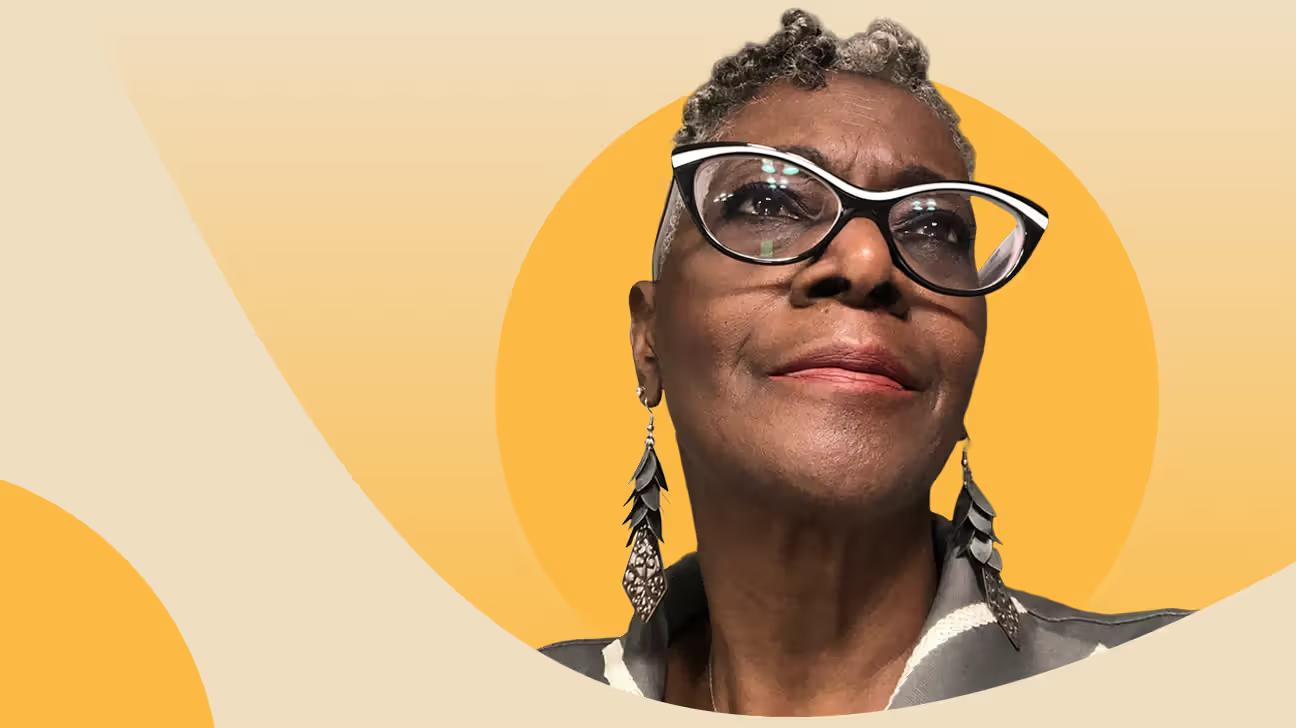
In 1996, Barbara Roberts thought she had a bad case of the flu that wouldn’t go away. After several days of experiencing a high fever and sweating, she decided to go to the emergency room, where she was sent home with antibiotics.
“I just still didn’t feel well,” Roberts told Healthline. “And I remember going back to the emergency room.”
She stayed in the hospital for three days while doctors ran tests. On December 21, 1996, Roberts was diagnosed with HIV. She was 44 years old.
“It surprised me because it never occurred to me that that’s what was going wrong with me,” she said. “I was in total shock, disarray, scared to death because back then, it was like a death sentence.”
Roberts left the hospital with a medication regimen and visited an HIV clinic for guidance.
“Everyone was so nice to me there. They were so kind and calmed all my fears; they tried to at least,” said Roberts.
Initially, her medications helped ease symptoms, and she felt better.
However, a year after her diagnosis, Roberts became extremely tired and experienced shortness of breath and nosebleeds. She also noticed that the skin on her hands and the bottom of her feet darkened.
An intense nosebleed led her back to the ER, where doctors discovered she had significantly low blood platelets. For 25 days straight, she received blood and platelet transfusions in the hospital.
During this time, doctors determined that one of her medications caused her symptoms, and they adjusted accordingly.
“After that, I have never gone back to the hospital or had any problems with my medications, and I’ve had different ones over the years,” said Roberts.
In 2021, Roberts’ rheumatologist, Debbie Hagins, MD, medical director of the Coastal CARE Centers in southeast Georgia, asked if she would like to participate in a clinical trial for try Idvynso, a daily two-drug single-tablet treatment for people with HIV who are virally suppressed.
“She explained the medication to me and asked if I would like to be in a study,” said Roberts. “I felt it was a privilege for her to ask me to be in this study.”
She decided to enroll in the clinical trial because she couldn’t pass up the opportunity to take only one medication a day.
“The only thing I remember from initially taking the medication was I had really vivid dreams for about two weeks, and it’s been smooth sailing [since],” said Roberts.
On April 21, 2026, the FDA approved Idvynso.
Roberts continues to participate in the clinical trial as part of an open-label extension, in which additional data are collected to better understand the drug’s long-term safety profile.
While she lives with age-related back pain and arthritis, at 74 years old, she said she’s grateful she doesn’t live with any other chronic conditions that require medication.
“I hear of people [having to take] many different medications in a day because their HIV had caused them so many other problems like organs breaking down and skin tissue issues, so that was a reason that I decided to get in the study…if this could help me, why shouldn’t I be able to help someone else?”
Hagins said that although HIV is a chronic and manageable disease, it is associated with increased risks of bone, cardiovascular, and renal diseases, and accelerated aging.
“Prescribing the least amount of medication and at the lowest dose possible to achieve the desired goal is always the objective,” Hagins told Healthline.
An HIV provider since 1989, Hagins said she witnessed treatment undergo revolutionary advances. She remembers patients who felt that the treatment was worse than the disease and whose quality of life was reduced.
“They gave up their dreams of having a family, of traveling, of pursuing a career, and the like,” she said. “Today, with HIV medications like Idvynso, persons living with HIV no longer embrace those limitations.”
However, she said more treatment options are needed, especially because those living with HIV require lifelong treatment, which can cause unwanted side effects that may not appear until several years into treatment.
“And though our currently FDA-approved medications have not changed in their efficacy, people change. As we age, our bodies respond and react to illnesses and their treatments differently with each decade of life,” said Hagins.
“It is standard medical practice to review a patient’s medications during office visits and to consider dose reductions, changes or discontinuations for each condition being managed.”
When Roberts was first diagnosed with HIV, she didn’t tell anyone about it except her close family members.
“It was just a private thing that I had and that I managed because…I didn’t want people to think of me with all the different stigmas that were attached to it,” she said.
But then she met the love of her life, Johnny L. Roberts, on Labor Day in 1997.
“It was just casual until it was serious, and I got afraid because I had to tell him. I had never been in any other relationship to have to tell someone about my HIV,” Roberts said.
One Friday night, she let him know.
“And he just embraced me, and he told me, ‘You’re going to be fine,’” she said. “He told me about the sadness that he saw in my eyes that I never thought I presented, but I guess that I did.”
She believes that education and understanding of HIV have helped with the stigma around it and that today, people are more open to sharing the reality of their condition.
She hopes this encourages others to open up and be true to their experience.
“Sometimes it’s hard because people and places and times can be mean, but I’m grateful that there’s more positive information now, and people are [more accepting than] they used to be,” she said.
Source link : https://www.healthline.com/health-news/barbara-roberts-hiv-30-year-journey
Author :
Publish date : 2026-05-10 02:00:00
Copyright for syndicated content belongs to the linked Source.