[ad_1]
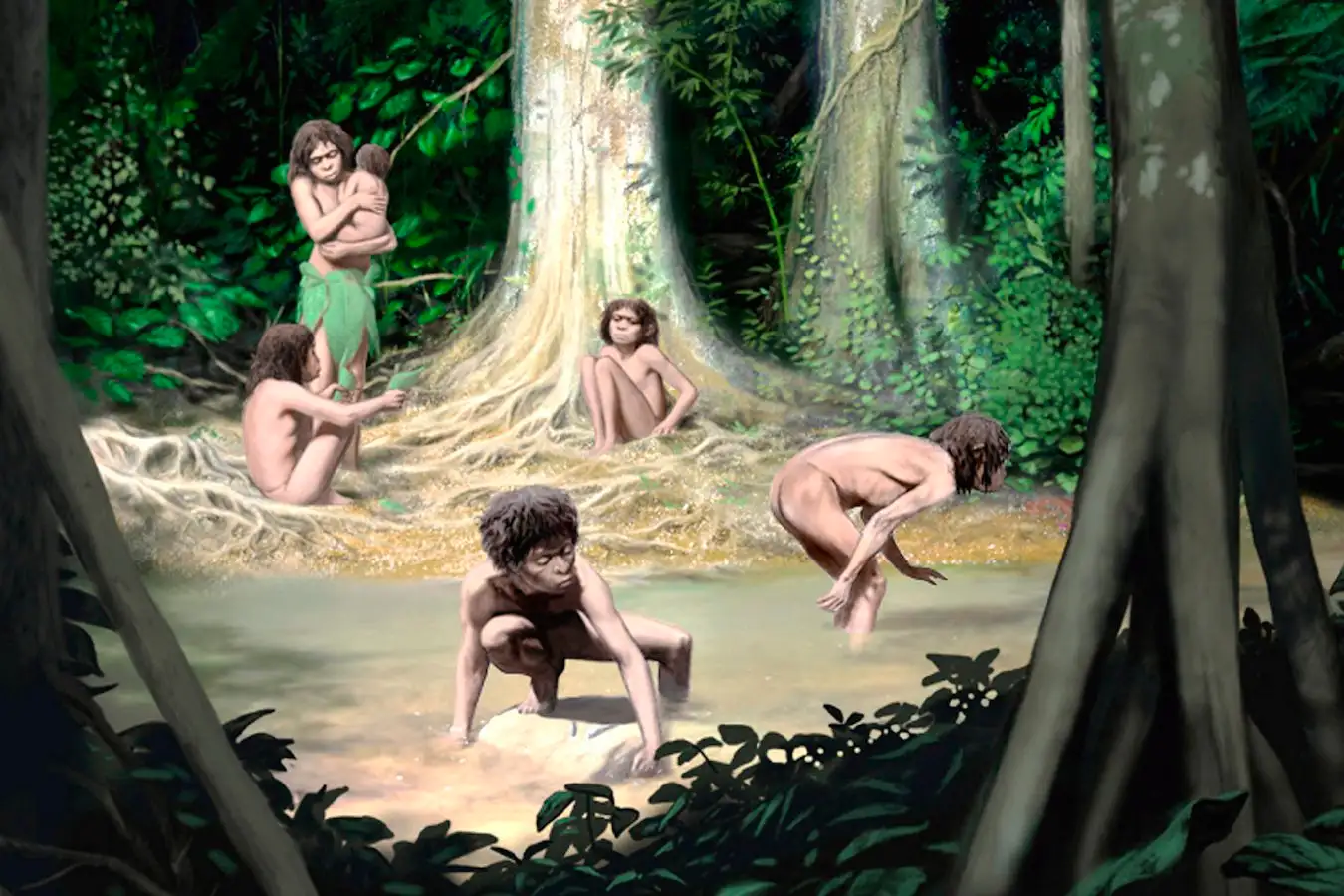
Homo floresiensis was a small hominin that lived on the island of Flores
LIONEL BRET/EURELIOS/SCIENCE PHOTO LIBRARY
The diminutive ancient humans nicknamed hobbits that lived on the Indonesian island of Flores until around 50,000 years ago had limited hunting skills, according to a study of animal bones found in their caves. Instead, researchers think they scavenged meat that was left behind by Komodo dragons.
Fossils of Homo floresiensis were first announced to the world in 2004. These humans stood just over a metre tall and their remains have been dated to between 90,000 and 50,000 years old.
Based on stone tools and blackened bones found alongside their remains, it was initially thought they were capable of advanced behaviour such as the controlled use of fire and ability to hunt the largest animals on their island. But in recent years, the cognitive abilities of these small-brained hominins have been a matter of debate.
“I would argue that our field at large still holds on to this idea that Homo floresiensis had to have some form of advanced cognition to have reached the island and survived in a depauperate faunal community, regardless of brain size,” says Elizabeth Veatch at the Smithsonian Institution in Washington DC.
The Liang Bua cave where the remains of H. floresiensis were found contains many bones of a dwarf elephant species (Stegodon florensis insularis). But Veatch and her colleagues suspected that these animals had been killed by Komodo dragons, one of the world’s largest reptiles, which live on Flores and some other Indonesian islands.
To determine exactly what kind of marks Komodo dragons leave on the bones of large mammals that they eat, Veatch and her team fed a dead goat to one of the giant reptiles at Zoo Atlanta in Georgia. “Stegodon are extinct and it would be near impossible to create an experiment where a Komodo dragon was fed a whole elephant,” says Veatch.
After the Komodo had finished its meal, 72 bones remained, 26 of which had a total of 192 toothmarks. The researchers then compared these bones to over 3000 Stegodon bone fragments found in deposits in Liang Bua cave associated only with H. floresiensis, as well as nearly 7000 much more recent bones from giant rats that were associated with Homo sapiens at the same cave. They also examined each of these roughly 10,000 bones for signs of having been exposed to fire.
They found that in their experiment with the goat, the Komodo dragon favoured the parts of the carcass that had the most meat, such as the hindquarters and forequarters.
However, the cut marks left by H. floresiensis’s stone tools on the Stegodon bones were primarily on the less desirable cuts such as cranial bones and thoracic vertebrae – an unexpected result if humans had first access to the dead elephants.
Out of the more than 3000 Stegodon bone remains associated with the small ancient humans, only one had any sign of being exposed to fire, and that was most likely from a section of the deposit that was disturbed and heated by later humans. By contrast, a fifth of all the rat bone remains left by modern humans after the hobbits became extinct showed signs of being cooked.
“The rat bones demonstrate the pattern clearly – zero burned bones in Homo floresiensis layers, hundreds burned in modern human layers,” says Veatch. “Claims of advanced behaviour have been slowly chipped away, but our study directly confirms our suspicion that Homo floresiensis did not use fire or hunt big game as was originally claimed.”
Adam Brumm at Griffith University in Brisbane, Australia says the study shows “convincingly” that Homo floresiensis probably did not hunt Stegodon but rather scavenged their remains.
Martin Porr at the University of Western Australia says previous claims of Stegodon hunting and fire use have been controversial. “In a sense, the new findings bring Homo floresiensis more in line with what we know about other small-bodied hominins, such as Australopithecines, and this would make some sense given their brain capacity and body weight,” says Porr.
But other small hominins have been found only in Africa. The big question is whether Homo floresiensis is descended from small hominins that had a much wider range than we thought, or whether it is descended from larger hominins like Homo erectus, which subsequently got smaller and lost certain abilities.
“I think that both options remain possible right now and it will require more research on and around Flores to clarify this,” says Porr.
Topics:
- human evolution/
- ancient humans
[ad_2]
Source link : https://www.newscientist.com/article/2532777-hobbit-hominins-scavenged-meat-left-over-by-komodo-dragons/?utm_campaign=RSS%7CNSNS&utm_source=NSNS&utm_medium=RSS&utm_content=home
Author :
Publish date : 2026-07-03 19:00:00
Copyright for syndicated content belongs to the linked Source.