
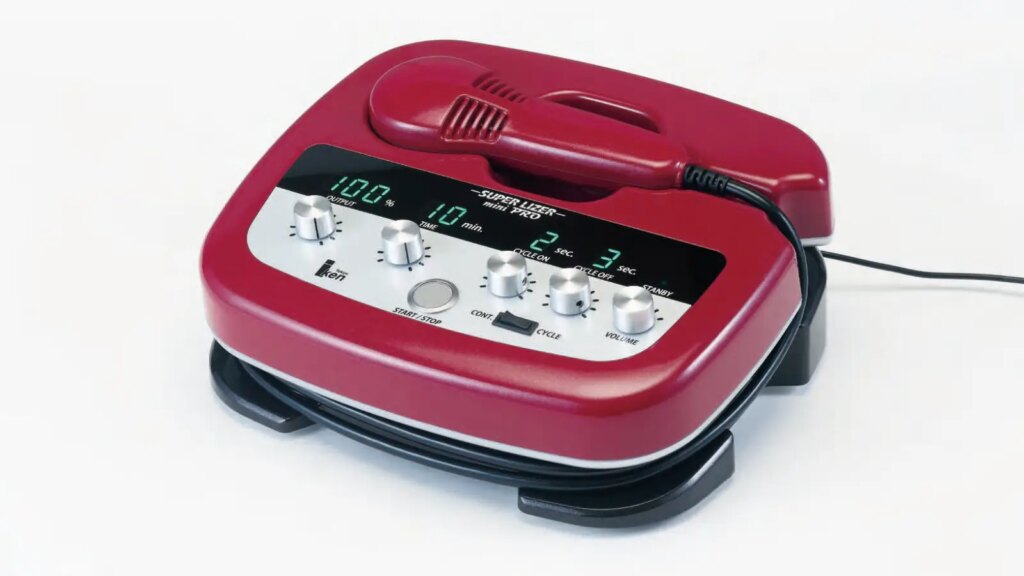
- A device for home-based stellate ganglion phototherapy (SGP) was used daily for managing ventricular arrhythmia in 28 Japanese patients.
- The number of antitachycardia pacing or ICD shocks fell to a median zero events during a month of at-home SGP therapy.
- While one in four individuals reported a warm sensation at the irradiation site during portable SGP, there were no burns or any adverse events requiring treatment.
Home-based daily neuromodulation was feasible for managing ventricular arrhythmia, and it produced good preliminary results at one Japanese center.
A portable device for stellate ganglion phototherapy (SGP), the Super Lizer mini, was used every day by 28 patients who’d experienced antitachycardia pacing (ATP) or implantable cardioverter-defibrillator (ICD) shocks 1 month prior. The number of ATPs or ICD shocks was significantly reduced during the first month of daily at-home SGP therapy (median 0 vs 3.9, P<0.01), reported Yuki Komatsu, MD, PhD, of the University of Tsukuba in Japan, and colleagues in Circulation.
All patients were able to apply SGP appropriately by themselves, and they stayed on this therapy for a median 57 days in the study. While a quarter of the individuals reported a warm sensation at the irradiation site during portable SGP, there were no burns or any adverse events requiring treatment.
“Daily SGP requires neither hospitalization nor specialized skills from healthcare professionals while demonstrating favorable monthly effectiveness in suppressing ventricular arrhythmic burden. Therefore, this therapy has the potential to expand its clinical implementation in outpatient settings, distinguishing itself from conventional neuromodulation therapies,” the authors wrote.
The portable SGP device emits near-infrared light as a noninvasive autonomic neuromodulation strategy for suppressing ventricular tachycardia (VT) events. This sets it apart from other neuromodulation techniques requiring a clinic visit (e.g., stellate ganglion block, spinal cord stimulation).
“Notably, this study supports that daily SGP may serve as a practical and effective treatment option for patients with VTs who require skill-dependent treatments but face social or physical barriers to accessing highly experienced institutions,” according to Komatsu and colleagues.
Their single-center retrospective study included 28 consecutive patients with VT who underwent daily portable SGP between January 2023 and June 2025.
The cohort had a mean age of 66.6 years and was 78.6% men. The group was split between the 39.3% with single- or dual-chamber transvenous ICDs and the remainder with cardiac resynchronization therapy defibrillators. Roughly one in seven had ischemic cardiomyopathy.
Implantable device electrograms demonstrated monomorphic VT in 92.9% of the patients, the remainder showing polymorphic VT.
Oral antiarrhythmic medications used included beta-blockers (92.9%), amiodarone (46.4%), and sotalol (32.1%). Most people (64.3%) had previously undergone at least one catheter ablation procedure. Median serum BNP was 176.5 pg/mL and left ventricular ejection fraction was 37.0%.
Patients applied the portable SGP bilaterally at home for 10 minutes on each side of the neck with high or medium output level while in a sitting or supine position.
During their time using the SGP device, no patient underwent radiofrequency catheter ablation or a change or escalation in antiarrhythmic medications, according to Komatsu and colleagues.
“However, given the retrospective observational design, our findings are limited by the lack of compliance data, nonstandardized device programming, short pre-SGP and post-SGP assessment periods, uncertainty regarding which cervical neural structures were modulated, potential confounding from concurrent change in guideline-directed medical therapy, and possible placebo effect,” the authors cautioned.
“Further prospective investigations are warranted to establish [at-home SGP’s] effectiveness, reproducibility, and optimal role in the therapeutic armamentarium for outpatient ventricular arrhythmia management,” they wrote.
Please enable JavaScript to view the comments powered by Disqus.
Source link : https://www.medpagetoday.com/cardiology/arrhythmias/121126
Author :
Publish date : 2026-05-05 19:58:00
Copyright for syndicated content belongs to the linked Source.