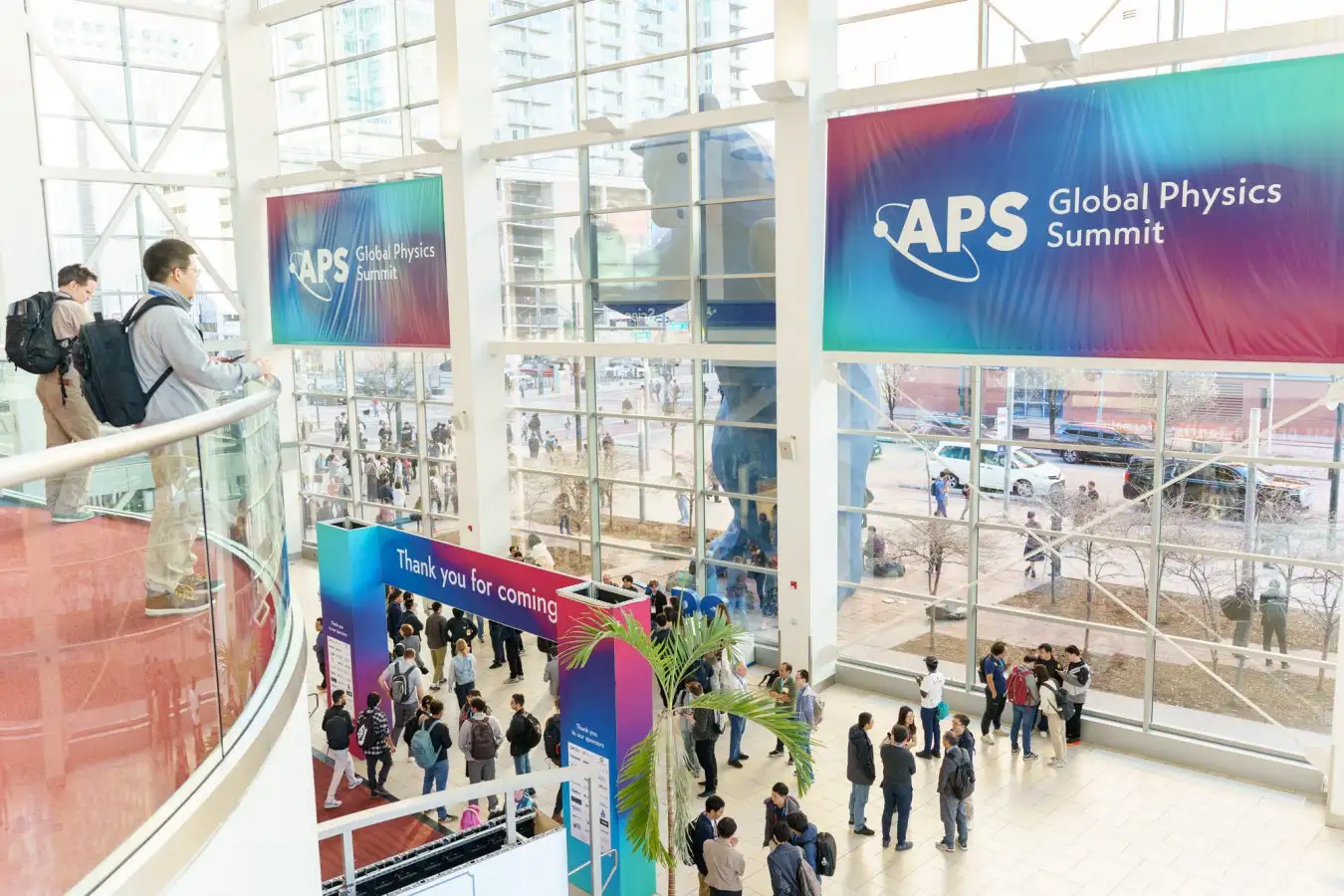
The American Physical Society Global Physics Summit is the world’s largest meeting of physicists
American Physical Society
I am sitting in a lecture theatre, and in front of me is a sight that I am still getting used to. I am at the American Physical Society Global Physics Summit, the world’s largest annual meeting of physicists, with 14,000 researchers attending in Denver, Colorado, this year. We have all come to listen to world-leading scientists talk about their work – and yet, many people are turning to artificial intelligence to help explain what we are actually hearing.
As the talks go on, I keep catching glimpses of laptop screens displaying AI chatbots, which are being asked to put concepts into easier-to-understand terms. “What are the benefits of transmon qubits?” “Explain spintronics to me.” “What is a two-level system?” The AIs are promptly providing the information, using emojis as bullet points.
While AI chatbots have demonstrated their usefulness in lecture halls, whether they can help with doing actual physics research is one of the hottest topics at the conference, debated in every forum, from the talks themselves to in-between sessions and alumni receptions.
In one presentation, Matthew Schwartz at Harvard University said that Anthropic’s Claude chatbot can solve advanced physics problems as effectively as a student in the early stages of a doctoral degree programme. In January, Schwartz co-authored a study in quantum field theory by working with Claude for about two weeks. Strikingly, he estimated that completing the same research in collaboration with a student would have taken roughly two years.
He believes that AI puts theoretical physics “on the chopping block”. Schwartz said he no longer mentors students who don’t want to collaborate with AI tools and believes that all the problems that currently plague fundamental physics, such as combining quantum theory with Albert Einstein’s theory of general relativity, will be solved in about five years thanks to AI. Working with Claude made him feel like Einstein himself – and like everyone could become an Einstein equivalent, he said. His talk was called “10,000 Einsteins”.
Schwartz represents an extreme end of the spectrum. Savannah Thais at City University of New York made the case in her presentation that it is too soon to tell how transformative the technology will be for physics. She pointed to the fact that AI is good at producing plausible-sounding science, but there is no fool-proof method for discerning whether it is correct. Many of the steps are typically hidden from researchers and underlying assumptions made in particle physics, for example, can lead to less accurate results.
Rachel Burley at the American Physical Society said in her presentation that there was an early sense of optimism around how AI tools may help physicists with writing and publishing scientific papers, but the subsequent explosion of submissions to journals has put the peer-review system under strain.
The question that loomed over these presentations and more informal conversations is what will be left for humans as AI advances. Matthew Ginsburg, a former physicist with decades of experience of working on AI, including at Google DeepMind, said that AI provides a consensus expert opinion, while scientific breakthroughs can originate with researchers willing to go against the grain or ask unexpected questions.
Schwartz conjectured that human physicists will be left the task of taste-making, determining which problems are the most interesting and most meaningful. “My fear is that some things may get worse before they get better,” said Schwartz. “It’s amazing and also a little scary.”
Topics:
Source link : https://www.newscientist.com/article/2520506-how-ai-shook-the-worlds-largest-meeting-of-physicists/?utm_campaign=RSS%7CNSNS&utm_source=NSNS&utm_medium=RSS&utm_content=home
Author :
Publish date : 2026-03-24 13:00:00
Copyright for syndicated content belongs to the linked Source.