[ad_1]
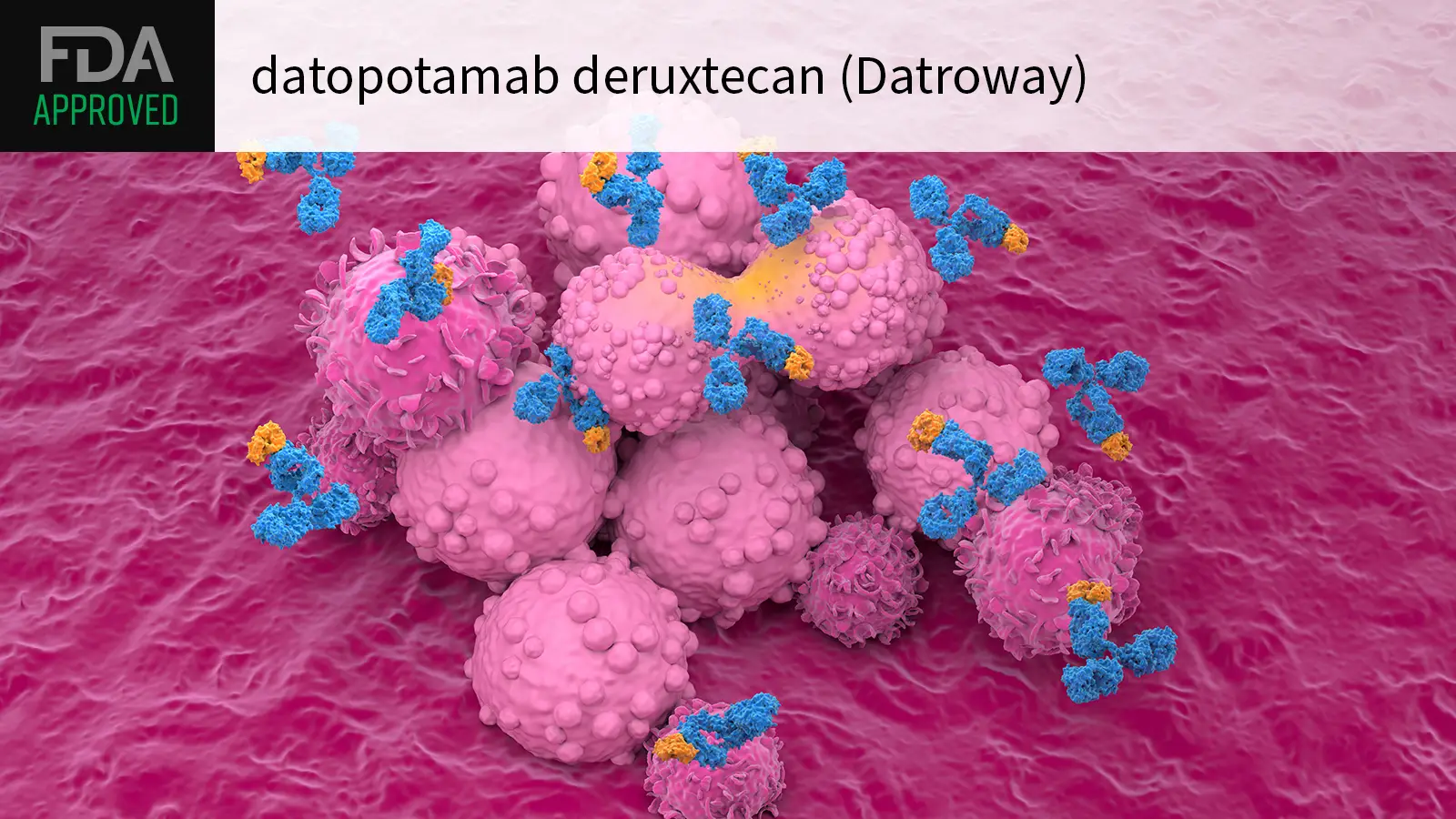
The FDA on Friday approved datopotamab deruxtecan (Dato-DXd; Datroway) as a first-line option for unresectable or metastatic triple-negative breast cancer patients ineligible for immunotherapy.
Approval of the Trop2-directed antibody-drug conjugate was based on results of TROPION-Breast02, a phase III study that demonstrated improved survival outcomes compared with investigator’s choice of chemotherapy (paclitaxel, nab-paclitaxel [Abraxane], capecitabine, eribulin, or carboplatin).
“Datopotamab deruxtecan is the first and only medicine to significantly prolong overall survival in the first-line setting compared to chemotherapy in patients with metastatic triple-negative breast cancer who are not candidates for immunotherapy,” investigator Tiffany Traina, MD, of Memorial Sloan Kettering Cancer Center in New York City, said in a press release from drugmakers Daiichi Sankyo and AstraZeneca. “This approval will bring a much-needed treatment option for these patients.”
The randomized trial included 644 patients with previously untreated unresectable or metastatic triple-negative breast cancer who were not candidates for PD-1/PD-L1 inhibitor therapy.
Median progression-free survival almost doubled in patients who received Dato-DXd versus chemotherapy (10.8 vs 5.6 months), translating into a 43% reduction in the risk of disease progression or death (HR 0.57, 95% CI 0.47-0.69, P<0.0001).
Dato-DXd demonstrated a statistically significant and clinically meaningful 5-month improvement in median overall survival (23.7 vs 18.7 months; HR 0.79, 95% CI 0.64-0.98, P=0.0290). Additionally, more than twice as many patients treated with Dato-DXd compared with chemotherapy had an objective response (64% vs 30%).
Triple-negative breast cancer accounts for about 15% of all breast cancer cases, and is diagnosed more frequently in younger and premenopausal women, with higher prevalence in Black and Hispanic women. Metastatic triple-negative breast cancer is the most aggressive type of breast cancer and has one of the worst prognoses.
Common adverse events (AEs) among patients who received Dato-DXd were stomatitis; nausea and vomiting; alopecia; constipation; fatigue; dry eye, keratitis; musculoskeletal pain; increases in amylase, alanine aminotransferase, aspartate aminotransferase, and blood alkaline phosphatase; and decreases in hemoglobin, white blood cells, calcium, lymphocytes, neutrophils, sodium, and albumin.
Serious AEs occurred in 17% of patients, including pneumonia, vomiting, COVID-19, and anemia in more than 1%.
Prescribing information includes warnings and precautions for interstitial lung disease and pneumonitis, ocular adverse reactions, stomatitis/oral mucositis, and embryo-fetal toxicity.
Dato-DXd is also approved for previously treated unresectable or metastatic hormone receptor-positive/HER2-negative breast cancer and for pretreated EGFR-mutated non-small cell lung cancer.
[ad_2]
Source link : https://www.medpagetoday.com/hematologyoncology/breastcancer/121430
Author :
Publish date : 2026-05-26 16:42:00
Copyright for syndicated content belongs to the linked Source.