- In the 2025 New Mexico outbreak, most cases (85.8%) happened in people who either weren’t vaccinated (57.6%) or had unknown vaccination status (28.3%).
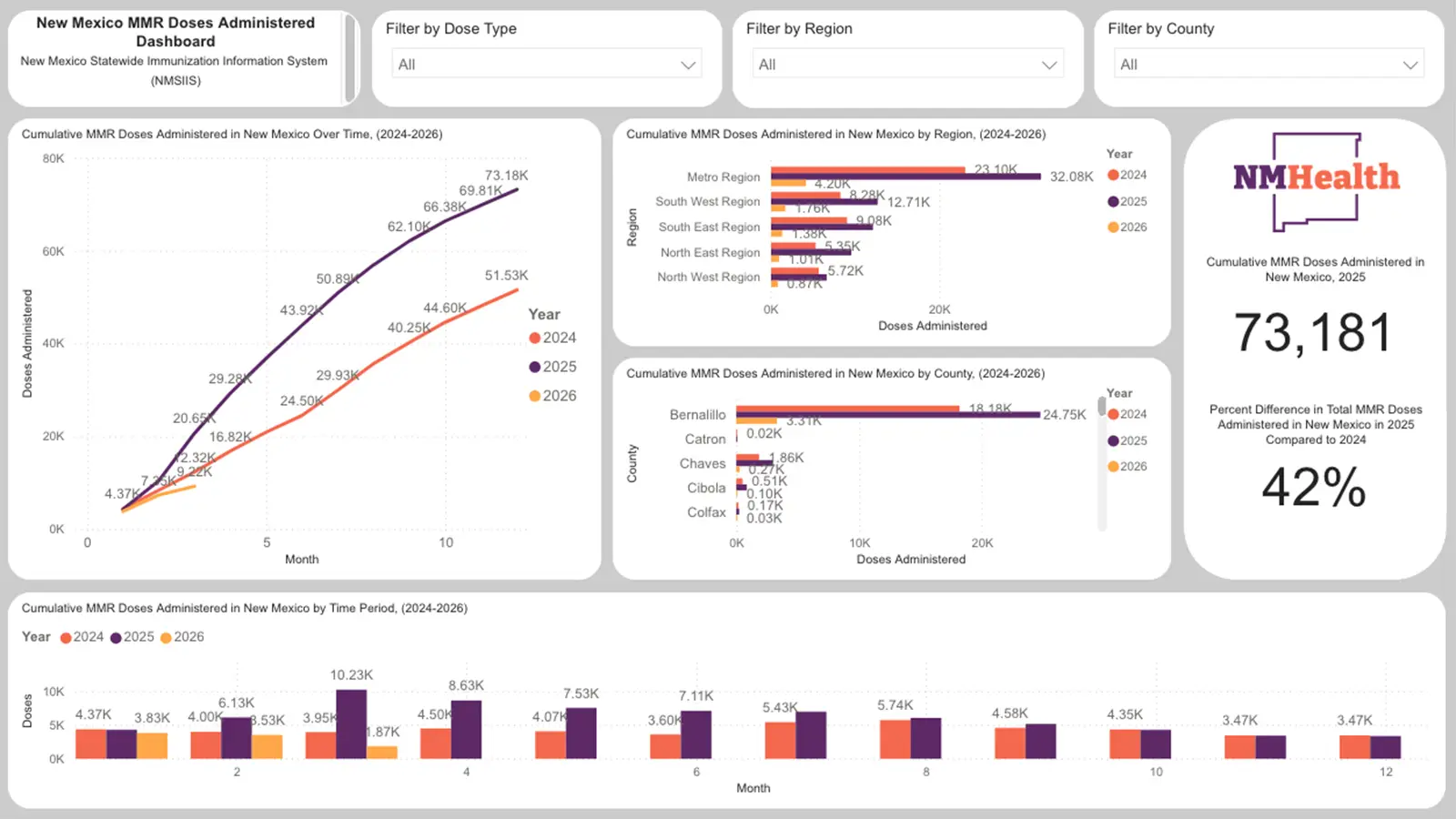
- By the outbreak’s September 2025 end, administered MMR doses increased 55% versus the same period the year prior.
- MMR doses in children were up 18%, while adult doses spiked 291%.
New Mexico paired a broad public communications campaign with expanded statewide access to measles vaccination for children and adults to end a 2025 measles outbreak and boost statewide measles, mumps, and rubella (MMR) vaccination rates.
The state’s multipronged strategy could offer other states a model as the U.S. grapples with local and regional outbreaks of the highly infectious respiratory virus, said Chad Smelser, MD, of the New Mexico Department of Health (NMDOH) in Santa Fe, and colleagues in Morbidity and Mortality Weekly Report.
New Mexico faced its first suspected measles case Feb. 9, 2025, following a January 2025 outbreak in neighboring Texas. By Sept. 26, New Mexico declared its outbreak over. In those 8 months, the state saw 99 confirmed cases in eight counties, with seven hospitalizations, and one death. Only 14% of people with measles infections had received at least one dose of a measles vaccine.
Declared eliminated from the U.S. in 2000, measles cases have since reached record levels in the wake of rising vaccine hesitancy and falling measles vaccination rates. As of March 12, CDC data show 1,362 confirmed U.S. measles cases and 14 outbreaks in 2026 — including 664 cases in South Carolina, 231 cases in Utah, and 116 cases in Florida. The nation’s 2025 totals reached 2,284 confirmed cases and 48 outbreaks, the most since 1991, when there were 9,643 cases.
In the 2025 New Mexico outbreak, most cases (85.8%) happened in people who either weren’t vaccinated (57.6%) or had unknown vaccination status (28.3%). The median age among those with measles was 20 years (range 4 months to 62 years).
Communicate and Vaccinate
New Mexico’s measles response combined a range of communications and vaccination resources, Robert Nott, of the New Mexico Department of Health, told MedPage Today.
The state’s approach started with community communication. State health officials quickly built a centralized measles webpage in English and Spanish. That online resource kept state residents up to date on cases, vaccine recommendations, their vaccination status, vaccination access locations, state Health Alert Network advisories, news releases, and resources such as the state’s nurse helpline number.
NMDOH had created that nurse helpline number during the COVID-19 pandemic. During the measles outbreak, helpline nurses pivoted to reach out to residents to let them know they’d been exposed to measles, help them find nearby vaccination resources, and counsel them on symptoms and quarantine requirements.
State health officials also broadcast public service announcements on radio and television, and delivered 184 social media posts.
“Our goal was to educate the community, providers, and schools to mitigate misinformation and miscommunication where possible,” Nott said. “The community was able to see the vaccine response via the dashboard, news releases, social media platforms, etc., which helped reinforce the idea New Mexicans were contributing to the protection in the state.”
The state matched its measles messaging with expanded vaccination access. Providers in public vaccination programs for children and adults could order the MMR vaccine without waiting for their usual scheduled monthly order. Public health offices offered onsite clinics and walk-in vaccination appointments.
New Mexico also used its statewide immunization registry to put mobile vaccination clinics in at-risk counties and communities and shift vaccine doses to outbreak counties within a day. That mobile approach brought faster vaccine access to the state’s rural communities and other underserved populations.
By September 2025, the two-pronged approach had delivered two outcomes: an end to the outbreak, and a rise in vaccinations.
At the outbreak’s start, 92% of New Mexico children and 51% of its adults had received at least one MMR dose. By the outbreak’s September 2025 end, administered MMR doses had risen 55%, to 61,592, compared with 39,847 doses during the same period in 2024. MMR doses in children were up 18%, while adult doses spiked 291%.
New Mexico has seen only nine confirmed measles cases this year, as of March 12.
Source link : https://www.medpagetoday.com/infectiousdisease/publichealth/120351
Author :
Publish date : 2026-03-17 21:26:00
Copyright for syndicated content belongs to the linked Source.