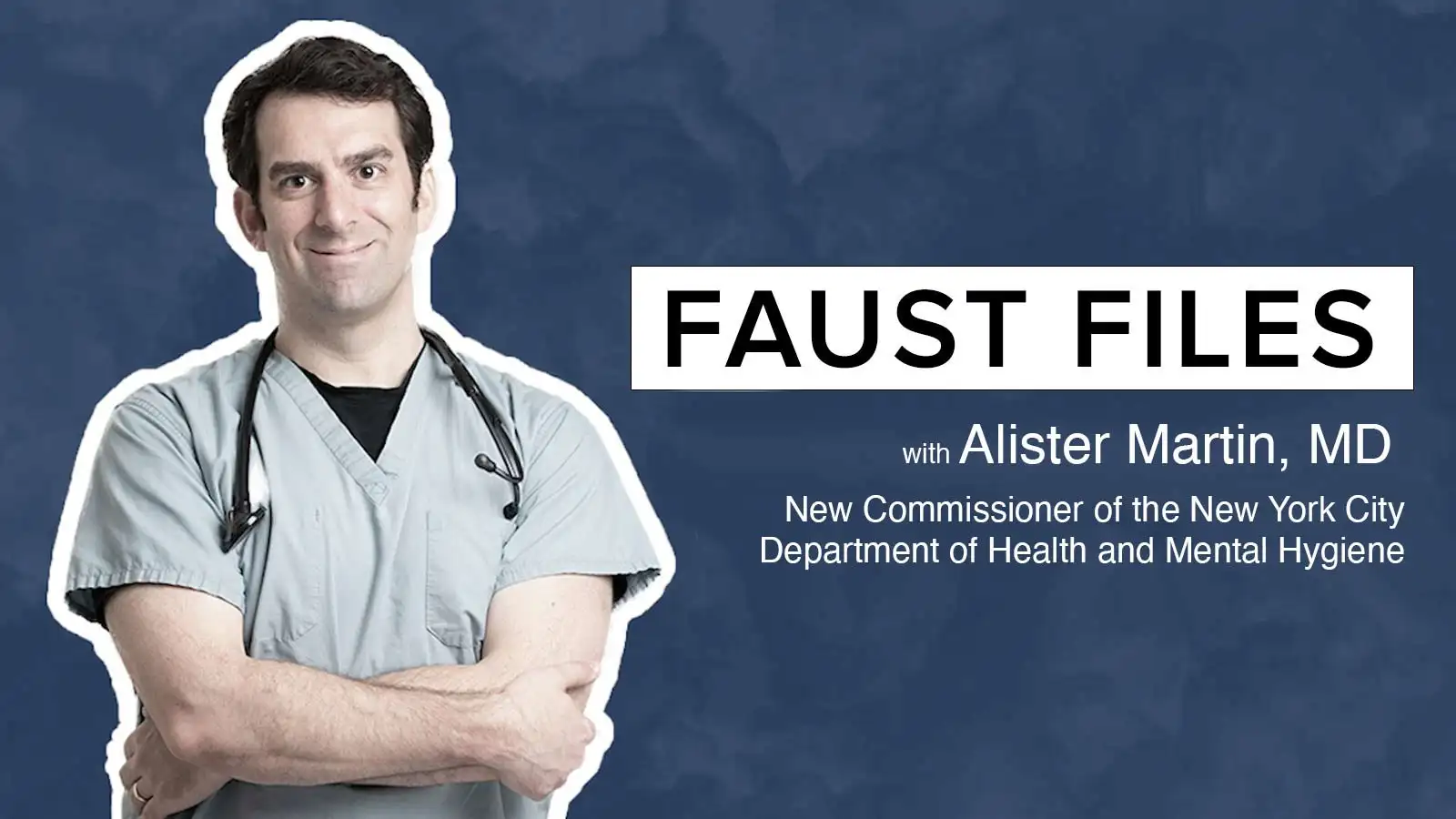
New York City’s new health commissioner, Alister Martin, MD, is stepping into the role at a time of growing tension between local public health officials and federal policy.
In a conversation with MedPage Today Editor-in-Chief Jeremy Faust, MD, Martin discusses his priorities for the city’s Department of Health and Mental Hygiene — including protecting Medicaid coverage, addressing affordability, and countering declining vaccination rates — while navigating what he calls unprecedented challenges from federal public health leadership.
The following is a transcript of their remarks:
Faust: Hey, it’s Jeremy Faust, editor-in-chief of MedPage Today. We are joined by the new Commissioner of Health for the City of New York, Dr. Alister Martin. Dr. Martin started as a resident ER physician in my program here in Boston. So I’ve known Alister since he was coming up, and his talent was apparent from the beginning. Since graduating from our program, he has joined the faculty of Harvard Medical School. He has been an attending physician. He went into the non-profit sector. He served at the White House. He now runs the Department of Health and Mental Hygiene in New York City, which oversees 7,000 employees. Dr. Alister Martin, thanks for joining us. Commissioner.
Martin: Dr. Faust, how are you? Thank you so much for having me. It’s good to catch up, brother.
Faust: So threading this needle as a doc and as a leader in the health and public health infrastructure. Look, there’s only so much time you have in the day and this job has a beginning, a middle, and an end. Tell me the key components of your strategy. What are your priorities? What are your verticals, as they say? What are the things you’re really hoping to achieve in the first year or 2 years of this position?
Martin: Yeah, so the priorities that we have in this department, Jeremy, No. 1, first and foremost, keeping New Yorkers safe and healthy and doing that in the face of quite frankly, federal setbacks. And we’re going to talk about what that means, but it’s not just the nonsense that we’re hearing with regard to public health communication and vaccine guidance from the federal government.
It’s also the threats to federal funding. And so doing that work of keeping New Yorker safe and healthy in the face of having to think about the threats that are coming from Washington, D.C. And this department is ready for that, and we are standing strong and leading in the face of that.
The second big priority is to advance the mayor’s affordability agenda. And there’s so much that I think we can do from the public health perspective to address affordability. We can’t do it all, Jeremy, but some of the big things are going to be really keeping people covered with regard to Medicaid, because we know that the upcoming policy changes with H.R. 1 [One Big Beautiful Bill Act] are going to mean people are going to get kicked off of their Medicaid for BS reasons.
We know, No. 2, that medical debt is still one of the biggest drivers of personal bankruptcy in this city. And so we’re going to continue our work erasing medical debt from thousands of New Yorkers. We’ve already done the work of erasing over $135 million in medical debt, and we’re going to amplify that. Third, every single year, New Yorkers are letting billions of dollars sit on the table because they’re not enrolling in things like rental assistance or WIC [Women, Infants, and Children] or Lifeline or EITC [Earned Income Tax Credit].
And so I think that we as a public health department can help connect people to that funding to address the financial instability in their lives. We’re going to help our agency partners throughout the city do that work through the lens of healthcare. And the last one is, you heard the mayor loud and clear on this, helping people who are struggling with eviction or dangerous living conditions.
I think we have a role to play there as well. If someone is screened within one of our clinics, helping them connect to our Right to Counsel program or help to get them connected to some of our other agency partners to help navigate them through the sticky situation they’re in at home. And the last big priority, the third, is just to make the work that we do in this department more visible and really tell the stories of what people do in this department day in, day out to keep New Yorkers safe and healthy.
Faust: So I’m curious though, and I know you wanted to talk about this, about this idea of affordability and reducing cost burdens on residents. But as the commissioner of health, what levers do you have other than to support the mayor’s initiatives or other deputies, mayor, or other people in the system? As commissioner with DOH, I know you have 7,000 people and a lot of resources, but what are the levers that you can actually use to advance that particular goal of affordability?
Martin: Well, you can’t have a conversation about affordability without having a conversation about healthcare. And we know that if you’re not covered, if you don’t have insurance, your healthcare costs are going to balloon to the point that you may not seek getting care. And so we think it’s a huge priority for us in this department to make sure that we’re keeping our New Yorkers who are eligible for Medicaid on Medicaid.
And so for the listeners at home, on January 1, 2027, H.R. 1, the big federal bill, will take effect with regard to Medicaid policy. It’s going to mean two things. No. 1, it’s going to mean that every single year, New Yorkers are going to have to reapply for Medicaid twice, and that’s new. That’s going to add burden, and that’s going to mean that people will fall off. Second, there’s going to be a new work requirement mandate that folks will have to do every single month.
And look, what we know from the facts are, when they tried this in Arkansas, what happened? People lost coverage. And these are people who were eligible for Medicaid. And so in this city, we are going to help make sure that folks have all the information they need, get the reminders they need. And if they come in through one of our clinics, we have over 11 different clinics, which are public health clinics. We’re going to help make sure that they remember to get re-enrolled. If we’re interfacing with them through our frontline teams, like Nurse Family Partnership or the Response and Engagement team or the relay team or the BCARE team, we’re going to do the work of helping to make sure they stay enrolled. We’re going to also work with all of our hospitals within Health + Hospitals and the voluntary hospitals to make sure that the message gets out to keep people enrolled in Medicaid.
And we’re going to also work with the thousands of physicians and nurses and social workers in this city to make it easier for them to remind their patients to stay enrolled in Medicaid. So that’s the big thing that we want to do in the first year here. It’s a lot more I could say about medical debt, which we’ll get into. A lot more I could say about evictions and benefits. But if you were to ask me, what do you want to do with regard to affordability? The first priority is really to help people stay covered when it comes to Medicaid.
Faust: All right. I want to turn to some kind of larger federal questions in just a minute. But before we do that, I want to circle back because when you listed off your priorities and the things you’re really thinking about and your strategic focus, I did not hear, which it makes sense, I did not hear the things that might keep you up at night, the things you might worry about, the things that can make life go sideways for someone in your role.
What are the things that you worry about right now that need to be addressed that you think are sore spots? And particularly, if you read the New York Times, they say, what are the things that could sink your tenure? One is something like there’s lead in the school pipes, or there’s an outbreak that isn’t well handled. What keeps you up at night and what are you doing to address those issues?
Martin: I have to tell you, one thing that’s really worrying me, Jeremy, is the way the federal government and the federal administration is dealing with public health education and vaccine guidance. I think that to say it bluntly, what the federal government is doing with vaccine guidance is creating a public health disaster. We are seeing it very clearly in the actions that they’ve taken, taking us out of the WHO, effectively gutting the CDC, muddling the language with regard to recommendations around trusted and proven vaccines. And the reality is we are already seeing here in this city declining rates of vaccinations on a couple of very, very key metrics.
The first is you look at the 0 to 2 cohort, for 2 year olds, that number for the seven series, the vaccination coverage has gone down from 64% down to 61% in just 1 year. A couple of other really important vaccine rates have also gone down, and we’re watching closely to see what exactly is going to happen long term.
And my hope is that these rates don’t continue to sustain this downward trend. But we’re not waiting for the federal government to come in and tell us what to do. Jeremy, we are, when the federal government is stepping back, stepping up here in this city to provide the guidance, to provide the clear messaging around vaccine guidance. You saw that we joined the WHO just 2 weeks ago, first big municipal city to do that.
I promise you we won’t be the last. You saw that we have been integral in creating the Northeast Public Health Collaborative. This is an association of cities and states in the Northeast that are helping to create best practices, helping to do the work of bringing us together in the face of the federal calamity, quite frankly. And the last thing, Jeremy, I’ll say is the federal government has tried in the past to take our money away, and they have threatened our funding.
And they did in the past try and withdraw about a hundred million dollars. And guess what? The last thing I’ll say is we went to court and we won. We got an injunction, we got our money back. And the bottom line is we are pushing forward on all counts to try and continue to lead in the face of the federal government that is not.
Faust: Well, moving towards the federal government, as you mentioned, there are all these new challenges. There’s the vaccine guidance, as you mentioned. There is this idea of funding being tied to administration priorities that they may think fly in the face of what your stated values are. How do you anticipate a situation where you have a program that’s been working for a long time or something you’re standing up that you believe in, and then the feds come in and say, “Actually, well, we’re going to pull your funding because that goes against our guidance and you can either make a choice: You can go ahead with that program or kiss the funding goodbye.”
Martin: Look, at the end of the day, we’re not fans of ultimatums. What we are fans of is doing the work that New Yorkers need every single day to keep them safe, keep them healthy. And the reality is the federal government has tried this in the past, which you’ve discussed, Jeremy, to come in and threaten and take away funding.
And what we’ve done in those cases is what we will do in the future, and that is fight back. And if that means litigation, that’s what it means. If that means advocacy, that’s what it means. If that means coalition building and bringing together our regional partners through the Northeast Public Health Collaborative, that’s what it means. And so at the end of the day, we are sticking by our priorities here in the city. We are not going to let folks in Washington, D.C., decide what’s best for New Yorkers.
And the reality is that this department has been through crises in the past. This department is 220 years old. We have been through crises like Ebola and yellow fever and COVID, and we will withstand this crisis too, because that’s what we do. We are resilient, we’re strong. And although these are unusual circumstances, this is an incredibly strong department that has been through much worse in the past.
Faust: But that is remarkable. If I just want to mark that moment and to say, when I asked you what bothers you, what keeps you up? What are you worried about? You did not say a novel outbreak of a pathogen. You did not say an environmental exposure, a spill, lead in the school pipes. You said the thing you’re worried about most is the United States federal government. And I think that’s an amazing situation that we need to reflect upon.
In terms of your role as now one of our nation’s leaders in the public health space, you talk about trust. How do we rebuild that outside of a very performative thing? I’ll be very straightforward and say, I think that the federal government right now is talking a lot about rebuilding trust. I don’t think they’re doing much about that. They’re talking about it, they’re saying it, but I don’t believe they’re doing a particularly good job of actually exhibiting that trust being rebuilt.
They’re just talking about it. So how do you think about rebuilding trust to the extent that that needs to happen in New York in a way that’s not performative? What are you looking for as signs that that’s happening?
Martin: Jeremy, I think that at the end of the day, you can only move at the speed of trust in public health. And the reality is we as an agency, as a government entity, we are, in this city, more trusted than those folks over in Washington, D.C. We know that from the polls that we have when we ask New Yorkers. And at the same time, we are not the most trusted entities to deliver public health education. We know who is, and that is the physician that’s in the life of that patient. It’s the pediatrician that’s helping that family. It’s the primary care doctor that’s helping that mom of two decide what’s best to do for herself and for her children.
And so that’s why we are so committed to continuing to support programs like the Vaccines for Children’s Program. We have over 1,200 providers that we support every single year, over $200 million in funding to make sure that they, the trusted messengers, have the resources that they need to get their patients vaccinated.
It’s the reason why we have a robust citywide immunization registry, which gives us the ability to really clearly understand what the areas, where the areas are, where the ZIP codes that are lowest in terms of things like vaccine coverage. So we can go there and see who are the best trusted messengers in those communities and use them as messengers.
And so what does that look like in New York City? It means working with, for instance, the Orthodox Jewish community with the Haredi Health Coalition. It means being in places of worship. It means being in community centers. It means taking the information that families need to make these decisions into their homes. And Jeremy, it’s a really important concept in public health that we are beginning to implement at scale nationally. I think people are understanding this. It’s not so much about the message, it’s about the messenger.
And we are spending a lot of time really making sure that we’ve got the right messengers to deliver these messages.
Faust: Dr. Alister Martin, good luck in your new position, and we’ll be watching very carefully as the years unfold. Thanks for joining us.
Martin: Dr. Faust, thank you so much.
Source link : https://www.medpagetoday.com/opinion/faustfiles/120240
Author :
Publish date : 2026-03-10 17:32:00
Copyright for syndicated content belongs to the linked Source.