[ad_1]
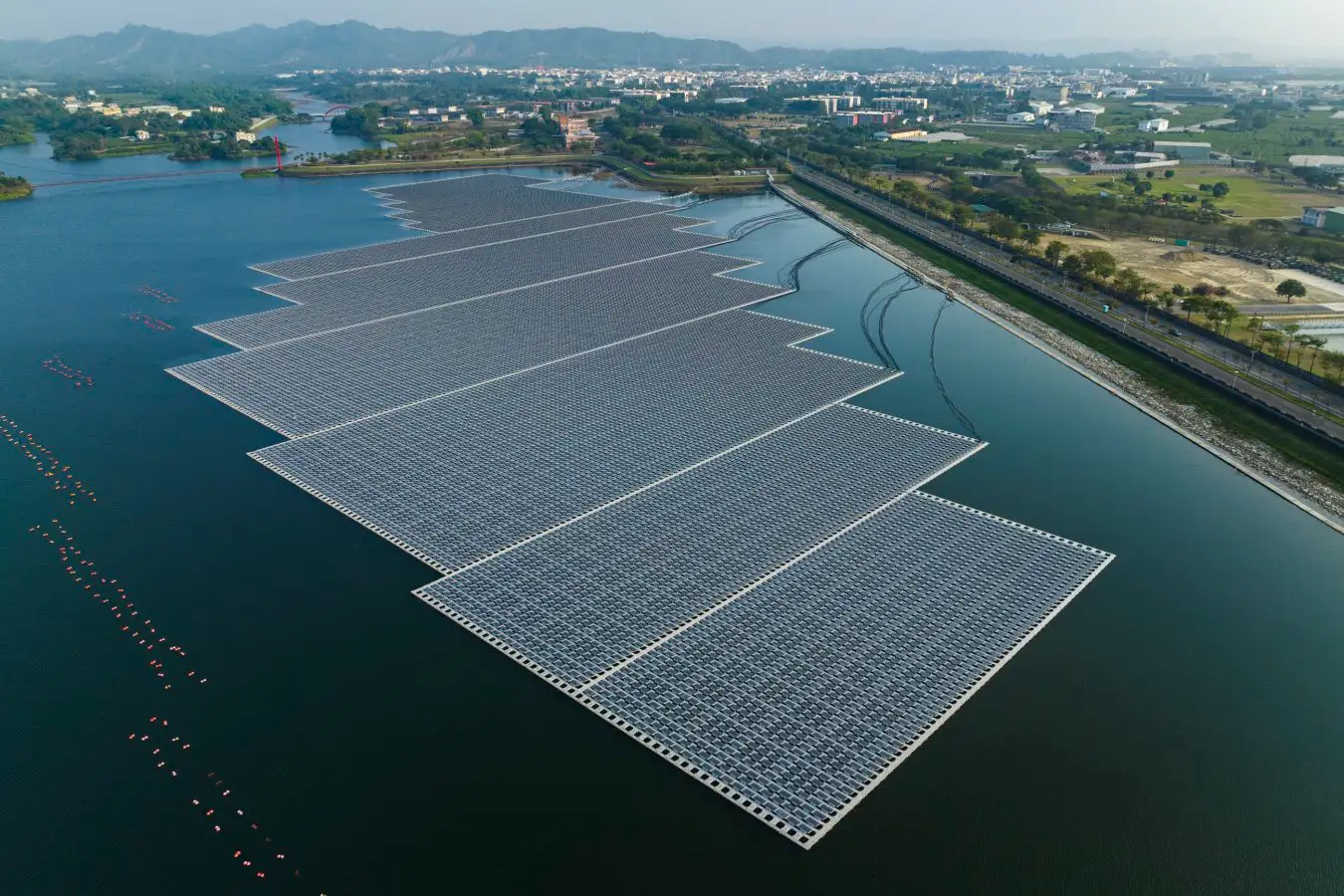
A floating photovoltaic project by Chenya Energy
Getty Images/iStockphoto
The ocean could be the next frontier for the world’s rapidly expanding solar energy industry. That’s the finding of a study showing a floating solar farm off the coast of Taiwan produces more electricity and more profit than a nearby solar farm on land.
Taiwan is roughly the same size as the Netherlands, but it is mostly mountainous and has 5 million more people, meaning open space is scarce. As a potential solution, Chenya Energy built a 181-megawatt offshore floating photovoltaic (OFPV) project – sometimes called a “floatovoltaic” – on 1.8 square kilometres of water in the protected bay of an industrial park in western Taiwan in 2020-21.
The year before, the Taiwan Power Company had constructed a 100-megawatt land-based photovoltaic (LPV) project on 1.4 square kilometres near the bay, providing an ideal comparison once researchers excluded the additional 81 megawatts of capacity at the floating solar installation.
Pound-for-pound, the floating solar produces 12 per cent more electricity than the land-based solar, they found. Even though it has slightly higher operations and maintenance costs, it generates 11 per cent net profit, as opposed to 8 per cent for the land-based solar.
“Installing the PV system on the sea, on water, is more difficult than installing the PV system on the ground,” says lead author Ching-Feng Chen at the National Taipei University of Technology. But “for the carbon reduction, emissions reduction, OFPV is much better than LPV”.
More than 1100 floating solar systems have been built on lakes and reservoirs, mostly in China and other densely populated Asian countries.
While the main attraction is that they don’t take land away from farming or development, they can also generate up to 20 per cent more electricity than land-based systems, although that number varies widely from site to site. The improved performance comes from the fact that solar panel efficiency declines as temperatures rise, and because conditions are typically 2-3°C cooler over water than over land. The stronger winds experienced over large bodies of water also contribute to this cooling effect.
“The principal enemy is the heat,” says Chen.
Floating solar on the ocean, where temperatures are even lower than on lakes and reservoirs, can produce more electricity still. But it’s also more challenging to build, and only a handful of projects have been deployed. The largest is in China, a 1-gigawatt system in shallow waters off the coast of Shandong province.
A framework of solar panels is attached to buoys and anchored to the ocean bottom. The floating solar in Taiwan rests directly on the seabed when the tide is out.
Installation costs in general are expected to be about 30 per cent higher on sea than on land because the systems have to resist humidity, rust, salt and waves, says Chen.
Salt and bird droppings also build up. Employees of the Taiwan project have to scrub the panels from walkways and patrol for driftwood and debris on jet skis. But the higher electricity output will more than compensate for these costs over a project’s lifetime.
Chen’s study did not consider the long-term wear and tear of waves and storms. That could become a bigger factor as offshore wind farms consider using floating solar to generate power when the wind isn’t blowing. Combined wind and solar covering 1 per cent of suitable ocean surface could provide almost 30 per cent of global electricity demand in 2050, a study published last year found.
German and Dutch companies have been testing two solar projects about 12 kilometres off the coast of the Netherlands, one of which has survived waves of up to 10 metres since 2019. But last year, Shell and Eneco removed another floating solar system off the Netherlands’ coast – this one installed at the Hollandse Kust Noord offshore wind farm – after a defective electrical connector led to overheating.
Another concern is that floating PV shadows the water column and reduces wind mixing, which can diminish oxygen and light available for aquatic life like phytoplankton and seaweed.
“If you do it further offshore, then maybe the waves and weather conditions and so on will become more problematic, but the closer to the shore the less favourable for biodiversity,” says Vincent Bax at HZ University of Applied Sciences in the Netherlands.
Given that it impacts human activities less than land-based solar, however, “there’s definitely potential for this technology”, he says.
Because offshore PV is technically challenging, Chen thinks it will expand mainly in sunny islands that don’t have much offshore wind power, like Taiwan, Japan, Indonesia and Caribbean nations.
“Location is very important,” he says.
Topics:
[ad_2]
Source link : https://www.newscientist.com/article/2527155-solar-farm-on-the-ocean-outperforms-land-based-solar-in-taiwan/?utm_campaign=RSS%7CNSNS&utm_source=NSNS&utm_medium=RSS&utm_content=home
Author :
Publish date : 2026-05-19 16:00:00
Copyright for syndicated content belongs to the linked Source.