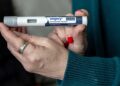
Implantation of a temporary prostatic urethra expander resulted in sustained improvements of lower urinary tract symptoms (LUTS) in men with benign prostatic hyperplasia (BPH), results from the sham-controlled trial showed.
Men who had the Urocross Expander System implanted had an average reduction in their International Prostate Symptom Score (IPSS) of 49% at 12 months — 6 months after removal of the device — which continued to improve up to 30 months (55.2% reduction), reported Kevin McVary, MD, of Loyola University Medical Center in Chicago, at the American Urological Association (AUA) annual meeting.
This group had a responder rate (defined by the FDA as an improvement of at least a 30% in IPSS at 12 months) of 74.4%.
The expander system, which was cleared in March, consists of a sterile, single-use, nitinol-based implant that is designed to remain inserted for up to 6 months and retrieved through standard cystoscopy, with the idea that it will “remodel the prostate,” allowing for long-term LUTS relief, McVary explained.
Clearance was based on data from the current trial (Expander-2) and was supported by the 12-month data presented here at AUA. Though no significant difference was observed for the study’s primary efficacy endpoint — at 3 months, the expander group had an average IPSS reduction of 25.7% compared with a reduction of 24.2% for the sham group — the intervention provided symptom relief.
“An incremental improvement in LUTS is a newer observation, unique as far as I’m aware. I think [it] validates, in part, our concept of remodeling the prostate by having this indwell for a limited period of time, and then a planned retrieval, and then that sustained improvement,” McVary said. “The advantage to patients is no permanent foreign body left in the urethra, which I think has an intrinsic appeal to many men.”
Expander-2 was a randomized, blinded, prospective trial that took place at 23 sites across the U.S. and Canada and included men ages 45 and older with moderate to severe symptomatic BPH based on the IPSS (a 0-35 point scale, with a score of 0-7 considered mild, 8-19 moderate, and 20-35 severe). Men were eligible if they had a prostate volume of 30 to 80 cc, and an IPSS of ≥13.
Patients had a mean age of 66 years, a mean prostate volume of 46.4 cc, and a mean IPSS score of 24.6.
Men in the expander arm (n=160) underwent implantation followed by intentional retrieval at 6 months, while sham patients (n=80) underwent cystoscopy and were blinded through 3 months.
The expander arm had a reduction in IPSS of 32.0% at 6 months prior to retrieval, with an immediate improvement at 7 months (-45.2%).
“There’s a prompt improvement at the 6-month mark,” McVary noted.
Quality-of-life scores (scale 0-6, ranging from completely satisfied to severely distressed) improved from 4.6 to 2.2 at 12 months, and remained stable through 30 months. Erectile and ejaculatory function was preserved, and urinary incontinence improved.
On a scale of 0-10 (with 0 indicating no pain and 10 the worst pain), the mean post-procedural pain score was 2.5, which fell to 1.0 at 1 week after the procedure. The mean pain score after retrieval was 1.9.
Regarding safety, no device- or procedural-related serious adverse events (AEs) occurred, and the rate of extended postoperative urinary catheterization (>7 days) for inability to void was 0.6% post-implant, 2.5% post-retrieval, and 0% in the sham arm.
As far as related AEs, “when you put scopes in urethras, men — with sham and otherwise — will report some very mild discomforts,” McVary observed.
In the intervention arm, 36.9% of men experienced an AE within 30 days after implant, while 18.8% reported an AE after retrieval, including dysuria, hematuria, pain, and urgency.
Source link : https://www.medpagetoday.com/meetingcoverage/aua/121313
Author :
Publish date : 2026-05-18 15:59:00
Copyright for syndicated content belongs to the linked Source.