


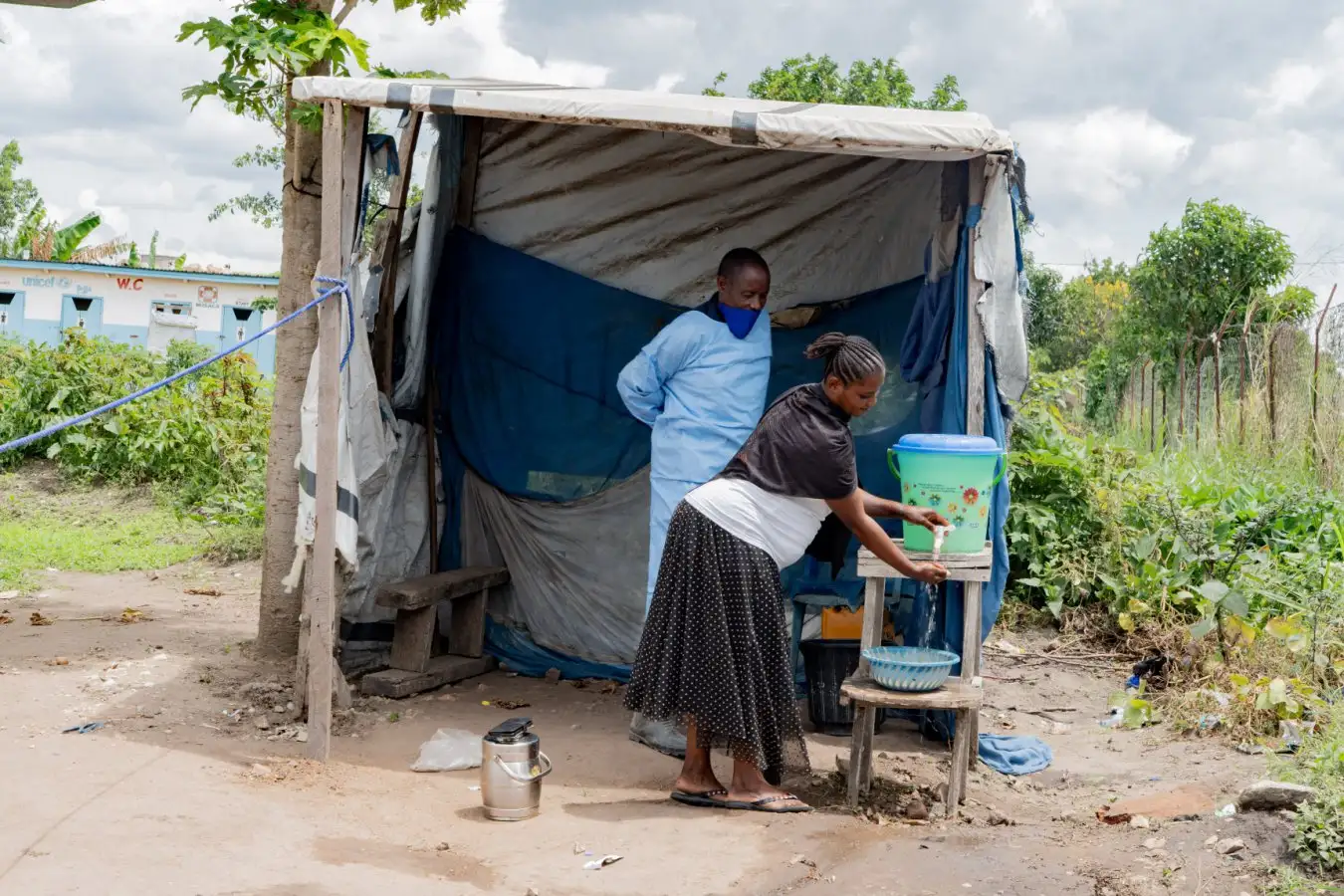
A health worker instructs a local resident to wash their hands in Rwampara, Democratic Republic of the Congo, on 16 May, amid the Ebola outbreak
Xinhua/Shutterstock
Vaccines for a suite of lethal viruses – including the one behind the unfolding Ebola emergency – must be developed urgently, warn epidemiologists. They also caution that while the global pandemic potential of Ebola is minimal, the outbreak highlights the perils of funding cuts at the World Health Organization.
The US began withdrawing funding for the World Health Organization (WHO) in early 2025, which forced the organisation to slash its budgets for 2026/27. “The key here is that the WHO is now greatly underfunded and they’ve had to shed huge numbers of staff,” says Adrian Esterman at Adelaide University, Australia. “So I think that the message here is that America leaving the WHO has been disastrous, basically.”
The WHO was made aware of an outbreak of Ebola in the Democratic Republic of the Congo (DRC) on 5 May. Cases have now also been reported in Uganda.
“The first currently known suspected case, a health worker, reported onset of symptoms including fever, haemorrhaging, vomiting and intense malaise on 24 April 2026,” according to the WHO. On 17 May, the organisation declared the crisis in the DRC and Uganda to be a public health emergency of international concern.
The US Centres for Disease Control and Prevention says that as of 17 May, there were 336 suspected cases of an Ebola strain called Bundibugyo, and 88 related deaths. The Bundibugyo strain has a mortality rate of between 20 and 50 per cent among known cases.
There are two licensed vaccines for Zaire ebolavirus, the strain that has caused the biggest outbreaks and has the highest case-mortality rate, at up to 90 per cent. No vaccines exist for Bundibugyo virus, though some promising trials have been undertaken in non-human primates. This means the WHO has been emphasising the importance of containment for halting the spread of the Bundibugyo virus.
In January this year, the University of Oxford announced that, in collaboration with partners including Moderna, it was working on vaccine candidates that would target multiple filoviruses – a group of RNA viruses that can cause lethal haemorrhagic fevers – including Bundibugyo and other strains of Ebola, as well as Marburg viruses.
Now, Esterman says that in light of the new crisis, this work must be brought forward. “The current outbreak makes a compelling case for accelerating this work,” he says. “We’ve known Bundibugyo exists for nearly two decades, yet we still lack vaccine options. This outbreak shows the real cost of that gap.”
He says a multivalent vaccine development programme addressing all known filovirus species “shouldn’t wait for bureaucratic and regulatory slowness”. “Faster doesn’t mean cutting safety corners, but there’s room to undertake vaccine trial phases in parallel, increase funding and use adaptive designs,” adds Esterman.
Raina MacIntyre at the University of New South Wales, Sydney, Australia, says that until now, Ebola vaccine research has been focused on the Zaire strain. But she says that mRNA technology means that vaccines for filoviruses like Bundibugyo can be developed “very quickly”.
One reason these filoviruses don’t have vaccines yet is because of the economics of drug development, says MacIntyre. “Ebola is a disease that affects predominantly low-income countries, and 90 per cent of drug development happens around diseases that affect people in high-income countries,” she says.
MacIntyre adds that because Ebola doesn’t spread as easily as infections such as SARS-Co-V2, the outbreak is unlikely to spread to other continents as a pandemic. But isolated “low-risk, high-consequence” cases in wealthier nations are possible as travellers to the impacted areas fly elsewhere in the world, she says.
Emergency departments everywhere should ask any patients presenting with a fever whether they have travelled in Central Africa so adequate quarantine measures can be put in place, says MacIntyre. “Any emerging infectious disease, whether it’s MERS [Middle Eastern respiratory syndrome] coronavirus, Ebola, hantavirus or even something like measles, spreads through travel,” she says.
“If they don’t identify that you’ve travelled somewhere where a serious epidemic is happening, you could be sent out to the waiting room to sit there for 3 hours until you’re seen and infect other people.”
Topics:
Source link : https://www.newscientist.com/article/2527072-the-ebola-emergency-shines-a-light-on-the-urgent-need-for-new-vaccines/?utm_campaign=RSS%7CNSNS&utm_source=NSNS&utm_medium=RSS&utm_content=home
Author :
Publish date : 2026-05-18 13:11:00
Copyright for syndicated content belongs to the linked Source.