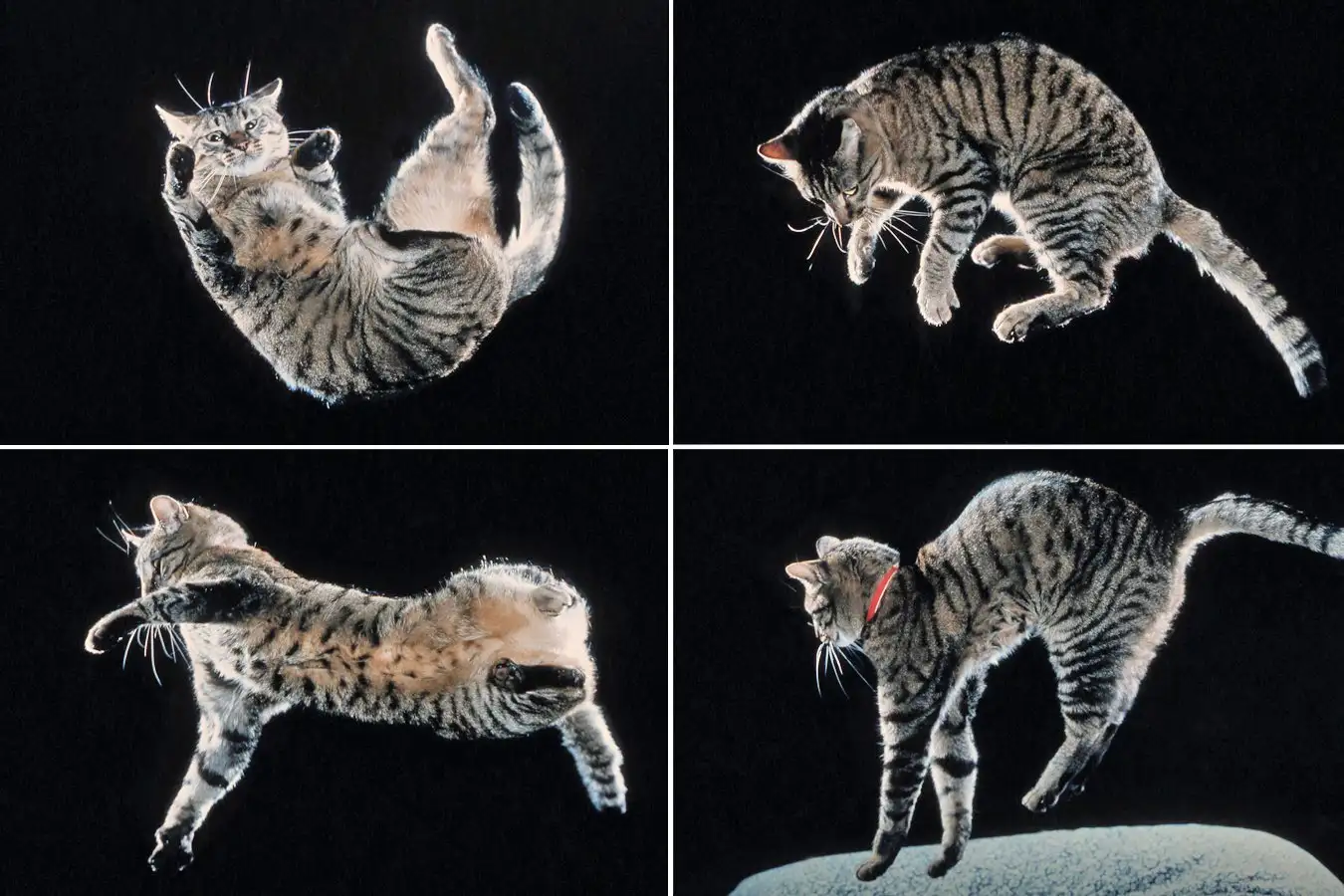
Falling cats seem to twist the front half of their body first
Evolve/Photoshot/ZUMAPRESS/Alamy
When falling cats turn themselves the right way up before they hit the ground, they have a secret trick: a region of their spine that is exceptional at twisting.
“We compared the flexibility of the thoracic spine and lumbar spine in cats, and we found that the thoracic spine is very flexible,” says Yasuo Higurashi at Yamaguchi University in Japan.
Cats famously always land on their feet. If you hold a cat upside down and drop it, the animal will quickly wriggle in mid-air and land confidently on its feet.
Quite how cats achieve this has been challenging scientists for over 100 years. Three main ideas have emerged.
One is the propeller tail: the cat swings the tail one way, causing its body to rotate the other way. “The tail seems to be the least important, because if it doesn’t have a tail it can still turn over,” says Greg Gbur at the University of North Carolina at Charlotte, author of Falling Felines and Fundamental Physics.
Another idea, the bend-and-twist model, proposes that the cat would bend its body almost into a right angle, then turn its front half one way and the back half the other. This means the front and rear legs both arrive at the correct position at the same time.
Or the cat could rotate the front first and then the back in a tuck-and-turn. To do this, it would extend its rear legs while keeping its front legs scrunched up, and twist its front half. Then it would swap so the front legs were extended and the rear ones contracted, and twist its rear half. This would mean one pair of legs is correctly oriented before the other.
To find out what cats really do, Higurashi and his colleagues performed two experiments. In the first, they examined the spines of five deceased cats and twisted them to see how much each region could rotate without breaking. They focused on the thoracic spine, from the middle of the back, and the lumbar spine, from the lower back. It turned out that the thoracic spine had a range of motion three times that of the lumbar spine.
Second, the team took high-speed video of two adult cats being dropped from a height of 1 metre. In both cases, the cats finished rotating their fronts tens of milliseconds before their rears.
“My general impression has been that the bend-and-twist is the most important, but this paper actually makes me reassess a bit and give a little bit more credence to the tuck-and-turn,” says Gbur. The highly flexible thoracic spine suggests to him that the front of the cat’s body might be rotating more. Furthermore, in the live experiments, “it really does look like the upper [front] part of the body is properly oriented first”.
Gbur emphasises that the models are not mutually exclusive. “Physicists in particular love to look for simple models of how things work, whereas nature tends to look for the most effective method, which may not be simple,” he says. “Cats are complicated creatures doing complicated motions.”
The study also threw up a strange detail. Both of the live cats rotated to the right as they fell: one did so every time, the other in six out of eight trials. Gbur says an audience member at one of his talks noticed that the cats in his videos also seemed to turn to the right. “It looks like, at least anecdotally, cats seem to have a rough preference for which way they twist,” he says. It’s not clear why; it may be that asymmetries in the placement of cats’ internal organs mean it’s easier to turn one way than the other.
Topics:
Source link : https://www.newscientist.com/article/2518096-the-secret-of-how-cats-twist-in-mid-air-to-land-on-their-feet/?utm_campaign=RSS%7CNSNS&utm_source=NSNS&utm_medium=RSS&utm_content=home
Author :
Publish date : 2026-03-04 18:00:00
Copyright for syndicated content belongs to the linked Source.