[ad_1]
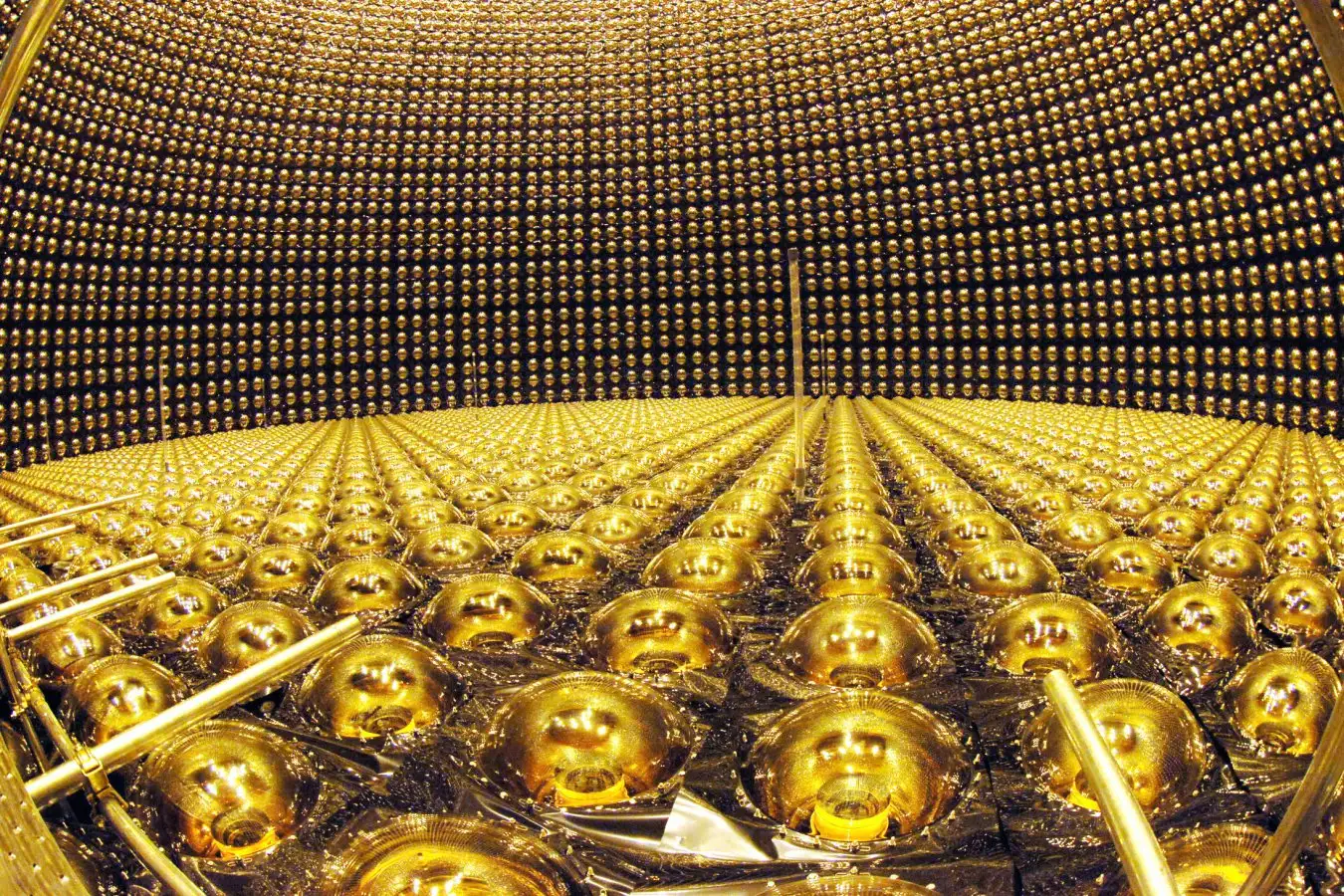
The Super-Kamiokande neutrino detector facility in Japan
The Asahi Shimbun via Getty Images
The standard model of particle physics may be due for a philosophical remodel, including rethinking what qualifies each of its particles to count as a particle to begin with.
Whether a particle is involved in making up matter or carrying a force, it or its constituent parts has a place in the standard model of particle physics. In this way, the standard model is similar to the periodic table of elements – it tabulates the building blocks of our world. But George Hobart at the University of Bristol in the UK now argues that this tabulation may need to be revisited, and even changed, to make for a more sound model of physical reality.
At the heart of his reasoning are particles called neutrinos, which are notoriously elusive because they only interact with other particles very weakly through gravity or across very short distances through the weak nuclear force. Additionally, their mass isn’t precisely known, nor can the standard model predict it through the so-called Higgs mechanism that explains the masses of all other particles.
There is another oddity, too. The standard model tabulates three different neutrinos – the electron neutrino, muon neutrino and tau neutrino – each of which has a more massive “big brother” particle that it shares a name with: electron, muon and tau. While an electron can’t spontaneously become a muon, an electron neutrino can, for example, randomly turn into a muon neutrino.
Hobart says it helps to visualise the standard model as an actual table with all the neutrinos in one row and their big brothers in another. “We have no evidence for the big brothers being able to swap horizontally; we have very good evidence that they can’t. But for some reason, the neutrinos… they are able to swap horizontally.”
Hobart says that to a philosopher, this begs the question of whether categorising the particles in this way makes sense. From numerous experiments, we know that neutrinos exist and what properties all the other particles in the standard model have, but there are multiple ways to turn that knowledge into a system of understanding, or an ontology.
The current rows and columns of the standard model are based on the particle properties of mass and “flavour”, which is the property that sets the three neutrinos apart. Neutrinos are troublesome on both fronts because they can change flavour and how they gain mass is mysterious, so Hobart proposes recasting the standard model so that its building blocks become “families”, or whole rows, rather than the individual particles that comprise them.
In this way, the three neutrinos would be quantum states of some more fundamental entity, rather than three distinct objects. This might change how researchers think about their mysterious swapping abilities by getting them to first focus on what they most fundamentally share, says Hobart.
“This is not changing any of the physics,” he says. “Rather [we] take this amazing theory that humans have been creating for close to a century now and try to figure out, how do we interpret this in a more philosophical way and how should that influence our picture of the world? That picture of the world then might help us look in new areas.” Hobart presented the work at the Foundations of Physics conference in Irvine, California, on 17 June.
Noel Swanson at the University of Delaware says that the way particles are typified within the standard model relies on idealisations of what it means to be a particle, which philosophers are still debating. Proposals like Hobart’s are worth thinking through and it would be surprising if properties like mass or flavour eventually proved to be the most fundamental properties of physical objects, he says.
“I suspect that, at a more fundamental level, you have something that looks approximately like a field, and the particles are different kinds of excitations of that thing. It makes sense to categorise excitations the way we do in the standard model, but if you view those as sort of like fundamental ‘joints’ of nature, that would probably be a mistake,” says Swanson.
The discussion about the exact philosophical nature of particles is ongoing, as are experimental investigations of neutrinos. Philosophy and more applied branches of physics rarely work in close contact, but here there might be a chance for the two to inform each other, says Swanson.
“How you interpret these quite weird particles might motivate which lines of research you want to go down next,” says Hobart.

CERN and Mont Blanc, dark and frozen matter: Switzerland and France
Prepare to have your mind blown by CERN, Europe’s particle physics centre, where researchers operate the famous Large Hadron Collider, nestled near the charming Swiss lakeside city of Geneva.
Topics:
- philosophy/
- particle physics
[ad_2]
Source link : https://www.newscientist.com/article/2532479-the-weirdness-of-neutrinos-could-completely-rewrite-particle-physics/?utm_campaign=RSS%7CNSNS&utm_source=NSNS&utm_medium=RSS&utm_content=home
Author :
Publish date : 2026-07-01 15:00:00
Copyright for syndicated content belongs to the linked Source.