[ad_1]
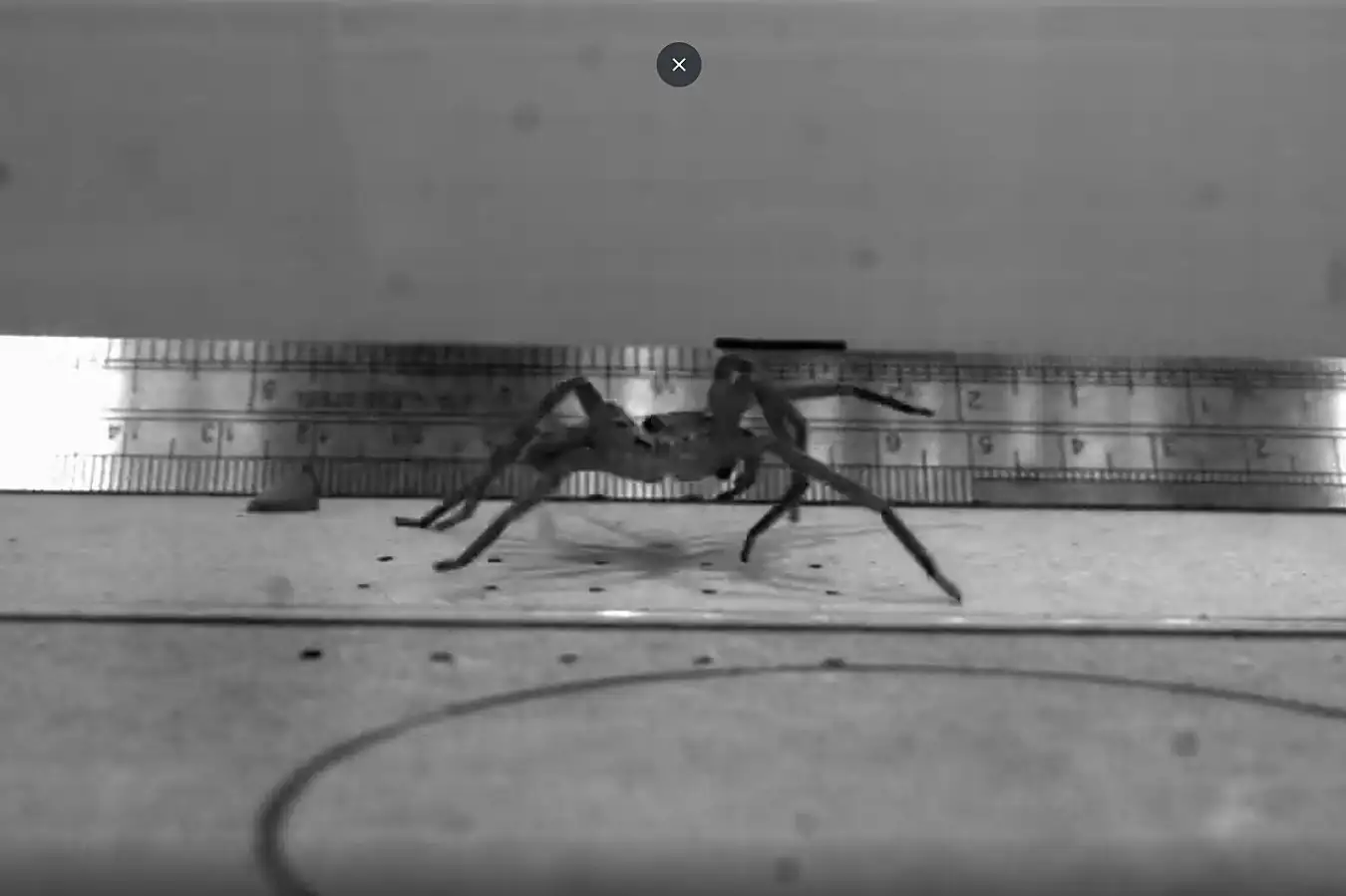
A jungle huntsman spider during a speed test
Christofer Clemente/University of the Sunshine Coast
A huntsman spider found in Queensland, Australia, has been crowned the fastest spider in the world with a top speed of nearly 3.6 metres per second, according to a global study of arachnid sprinting prowess.
Currently, the official world record is held by the Moroccan flic-flac spider (Cebrennus rechenbergi) which can hit speeds of 1.7 metres per second when it is startled, using a rolling-tumbling motion. But some experts regard this as incorrect.
“The flic-flac is a special type of locomotion,” says Jonas Wolff at University of Greifswald, Germany. “It is not running and it only works downhill on sand dunes.”
To get a comprehensive picture of running speed in spiders, Shreyas Kuchibhotla at Imperial College London and his colleagues, including Wolff, collected 162 live spider species during fieldwork throughout the UK, North America, southern Europe and Australia, along with dozens of specimens sourced from pet shops.
Each of these was carefully weighed then tested for their speed on A4 or A3 grid paper, in an attempt to understand the biomechanics across as many species as possible.
Most species were coaxed into running by gently touching them with a paintbrush, but others weren’t so cooperative, says Kuchibhotla. “This project would have been over in a month if spiders could understand English,” he says. “Tarantulas aren’t built for running; they’d much rather stand their ground, so they had to be blown at with puffs of compressed air.”
Kuchibhotla and his colleagues also collected speed recordings of a further 96 species made by other research teams. The 3-gram jungle huntsman spider (Heteropoda jugulans) was clocked at 3.59 metres per second by Christofer Clemente and his colleagues at the University of the Sunshine Coast in Australia.
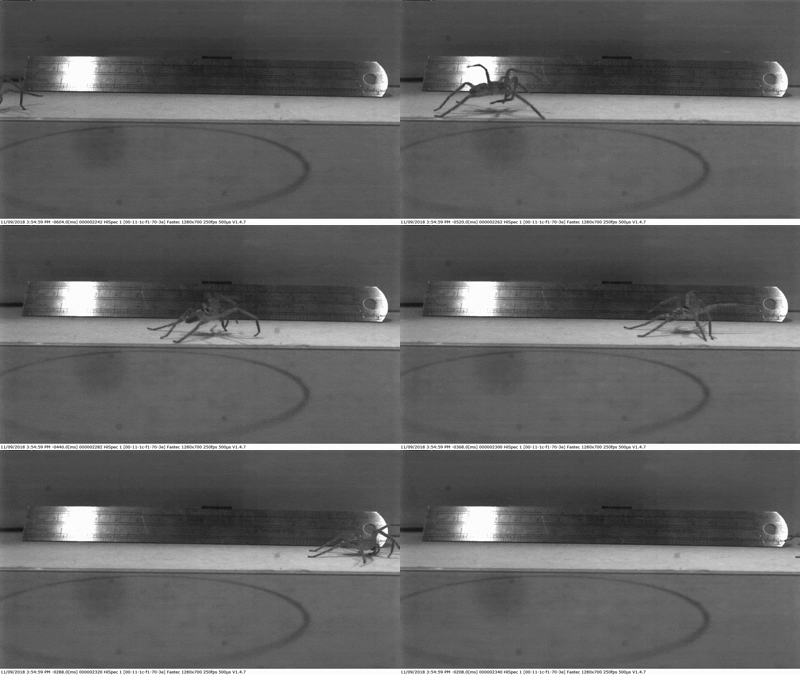
The jungle huntsman is the fastest spider in the world
Christofer Clemente at the University of the Sunshine Coast
These spiders can achieve such high speeds because they are “relatively large as far as spiders go, but not large enough that their legs get over- burdened by a heavy abdomen,” says Clemente.
In general, bigger spiders tended to be faster, but some are much faster than expected for their size. The biggest surprise was the orange goblin spider (Oonops pulcher), which weighs a mere 0.1 milligrams but moved at over 20 centimetres per second. “Nothing could have prepared me for how it practically teleported across the arena,” says Kuchibhotla.
David Labonte, a team member at Imperial, says speed is, in principle, entirely determined by physics. But it is lifestyles such as hunting strategies that drive the evolution of extreme anatomical and physiological adaptations, he says.
“A cheetah, say, comfortably outruns most similarly sized dogs. This is, of course, because its lifestyle has made this speed beneficial, but it is still dictated by physics,” says Labonte.
After accounting for both body size and shared ancestry, the team’s conclusion is that fast running is associated with relatively longer legs but not with leg slenderness or, surprisingly, whether a spider lives its life upside down or not.
Leanda Mason at Edith Cowan University in Perth, Australia, says long legs appear to be a spider’s “speed gear”. “The huntsman supplies the record-book hook, but the deeper discovery is that spider speed is shaped by leg architecture and evolutionary history, not simply by size or whether a spider spins a web,” says Mason.
Topics:
[ad_2]
Source link : https://www.newscientist.com/article/2532086-the-worlds-fastest-spider-tops-3-5-metres-per-second/?utm_campaign=RSS%7CNSNS&utm_source=NSNS&utm_medium=RSS&utm_content=home
Author :
Publish date : 2026-06-30 18:00:00
Copyright for syndicated content belongs to the linked Source.