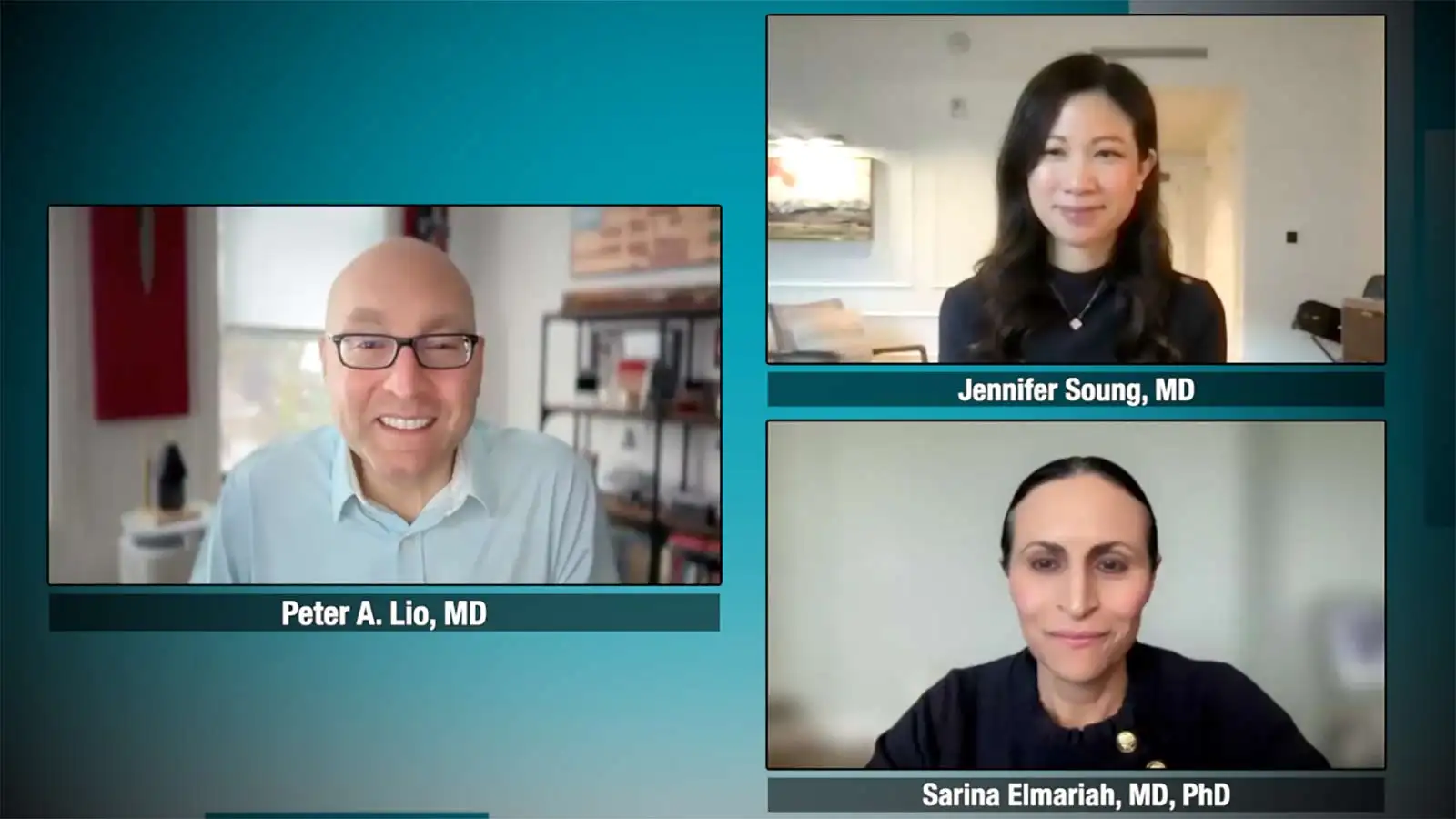
MedPage Today brought together three expert leaders for a virtual roundtable discussion on atopic dermatitis (AD) following the American Academy of Dermatology annual meeting: Moderator Peter A. Lio, MD, of Northwestern University Feinberg School of Medicine in Chicago, is joined by Sarina B. Elmariah, MD, PhD, of the UCSF Center for Itch and Neurosensory Disorders in San Francisco, and Jennifer Soung, MD, a dermatologist and director of clinical research at Southern California Dermatology in Orange County.
In this final episode, the panel discusses new data on potential use of the topical phosphodiesterase 4 (PDE4) inhibitor roflumilast (Zoryve) in AD patients as young as 3 months and what an additional once-daily nonsteroidal option could mean for infants, young children, and their families.
Watch the other episodes here.
Following is a transcript of their remarks:
Lio: So from highly-targeted systemics, I’d like us to just for our last section here to talk about something that’s a little broader and touches even more lives. These are some of our topical agents, and we got to see some new updates on topical roflumilast, a PDE4 inhibitor.
What’s really exciting is, right now, essentially all of our drugs have a base of about 2 years of age, except for crisaborole [Eucrisa], which goes down to 3 months, which is awesome, but we need more. We need definitely more options there.
So we got some data now finally that topical roflumilast at an even lower dosing percentage can be used potentially safely and effectively in the 3-month range all the way up, of course, all the way through adulthood. Now, any thoughts on that? What might that mean clinically to have something that is pretty safe and pretty effective, but also quite gentle and once-daily that could be used in this younger population?
Soung: I think it’s huge. That population in particular, not only is the baby suffering, but also the family because baby’s not sleeping, parents aren’t sleeping. So having a nonsteroidal option is huge. And I think that gives a lot more reassurance and peace of mind to parents.
Elmariah: It’s also wonderful because as a once-daily application, mild to moderate AD, these 34% of the kiddos achieved an IGA [Investigator Global Assessment] of 0-1 with a two-point improvement or more, and 58% achieved an EASI 75 [75% improvement in Eczema Area and Severity Index] from a topical once-a-day at week 4. And I think that that’s really pretty impressive. And those numbers even looked great at 2 weeks.
So again, I really echo this. It’s about the whole experience of AD, the baby, the parents, the emotional aspect of that, even just the sleep component. And so I think all of that rolled into one, having more topicals for this age group is really critical.
Lio: Totally agree. Steroids are still super important. Essentially, all of my patients are going to get steroids in some way, shape, or form, but we want to be good stewards and having more nonsteroidal options for the right patient can really be a game-changer. It can open the door, especially now we’re seeing a lot of corticophobia families say, “I don’t want any more. I’m freaked out about this.” To have something that we can use and say, “Listen, this is a different category. It might not be a right fit for everybody,” but I love having these options because at the end of the day, every pot has a lid and our job is to find it.
On that note, thank you guys so much. This has been wonderful. I really appreciate it and thank you all for joining us today.
Source link : https://www.medpagetoday.com/meetingcoverage/aad-expert-video-roundtable/121226
Author :
Publish date : 2026-05-12 18:17:00
Copyright for syndicated content belongs to the linked Source.