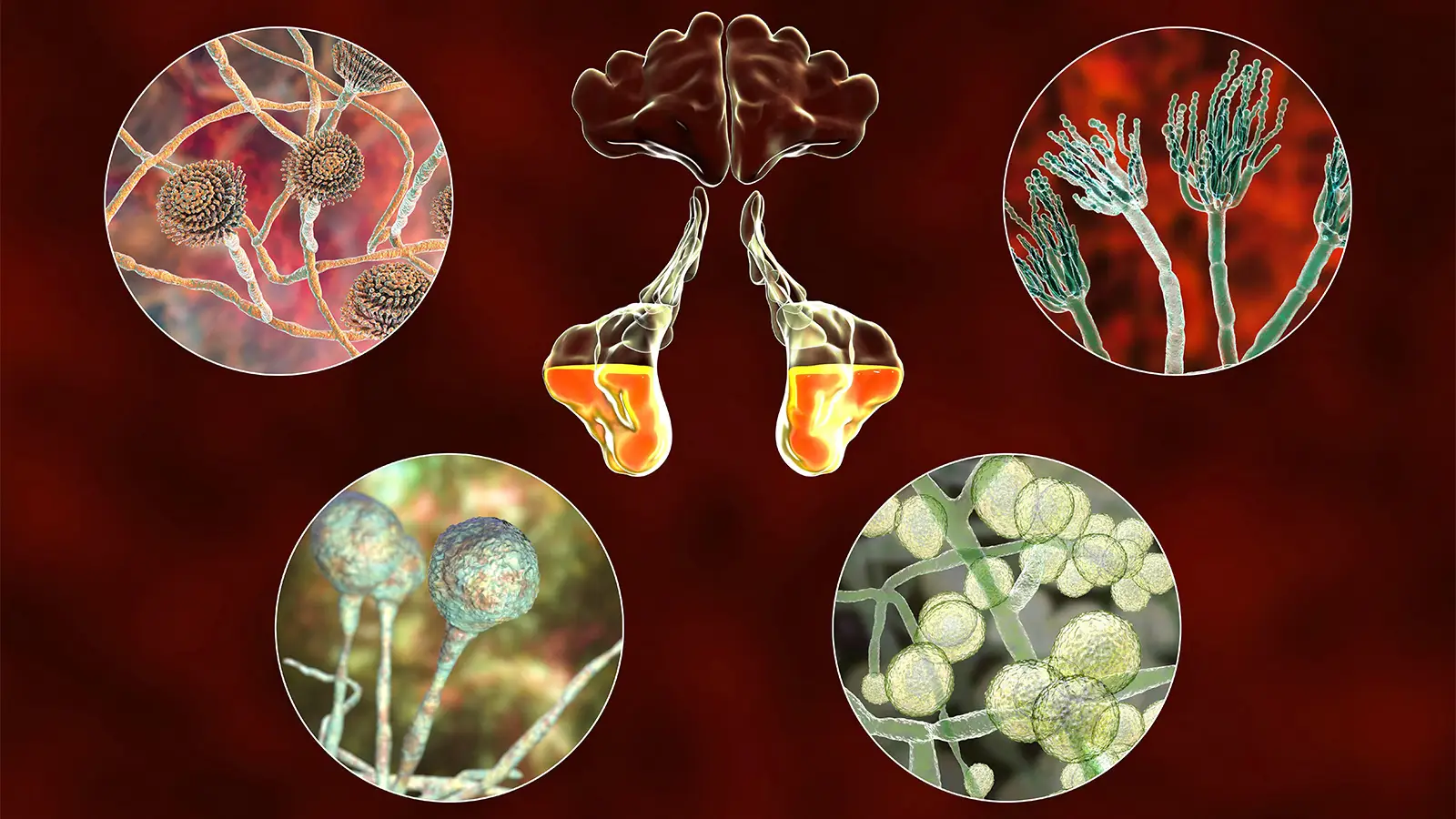
Allergic fungal rhinosinusitis can be a severe, recalcitrant condition, but it has an expanding treatment base.
The condition is characterized by thick eosinophilic mucus, nasal polyps, and high recurrence rates. It causes chronic congestion, facial pressure, and nasal blockage and can be erosive into adjacent structures, even resulting in blindness.
“The spores are pretty inert, but it’s the hyphae form that has all these immunogenic components,” said Amber Luong, MD, PhD, of the University of Texas Health Science Center in Houston. “The mucin has a lot of eosinophils, but it’s also teeming with fungal hyphae.”
Epidemiology
In an analysis of more than 1.6 million U.S. patient samples sent to a national clinical laboratory, one in five (22%) tested sensitive to at least one of the 17 fungal allergens tested. While uncommon in children under age 5 years, youth ages 10-19 years had the highest prevalence of all age groups.
The researchers on that 2023 Journal of Allergy and Clinical Immunology study noted that their findings were consistent with other similar studies from the U.S., Europe, and Asia. “Taken together, these results mirror the natural history of allergic sensitization in atopic respiratory disease where incidence peaks during childhood and early adulthood,” they wrote, which “may reflect relative senescence of immune function or, alternatively, increased tolerance associated with accumulated exposure over time.”
Male gender, atopic dermatitis, and asthma were also associated with higher likelihood of sensitivity. Studies have also strongly associated allergic fungal rhinosinusitis with rhinitis from other allergens.
Although the condition is a type of chronic rhinosinusitis with nasal polyps, exposure is seasonal.
“The incidence of fungal spores is seasonal and high concentrations are achieved in the summer due to the presence of nutrients in the soil, favorable temperature, and humidity,” a review noted. “Therefore, in the temperate zone, … peak concentration of mold spores mostly occurs in the air in the late summer and early autumn, when rainy days are followed by sunny, dry, and windy days. The spores are common in very large quantities, not only in the external environment, but also indoors. Fungal spores present in the environment enter the room with air or are carried by humans and animals. The high concentration of indoor spores applies especially to states of increased humidity, poor ventilation, or air conditioning systems.”
Timing of the fungal rhinosinusitis season appears to be moving earlier — 11 to 22 days earlier depending on definition of the season, according to a 2025 study in GeoHealth.
“The concern is that over time, as the environment changes, we may start seeing more and more allergic fungal rhinosinusitis — even up in the North,” Luong said. “With global warming and then increased fungal spores, in those people who have some genetic predisposition, you may start seeing more and more of it.”
Treatment
The cornerstone of allergic fungal rhinosinusitis treatment has been sinus surgery to remove the thick mucus, and topical corticosteroids afterward. Short courses of systemic steroids can be used with caution to keep the disease under control. Surgical revision rates remain high, at 30-50%.
Fungal-specific immunotherapy and systemic antifungals are options in recalcitrant disease, adds a review in the Annals of Allergy, Asthma & Immunology.
In February, the FDA approved dupilumab (Dupixent) for treating allergic fungal rhinosinusitis in individuals 6 years and older with prior sino-nasal surgery.
That was based on the phase III LIBERTY-AFRS-AIMS trial findings from 62 adults and kids with allergic fungal rhinosinusitis who were randomized 1:1 to either dupilumab (300 mg every 4 weeks for kids 15-29 kg, 200 mg every 2 weeks for children 30-59 kg, and 300 mg every 2 weeks for everyone else) or matching placebo.
In findings Luong reported in March at the American Academy of Allergy, Asthma & Immunology annual meeting, sinus opacification scores as assessed by CT scans improved by 50% with dupilumab versus 10% with placebo (-9.17 vs -1.81 from baseline on the 24-point Lund-Mackay CT scale, P<0.0001) in the primary 1-year endpoint.
Among secondary findings, the biologic also led to significant improvements in nasal polyp size (least-squares mean difference -2.77 on the 8-point scale, P<0.0001) as well as in congestion, sense of smell, need for systemic corticosteroids and sinus surgery, and sinus bone erosion.
“The nasal polyps score is even better in this study than it was in [chronic rhinosinusitis] with nasal polyps,” Luong said, “so I think you’ll get similar — even better — results with allergic fungal [rhinosinusitis] but no other additional concerns in this particular patient population.”
Treatment-emergent adverse event rates were similar overall between treatment groups in the trial, with no serious events in the dupilumab group and safety generally similar to findings in chronic rhinosinusitis with nasal polyps.
“The polyps tend to come back, they tend to be symptomatic, and now we have something other than repeat surgeries to clear things out,” Luong said. “We have something better to offer.”
Omalizumab (Xolair) and mepolizumab (Nucala) are also approved for chronic rhinosinusitis with nasal polyps but no randomized trials have yet been done for them in allergic fungal rhinosinusitis, although mepolizumab has been tried for it in limited case reports.
Source link : https://www.medpagetoday.com/spotlight/pediatric-seasonal-allergy/120692
Author :
Publish date : 2026-04-08 13:23:00
Copyright for syndicated content belongs to the linked Source.