[ad_1]
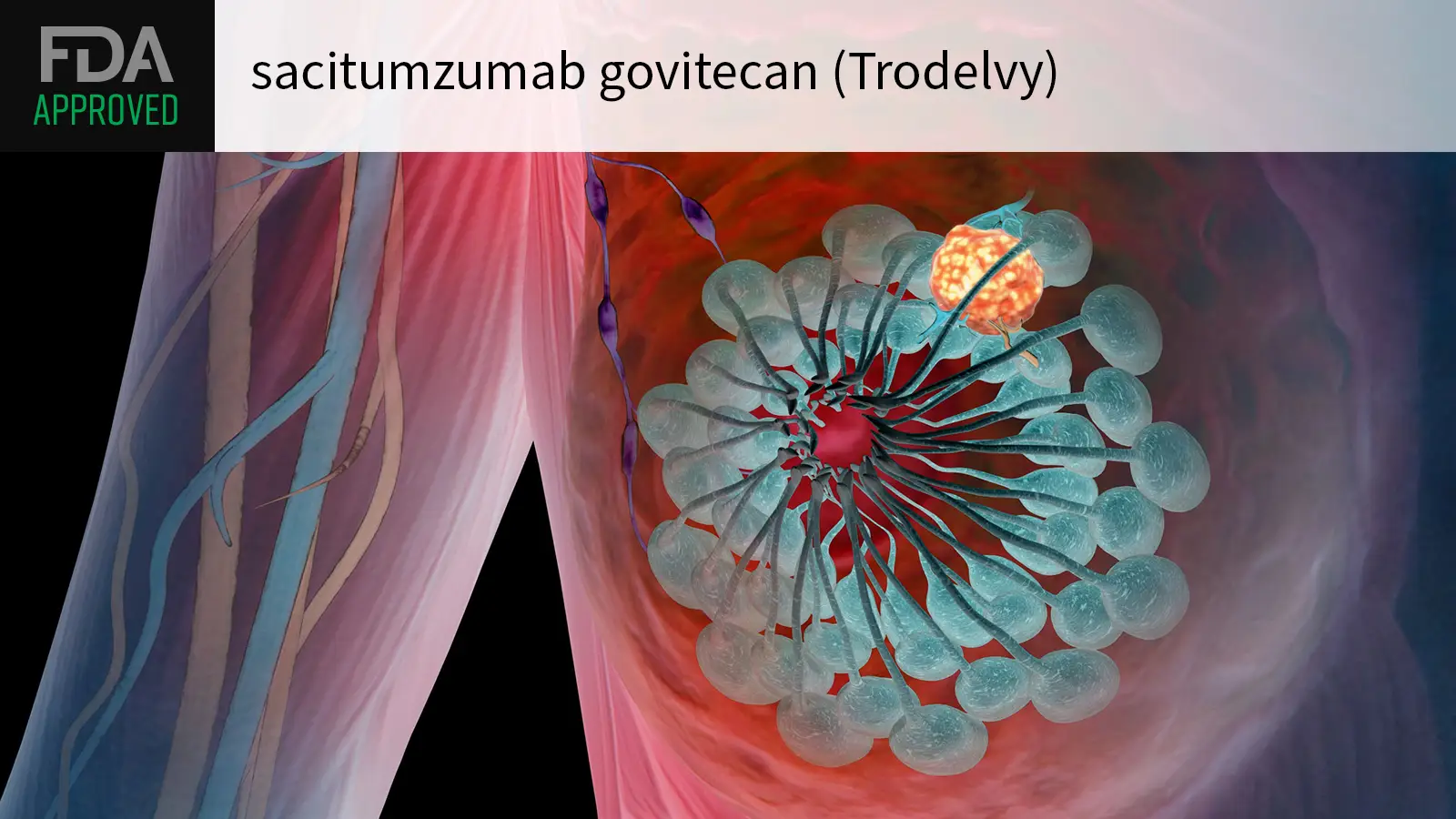
The FDA approved sacituzumab govitecan (Trodelvy) for two indications in patients with metastatic triple-negative breast cancer (TNBC).
The first indication for the TROP2-targeting antibody-drug conjugate, supported by the ASCENT-03 trial, is for the first-line treatment of adults with unresectable locally advanced or metastatic disease who are not candidates for PD-1 or PD-L1 inhibitor-based therapy due to previous use or co-existing conditions.
The second indication, based on results from the ASCENT-04/KEYNOTE-D19 trial, is in combination with pembrolizumab (Keytruda) or pembrolizumab and berahyaluronidase alfa (Keytruda Qlex) for the first-line treatment of adults with unresectable locally advanced or metastatic disease whose tumors express PD-L1.
“For people living with metastatic TNBC, the first treatment choice can be pivotal, as many patients may not have the opportunity to receive subsequent therapies,” said Sara Tolaney, MD, MPH, of the Dana-Farber Cancer Institute in Boston, who was a principal investigator of the two studies, in a press release from the drugmaker. “This approval is heartening news for patients and the clinical community, and I believe offers a practice-changing first-line treatment option for all patients across PD-L1 status.”
In the multicenter, open-label ASCENT-03 trial, patients who had not received previous systemic therapy for advanced disease were randomized to either sacituzumab govitecan or investigator’s choice of chemotherapy (nab-paclitaxel [Abraxane], paclitaxel, or gemcitabine and carboplatin).
Median progression-free survival (PFS) was 9.7 months in the sacituzumab govitecan arm versus 6.9 months in the chemotherapy arm (HR 0.62, 95% CI 0.50-0.77, P<0.001). The confirmed objective response rates (ORR) were 50% and 47%, respectively.
In the multicenter, open-label ASCENT-04/KEYNOTE-D19 trial, patients who had not received previous systemic therapy for advanced disease and whose tumors express PD-L1 (combined positive score ≥10) were randomized to receive either sacituzumab govitecan in combination with pembrolizumab or pembrolizumab in combination with nab-paclitaxel, paclitaxel, or gemcitabine and carboplatin.
Median PFS was 11.2 months in the sacituzumab govitecan/pembrolizumab arm compared with 7.8 months in the pembrolizumab/chemotherapy arm (HR 0.65, 95% CI 0.51-0.84, P=0.0009). The confirmed ORR was 61% versus 55%, respectively.
Sacituzumab govitecan is also approved as second-line and later treatment for patients with metastatic TNBC and for patients with pretreated hormone receptor-positive/HER2-negative metastatic breast cancer.
The prescribing information for sacituzumab govitecan contains a boxed warning for diarrhea and neutropenia and includes warnings and precautions for hypersensitivity and infusion-related reactions, nausea/vomiting, reduced UGT1A1 activity, and embryo-fetal toxicity.
[ad_2]
Source link : https://www.medpagetoday.com/hematologyoncology/breastcancer/121926
Author :
Publish date : 2026-06-25 14:29:00
Copyright for syndicated content belongs to the linked Source.