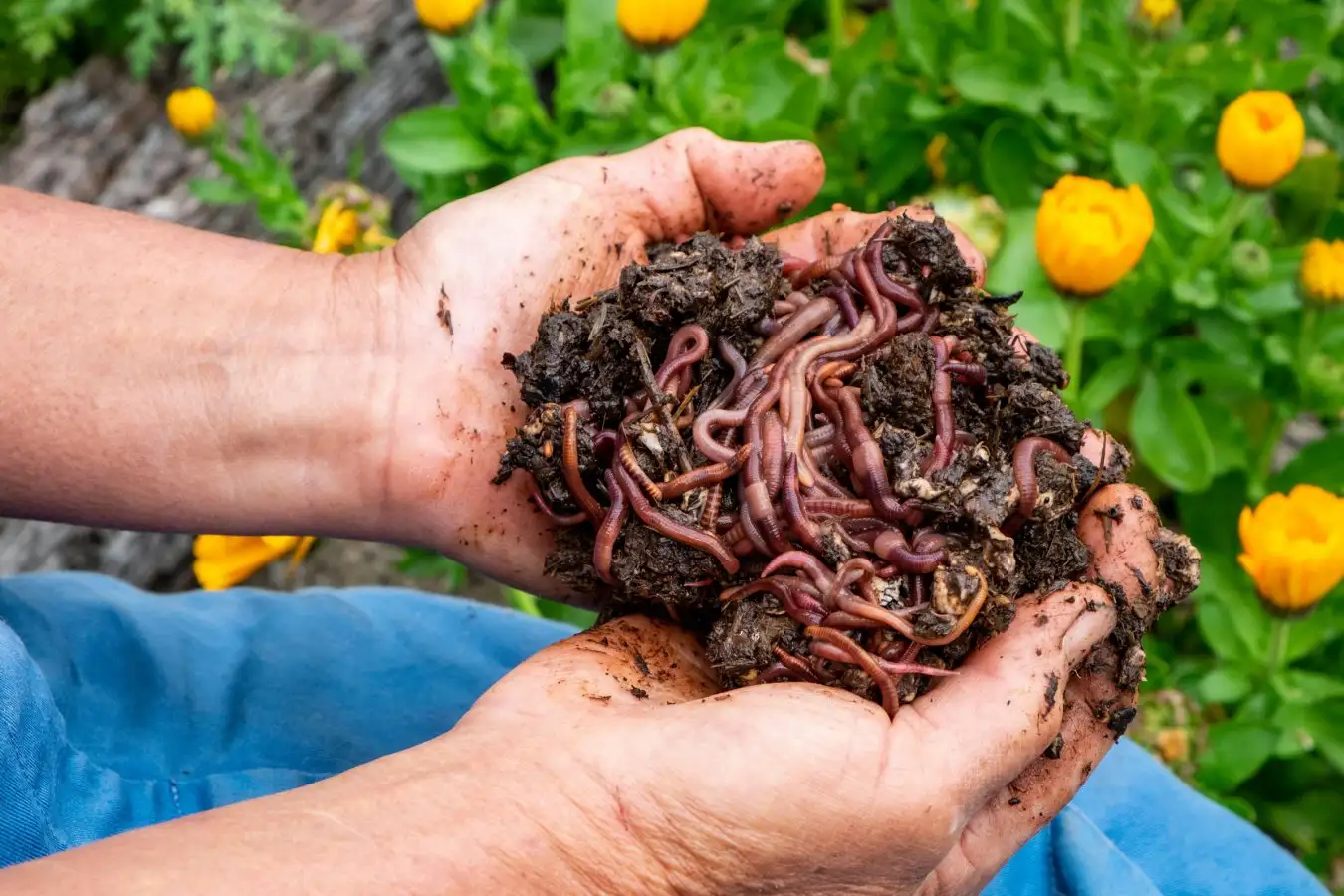
Compost worms can make quick work of food scraps and other waste
Rob Walls/Alamy
Worms. I’ve got a few.
I split my time between a small inner-city apartment in Sydney, Australia, and a wild property that was once a farm, before it was abandoned in the 1970s, four hours to the south.
They are opposites in almost every way – one thrums with the incessant noise of a big city, while the other moves to the beat of the wilderness: kookaburra choruses, deafening cicadas and, at night, powerful owl hoots and the gurgling, zombie-like calls of brushtail possums. But the one thing both properties have in common is that they each boast a cranking worm farm. The one on the farm is huge and deals with the organic waste of an entire household, while the one in the city is small enough to fit on a porch and easy to set up – suitable for anyone.
On the farm, I’ve continued to let nature take its course on the land and use it as a place to retreat to for peace and quiet. But below ground, it’s busy. Inside a 4000-litre tank buried on the property, there is a vast colony of worms, into which pours all my sewerage and grey water. The worms turn the sludge into nutrient-rich juice and excreted castings, which are slowly released, filtered into a series of infilled porous trenches and then out through the soils into the surrounding forest.
The giant worm farm in the wilderness has a lid and it is possible to vary the worms’ diet a little from a daily fare of toilet waste and shower water by throwing in my compost and weeds, as well as the occasional kangaroo, possum or bird carcass that I find on the property. My rule of thumb is that if it was once alive, then its final resting place is the worm farm.
When I take off the cover and look into that black hole of decomposition, I am always stunned at how quickly whatever ends up in there disappears. A dead, 50-kilogram, male eastern grey kangaroo (Macropus giganteus) is barely recognisable after a week, and invisible to my torch after a month. Admittedly, the worm farm is now a multicultural ecosystem that includes frogs, spiders and fly larvae, all thriving on that nutrient-rich humidity that would do the Daintree Rainforest on Australia’s north-eastern coast proud.
And yet, even after more than eight years of being a repository of all things biological – I’ve shovelled wheelbarrows full of organic material into that insatiable wormhole – its steady state seems to be no more than a quarter full. No matter how rank a dead kangaroo or maggoty bird is when I hurl it in, I have never once smelled any foul odours coming from my worm farm. This is no amateur-hour operation – the local shire council comes out every couple of years to inspect that it is officially compliant.
On the day the worm farm was installed in 2018, I was invited by the plumber to ceremoniously drop the worms into their new home – a small bag of tiger worms (Eisenia fetida), a species originally named in 1826 in Europe and which have become the international superstars of global composting.
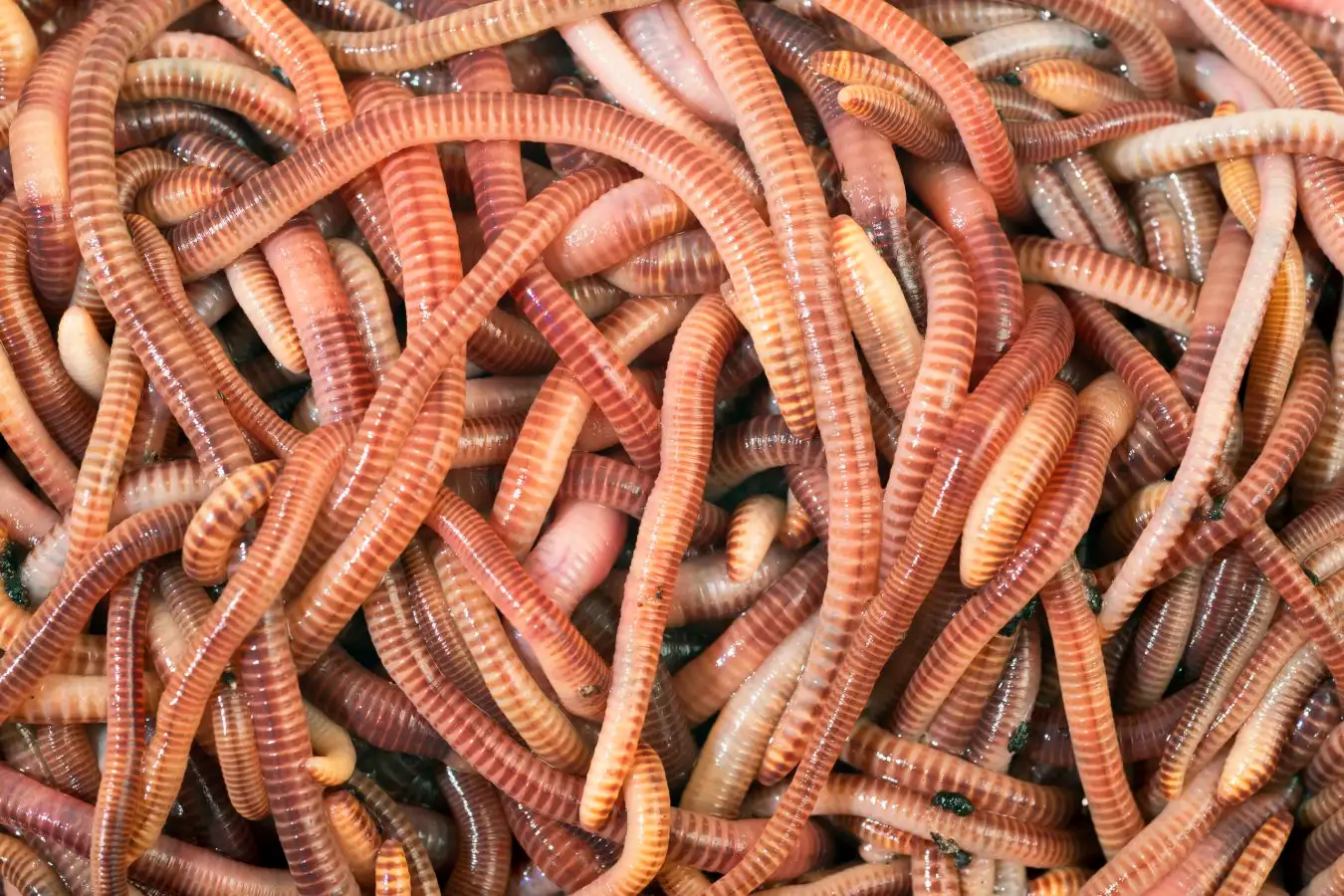
Tiger worms go by many common names, including brandling worms, redworms, manure worms, trout worms and red wigglers
DANIEL SAMBRAUS/SCIENCE PHOTO LIBRARY
Independent earthworm researcher Robert Blakemore says the species lives in temperatures from -2˚C to 40˚C, and can survive the loss of nearly two-thirds of their body moisture and, reportedly, total water immersion for periods up to 6 months.
He argues that there is no other species on Earth that has provided such an important service to humanity, and that a compost worm can supposedly process the equivalent of their body weight per day. No wonder a dead kangaroo can vanish in just a few weeks.
I love the fact that everything that goes into that worm farm is discombobulated by the worms into all of life’s varied original ingredients and then slowly seeps out into an ancient red gum forest to be taken up and recycled into the ecosystem. That worm farm is my idea of a genuine pearly gates – through which everything is recycled into immortality. That’s why I tell my kids “when I die, drop me in there” to join all the other life that has passed through. Heaven, to me, is to become food for my forest. If, instead, I were cremated and turned into a handful of anonymous dust to be kept in a jar, I would actually be upset.
I have an elderly chocolate border collie who follows me around everywhere like my own personal discrete secret service agent. The highest honour I can bestow on him, the surest way I know to forever have him close, is for him to also pass through the worm farm clearing house when his day comes. My daughter is not impressed at the fate that awaits our family dog.
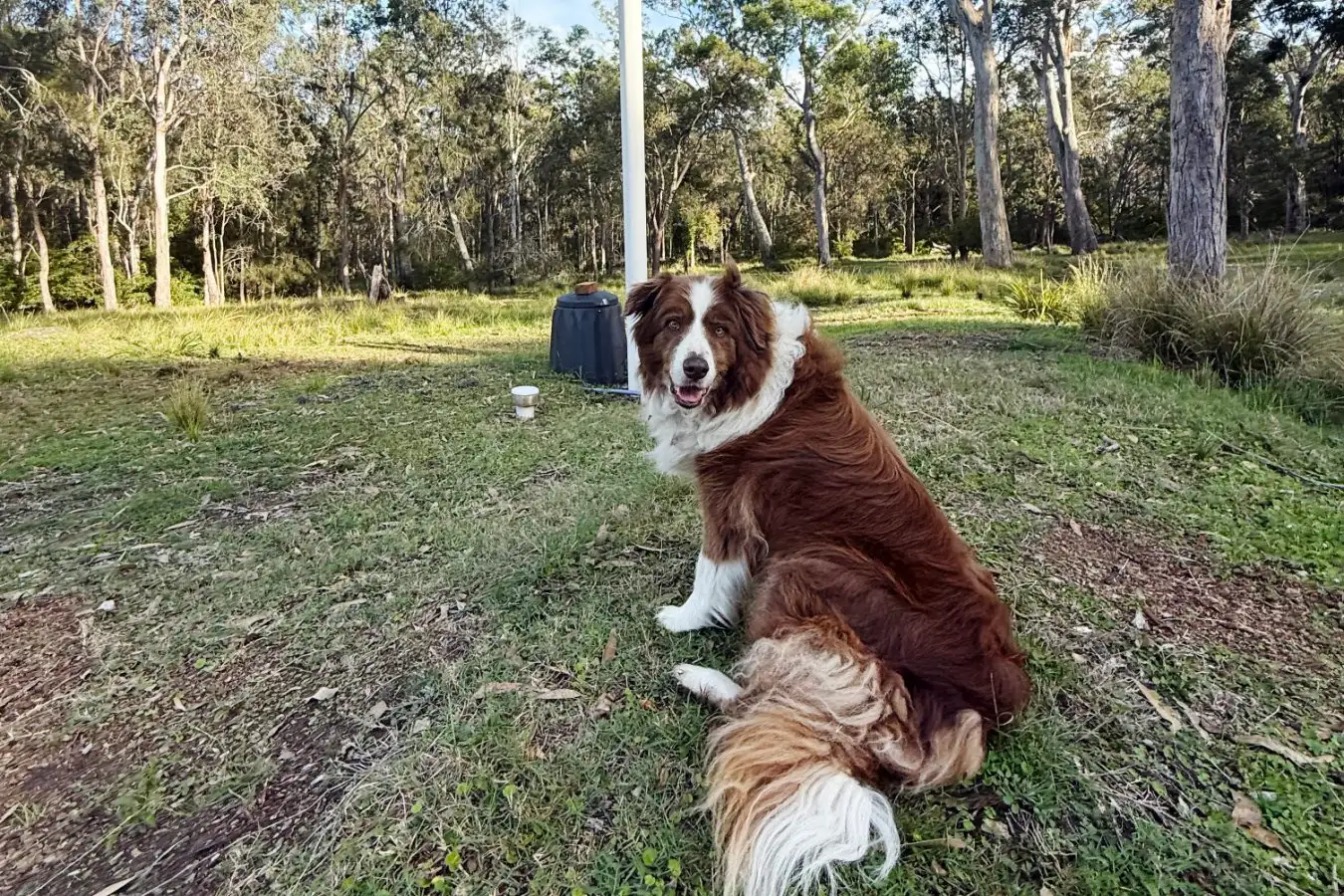
Ringo, the border collie, sitting atop the underground worm farm
James Woodford
Urban worm farming
When I moved part-time to the city a few years ago, I arrived with a bag of tiger worms from the wilderness worm farm and used them to seed a small, commercially made household composting container that I keep in my tiny courtyard.
My small home worm farm is much more intimate and in-your-face than the giant one. It’s about half a metre in diameter and height, and has a few bins stacked vertically that can be rotated when the top one is full.
Unlike the worms at the rural property, which are metres away at the bottom of a huge dark tank, my city worms are right there to easily watch and are more grossly intriguing. Sometimes, I just take the lid off and catch myself staring at it meditatively, with my face screwed up in awe that the composting process looks so disgusting.
No one wants to see how a sausage is made and the same goes for decomposition. The first thing you see when you take off the lid of my city worm farm is writhing, tangled worms. There are so many and they are so wriggly that it looks as though, if I were to sink my hand into the organic matter in various states of decay, it would be chewed off to a stump in minutes by those dirt piranhas.
Into my apartment worm farm go all my vegetable scraps, dog poo, dog hair (my dog sheds a lot), eggshells, bills, tea leaves, coffee grounds – everything organic. Though when Blakemore saw a picture I sent him of the contents of my worm farm, he was slightly concerned about my laissez-faire approach.
“I see you have eggshells; these are better crushed or microwaved to help decay, although they will eventually break down,” Blakemore advises. “Ditto fur. My bane is teabags, I suspect these are made of plastic as they do not decay! Also those stupid labels they stick on bananas or avocados.”
He also cautions that “dog poo is a problem with parasites, but worms can stabilise many of these”.
No matter how much I put into my city compost, the worms seem to keep up, but eventually, after many months, I need to lift the top cartridge, move it to the bottom and start filling a fresh, empty one. When that one is full, the contents of the first cartridge will have turned into rich black soil that can be distributed among my courtyard plants.
It is a great wriggly circle of life, a window into the fact that decomposition is a shiver-inducing reminder that death awaits us all and that we live on a planet where everything is eating everything else. The undertakers of the soil, the humble worms, are the bringers of immortality, the processors of everything that once lived.
I think of Blakemore’s admonition: “Everyone should compost,” he says. “There is no reason not to, except our major sins of ignorance and laziness.”
What to consider if you would like to start your own worm farm:
- Compost worms are commercially available and easy to obtain – the king of compost worms is the tiger worm (Eisenia fetida), originally from Europe, but now found globally. While you can easily buy worms, I have given several friends “starter” colonies – just a small bag filled with worms – from my compost and, within weeks, their bins were chugging away!
- You will be amazed how much waste can be processed by a colony of worms even in a relatively compact city worm farm. They are easy to set up and buy. But if you want a farm suitable for dealing with an entire household’s waste, you will need professional installers and a lot of space.
- I keep my city worm farm bin out of direct sunlight. When picking your spot outside, look for some shade, especially if you live in an extremely warm climate. It also never seems to smell – though take the lid off and it looks like a horror film. But the long and short of it is that it isn’t an unpleasant thing to have nearby.
- My favourite things to compost are utility bills and unwanted marketing mail. (It’s best to avoid heavily coloured or shiny papers.) There’s something very satisfying about putting things you don’t like into the worm farm and watching them turn to dirt in a week!
Topics:
Source link : https://www.newscientist.com/article/2521536-how-a-diy-worm-farm-can-compost-food-scraps-paper-or-a-whole-kangaroo/?utm_campaign=RSS%7CNSNS&utm_source=NSNS&utm_medium=RSS&utm_content=home
Author :
Publish date : 2026-04-03 09:00:00
Copyright for syndicated content belongs to the linked Source.