Tyrannosaurus rex wasn’t the only predatory dinosaur with small arms
ROGER HARRIS/Getty Images/SCIENCE PHOTO LIBRARY
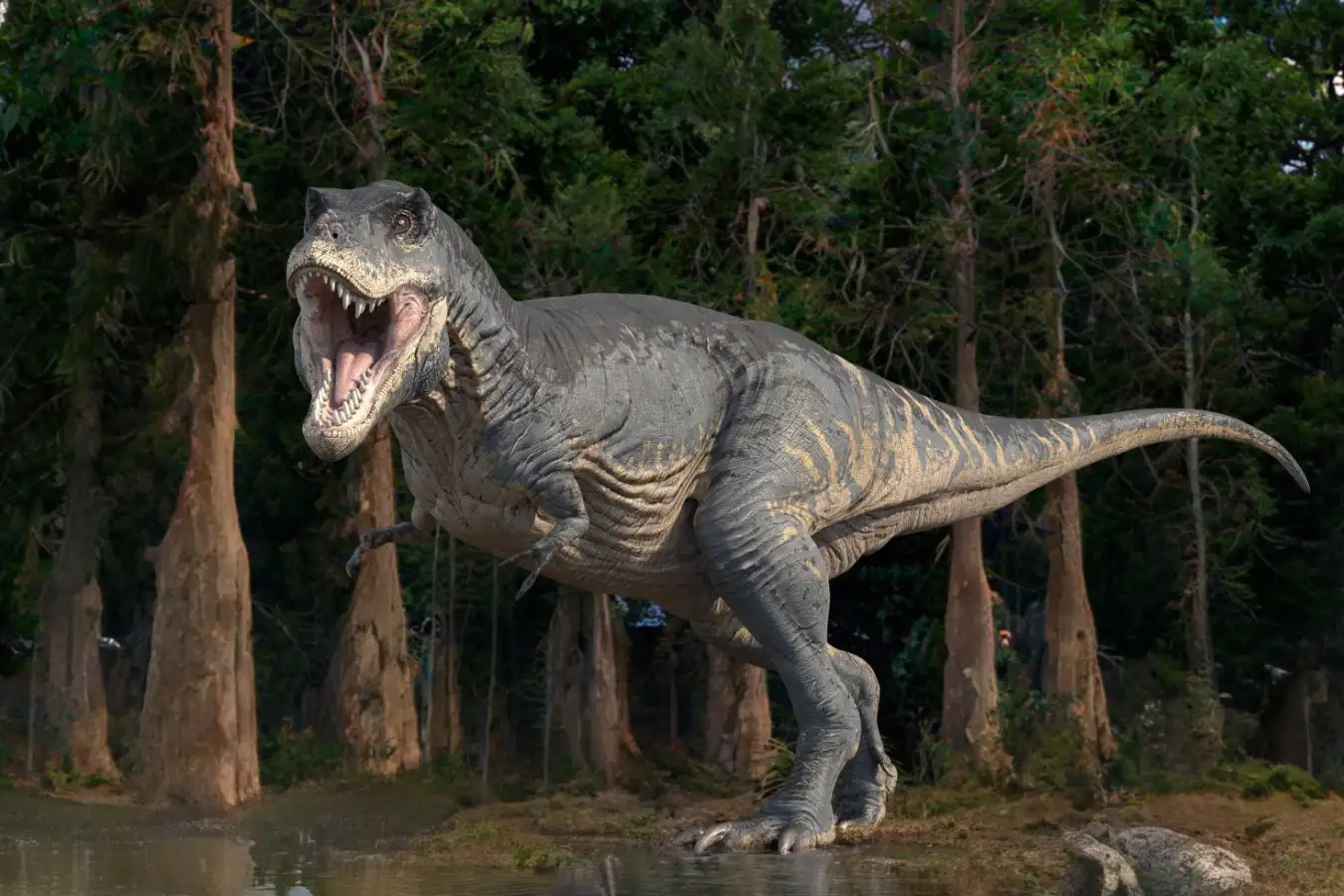
With jaws like these, who needs big arms? A new analysis suggests dinosaurs like Tyrannosaurus rex had shrunken forelimbs because their massive, powerful heads became their primary tool for killing large prey, rendering their arms redundant. It is an evolutionary approach that five different lineages of large theropod dinosaurs took independently.
Researchers are well aware that a number of large, predatory theropods followed a trend towards bigger bodies, bigger heads and smaller, shorter arms over time. But it wasn’t known why this pattern repeated across multiple predatory dinosaur families, scattered across the globe and separated by many millions of years, says Charlie Scherer at University College London. There was also little understanding of how the bones in their ever-heftier skulls changed as their arms became proportionally smaller.
“This paper tackles one of the big evolutionary questions in theropod dinosaurs,” says Andre Rowe at the University of Bristol, UK, who wasn’t involved with the research.
Scherer and his colleagues compiled data on the proportions of the forelimbs and skulls of 85 theropod species, along with body-mass data. This allowed them to calculate a ratio between the skull dimensions and forelimb lengths, quantifying just how small the arms were compared with the head. The researchers then compared this ratio with other measurements of the dinosaurs’ bodies, along with a measure of the skulls’ strength based on factors such as bite force and skull rigidity.
The team found that skull durability was associated with smaller arms, regardless of where the species sat in the theropod evolutionary tree. “If it’s a predatory theropod and has a very robust skull, it will most likely have relatively small forelimbs,” says Scherer.
The researchers found this head-arm divergence evolved independently in five theropod groups: tyrannosaurids, the short-snouted abelisaurids, the knife-toothed carcharodontosaurids, ceratosaurids and megalosaurids. This evolutionary pattern hadn’t been identified in the last two groups until this study, points out Fion Waisum Ma at the University of Hong Kong, who wasn’t involved in the research. This shows how hidden evolutionary signals can be revealed when traits are quantified in this way, she says.
The findings provide clues as to why the dinosaurs’ arms kept shrinking. These predators’ increasing skull strength and body size coincided with the rising mass of their quarries. The theropods evolved huge, sturdy skulls for subduing their large, difficult-to-control prey. Their heads were clearly doing the majority of the work, says Scherer, reducing the need for strong, grappling arms.
“Nature doesn’t like to have everything all at once,” he says. A big, powerful head plus strong forelimbs would require a lot of energy to maintain.
This creates a trade-off between jaws and claws. Other theropods like the megaraptorans and spinosaurs were also very large predators, but they took the opposite route to dinosaurs like T. rex, coupling long arms with slender skulls.
Rowe is curious about the mechanical function of the jaw-centric theropods’ arms, even in their shortened state. “Yes, tyrannosaurs had tiny, vestigial arms, but that does not necessarily mean they were completely useless,” he says.
He adds that the study emphasises the evolutionary diversity of dinosaurs. “It reminds me of why I fell in love with dinosaurs in the first place,” he says. “They were some of the most innovative and successful animals to ever exist.”
Topics:
Source link : https://www.newscientist.com/article/2527282-we-may-finally-know-why-dinosaurs-like-t-rex-evolved-tiny-arms/?utm_campaign=RSS%7CNSNS&utm_source=NSNS&utm_medium=RSS&utm_content=home
Author :
Publish date : 2026-05-20 00:01:00
Copyright for syndicated content belongs to the linked Source.