[ad_1]
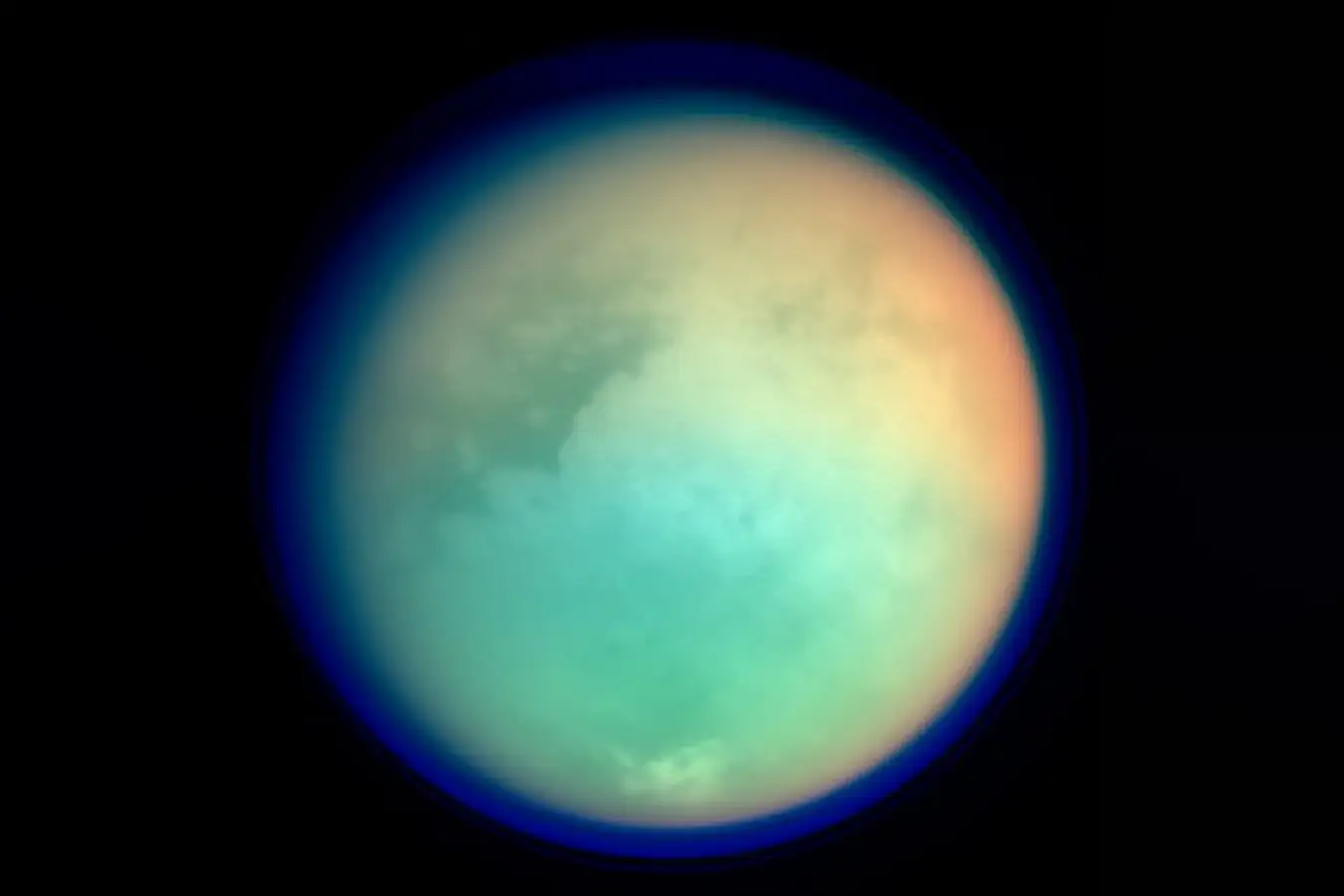
Titan in ultraviolet and infrared wavelengths, as captured by the Cassini probe in 2004
NASA/JPL/Space Science Institute
A strange substance is hiding on the surfaces of both Pluto and Saturn’s moon Titan, and researchers aren’t sure what it is.
Titan’s thick atmosphere means it is extremely difficult to study its surface, so identifying this compound may help us understand the complex chemistry happening there. This moon is one of the most intriguing places in the solar system to search for alien life, and figuring out its chemistry is key to that search.
Astronomers study what distant worlds are made of using spectroscopy: analysing the wavelengths of light that are absorbed, reflected or emitted by chemicals.
Bruno Bézard at the Paris Observatory and his colleagues found the compound using data from the James Webb Space Telescope (JWST). They found a narrow-wavelength band of light being absorbed by something on Titan’s surface, and the same wavelengths of light – although with a broader spread – being absorbed on Pluto.
On the face of it, the two worlds don’t seem alike: Pluto is much colder than Titan, it has no liquid oceans on its surface and its atmosphere is about 15,000 times less dense. But despite all these differences, the chemistry in their atmospheres is similar. “Both atmospheres are mostly nitrogen and methane, so you have, in both, this chemistry in which haze particles are produced and they can snow down and accumulate on the surface,” says Bézard. That is probably how the mystery compound forms, he says.
The researchers compared the spectral feature seen on both worlds to a myriad of spectra from astronomical observations and laboratory tests, representing compounds that we already know exist in Titan’s atmosphere and forms of ice that might be on both surfaces. None of them matched.
There were a few that were nearly matches, though, which could explain the mystery compound if they were modified slightly or mixed with other molecules. Plus, there would have to be some differences in the form of the substance on Pluto and Titan, perhaps variations in the size of the grains. “We have a few candidates, but it will not be a simple compound,” says Bézard. “Whatever it is, it will be a surprise.”
Investigating further will require a three-pronged approach. First, the researchers have already got more data from JWST, which they say might allow them to track down where the substance is on the surface of Titan. The geological features there might give us some clues. Second, researchers are performing laboratory experiments to test whether the near-matches can be made to fit the mystery spectral feature. And finally, NASA’s Dragonfly spacecraft is scheduled to launch in 2028 and land on Titan’s surface in 2034 – that mission could nail it down once and for all.
Topics:
[ad_2]
Source link : https://www.newscientist.com/article/2531107-weve-found-a-mysterious-substance-on-titan-and-pluto/?utm_campaign=RSS%7CNSNS&utm_source=NSNS&utm_medium=RSS&utm_content=home
Author :
Publish date : 2026-06-19 17:00:00
Copyright for syndicated content belongs to the linked Source.