
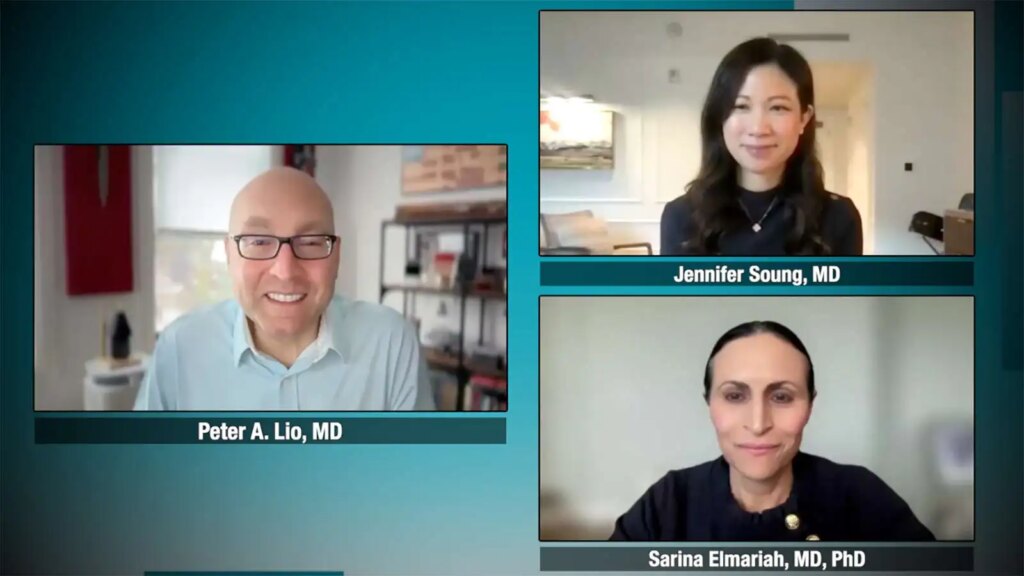
During the recent American Academy of Dermatology (AAD) annual meeting, MedPage Today brought together three expert leaders for a virtual roundtable discussion on atopic dermatitis: Moderator Peter A. Lio, MD, of Northwestern University Feinberg School of Medicine in Chicago, is joined by Sarina B. Elmariah, MD, PhD, of the UCSF Center for Itch and Neurosensory Disorders in San Francisco, and Jennifer Soung, MD, a dermatologist and director of clinical research at Southern California Dermatology in Orange County.
In this episode, the panel discusses the next wave of biologic development in atopic dermatitis, including bispecific approaches, faster onset of action, and the broader goal of disease modification.
Watch the other episodes here.
Following is a transcript of their remarks:
Lio: With something like IL-13 [interleukin-13], we already have a lot of experience with it. We feel pretty comfortable with it overall. So my sense is that that’s only the beginning of this technology though, because it is something that can affect antibodies across the board. It sounds like the same company, Apogee, is working on some other things, an IL-13 plus an OX40 ligand bispecific antibody.
And then I think right now, they’re looking at it for asthma and COPD [chronic obstructive pulmonary disease], but an IL-13 and TSLP (thymic stromal lymphopoietin) bispecific, also really exciting and the potential, again, to attack from different pathways at the same time.
Soung: Yeah, we’re really entering a new era of biologics, which I never would’ve thought of. And using, like you said, the same technology, they’re applying it to psoriasis, so potentially even one dose a year. And Sarina, you brought up the upfront loading dose. I think that’s much needed in atopic dermatitis right now.
We don’t have anything that’s a biologic that can get patients a little bit better faster and get them relief within that 4-week period. And so, oftentimes, I’m finding myself having to maybe do combination therapy initially before that biologic kicks in. However, this is really exciting with that upfront loading dose. I’m looking forward to something that works a little bit faster, especially for our AD [atopic dermatitis] patients who really need that relief immediately.
Elmariah: Such a good point. It’s really critical that the landscape is changing as it is to address the patient needs, to address the fact that it works well for the lesional burden, but really also improves itch. That is very, I think, near and dear to the heart of every AD patient or the majority of AD patients. So that kind of early onset, but with the sustained release.
And I think that’s actually what’s so nice having seen what was evolving in the AD landscape at the AAD is that we’re really starting to digest not just kind of controlling, not just tweaking, AD, but actually addressing the patient needs of itch, of the lesional burden, of the durability of these drugs, and even this, I think, holy grail, ultimately, of disease modification, which is really, it’s just a fabulous time in atopic dermatitis.
Please enable JavaScript to view the comments powered by Disqus.
Source link : https://www.medpagetoday.com/meetingcoverage/aad-expert-video-roundtable/120881
Author :
Publish date : 2026-04-21 16:44:00
Copyright for syndicated content belongs to the linked Source.